

7.2 Transition Metal Clusters React with CO
101
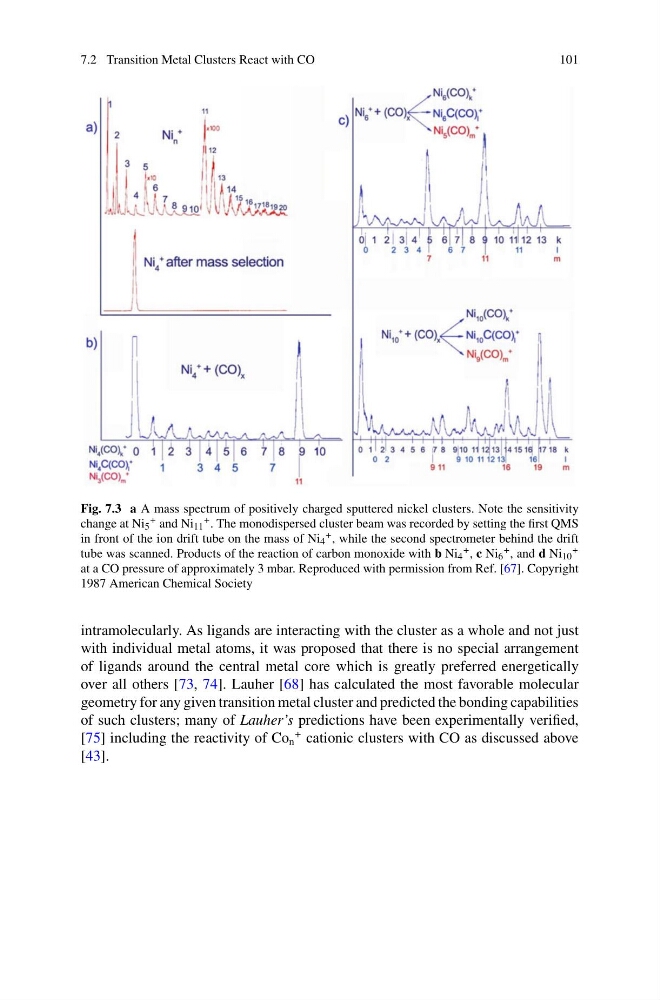
Fig. 7.3 a A mass spectrum of positively charged sputtered nickel clusters. Note the sensitivity
change at Ni 5
+ and Ni 11
+ . The monodispersed cluster beam was recorded by setting the first QMS
in front of the ion drift tube on the mass of Ni 4
+ , while the second spectrometer behind the drift
tube was scanned. Products of the reaction of carbon monoxide with b Ni 4
+ , c Ni 6
+ , and d Ni 10
+
at a CO pressure of approximately 3 mbar. Reproduced with permission from Ref. [67]. Copyright
1987 American Chemical Society
intramolecularly. As ligands are interacting with the cluster as a whole and not just
with individual metal atoms, it was proposed that there is no special arrangement
of ligands around the central metal core which is greatly preferred energetically
over all others [73, 74]. Lauher [68] has calculated the most favorable molecular
geometry for any given transition metal cluster and predicted the bonding capabilities
of such clusters; many of Lauher’s predictions have been experimentally verified,
[75] including the reactivity of Co n
+ cationic clusters with CO as discussed above
[43].
101
Fig. 7.3 a A mass spectrum of positively charged sputtered nickel clusters. Note the sensitivity
change at Ni 5
+ and Ni 11
+ . The monodispersed cluster beam was recorded by setting the first QMS
in front of the ion drift tube on the mass of Ni 4
+ , while the second spectrometer behind the drift
tube was scanned. Products of the reaction of carbon monoxide with b Ni 4
+ , c Ni 6
+ , and d Ni 10
+
at a CO pressure of approximately 3 mbar. Reproduced with permission from Ref. [67]. Copyright
1987 American Chemical Society
intramolecularly. As ligands are interacting with the cluster as a whole and not just
with individual metal atoms, it was proposed that there is no special arrangement
of ligands around the central metal core which is greatly preferred energetically
over all others [73, 74]. Lauher [68] has calculated the most favorable molecular
geometry for any given transition metal cluster and predicted the bonding capabilities
of such clusters; many of Lauher’s predictions have been experimentally verified,
[75] including the reactivity of Co n
+ cationic clusters with CO as discussed above
[43].