

7.2 Transition Metal Clusters React with CO
99
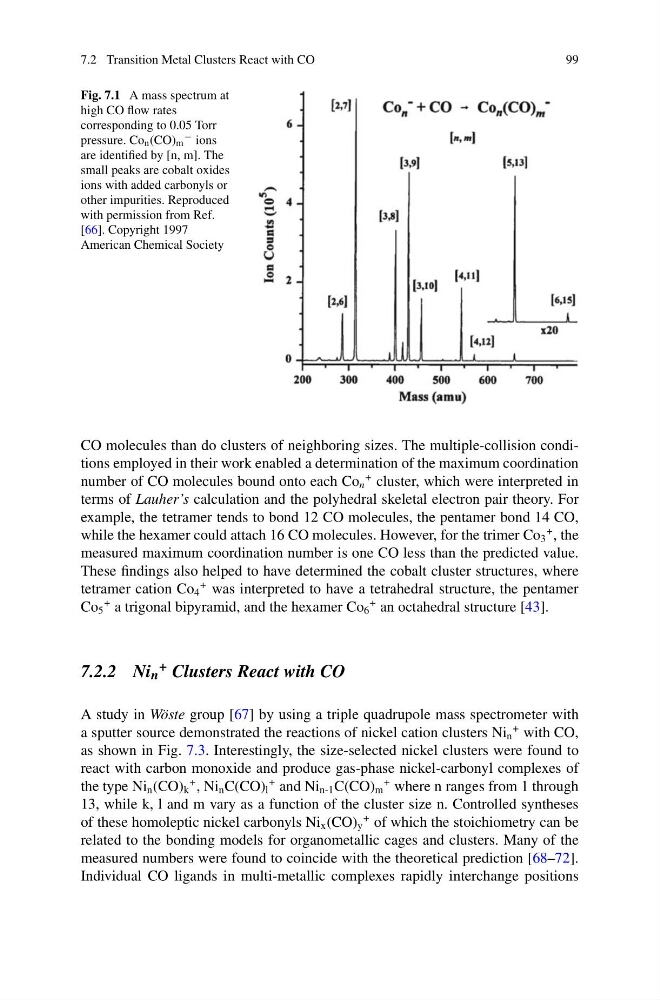
Fig. 7.1 A mass spectrum at
high CO flow rates
corresponding to 0.05 Torr
pressure. Co n (CO) m
− ions
are identified by [n, m]. The
small peaks are cobalt oxides
ions with added carbonyls or
other impurities. Reproduced
with permission from Ref.
[66]. Copyright 1997
American Chemical Society
CO molecules than do clusters of neighboring sizes. The multiple-collision conditions employed in their work enabled a determination of the maximum coordination
number of CO molecules bound onto each Co n
+ cluster, which were interpreted in
terms of Lauher’s calculation and the polyhedral skeletal electron pair theory. For
example, the tetramer tends to bond 12 CO molecules, the pentamer bond 14 CO,
while the hexamer could attach 16 CO molecules. However, for the trimer Co 3
+ , the
measured maximum coordination number is one CO less than the predicted value.
These findings also helped to have determined the cobalt cluster structures, where
tetramer cation Co 4
+ was interpreted to have a tetrahedral structure, the pentamer
Co 5
+ a trigonal bipyramid, and the hexamer Co 6
+ an octahedral structure [43].
7.2.2 Ni n
+ Clusters React with CO
A study in Wöste group [67] by using a triple quadrupole mass spectrometer with
a sputter source demonstrated the reactions of nickel cation clusters Ni n
+ with CO,
as shown in Fig. 7.3. Interestingly, the size-selected nickel clusters were found to
react with carbon monoxide and produce gas-phase nickel-carbonyl complexes of
the type Ni n (CO) k
+ , Ni n C(CO) l
+ and Ni n-1 C(CO) m
+ where n ranges from 1 through
13, while k, l and m vary as a function of the cluster size n. Controlled syntheses
of these homoleptic nickel carbonyls Ni x (CO) y
+ of which the stoichiometry can be
related to the bonding models for organometallic cages and clusters. Many of the
measured numbers were found to coincide with the theoretical prediction [68–72].
Individual CO ligands in multi-metallic complexes rapidly interchange positions
99
Fig. 7.1 A mass spectrum at
high CO flow rates
corresponding to 0.05 Torr
pressure. Co n (CO) m
− ions
are identified by [n, m]. The
small peaks are cobalt oxides
ions with added carbonyls or
other impurities. Reproduced
with permission from Ref.
[66]. Copyright 1997
American Chemical Society
CO molecules than do clusters of neighboring sizes. The multiple-collision conditions employed in their work enabled a determination of the maximum coordination
number of CO molecules bound onto each Co n
+ cluster, which were interpreted in
terms of Lauher’s calculation and the polyhedral skeletal electron pair theory. For
example, the tetramer tends to bond 12 CO molecules, the pentamer bond 14 CO,
while the hexamer could attach 16 CO molecules. However, for the trimer Co 3
+ , the
measured maximum coordination number is one CO less than the predicted value.
These findings also helped to have determined the cobalt cluster structures, where
tetramer cation Co 4
+ was interpreted to have a tetrahedral structure, the pentamer
Co 5
+ a trigonal bipyramid, and the hexamer Co 6
+ an octahedral structure [43].
7.2.2 Ni n
+ Clusters React with CO
A study in Wöste group [67] by using a triple quadrupole mass spectrometer with
a sputter source demonstrated the reactions of nickel cation clusters Ni n
+ with CO,
as shown in Fig. 7.3. Interestingly, the size-selected nickel clusters were found to
react with carbon monoxide and produce gas-phase nickel-carbonyl complexes of
the type Ni n (CO) k
+ , Ni n C(CO) l
+ and Ni n-1 C(CO) m
+ where n ranges from 1 through
13, while k, l and m vary as a function of the cluster size n. Controlled syntheses
of these homoleptic nickel carbonyls Ni x (CO) y
+ of which the stoichiometry can be
related to the bonding models for organometallic cages and clusters. Many of the
measured numbers were found to coincide with the theoretical prediction [68–72].
Individual CO ligands in multi-metallic complexes rapidly interchange positions