

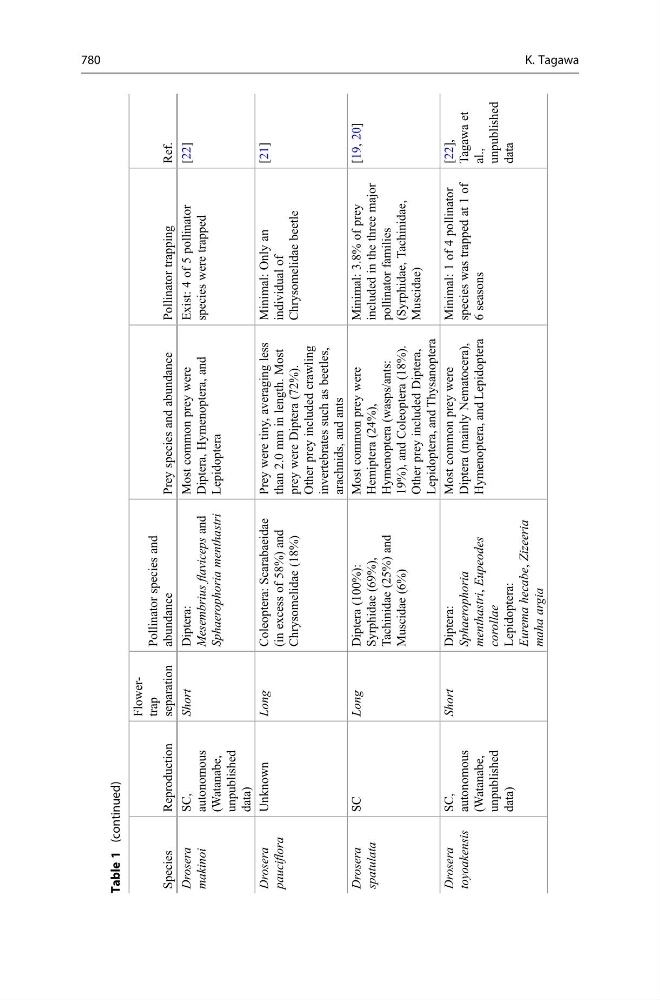
Table 1 (continued)
Species
Reproduction
Flowertrap
separation
Pollinator species and
abundance
Prey species and abundance
Pollinator trapping
Ref.
Drosera
makinoi
SC,
autonomous
(Watanabe,
unpublished
data)
Short
Diptera:
Mesembrius
flaviceps and
Sphaerophoria menthastri
Most common prey were
Diptera, Hymenoptera, and
Lepidoptera
Exist: 4 of 5 pollinator
species were trapped
[22]
Drosera
pauciflora
Unknown
Long
Coleoptera: Scarabaeidae
(in excess of 58%) and
Chrysomelidae (18%)
Prey were tiny, averaging less
than 2.0 mm in length. Most
prey were Diptera (72%).
Other prey included crawling
invertebrates such as beetles,
arachnids, and ants
Minimal: Only an
individual of
Chrysomelidae beetle
[21]
Drosera
spatulata
SC
Long
Diptera (100%):
Syrphidae (69%),
Tachinidae (25%) and
Muscidae (6%)
Most common prey were
Hemiptera (24%),
Hymenoptera (wasps/ants:
19%), and Coleoptera (18%).
Other prey included Diptera,
Lepidoptera, and Thysanoptera
Minimal: 3.8% of prey
included in the three major
pollinator families
(Syrphidae, Tachinidae,
Muscidae)
[19, 20]
Drosera
toyoakensis
SC,
autonomous
(Watanabe,
unpublished
data)
Short
Diptera:
Sphaerophoria
menthastri, Eupeodes
corollae
Lepidoptera:
Eurema hecabe, Zizeeria
maha argia
Most common prey were
Diptera (mainly Nematocera),
Hymenoptera, and Lepidoptera
Minimal: 1 of 4 pollinator
species was trapped at 1 of
6 seasons
[22],
Tagawa et
al.,
unpublished
data
780
K. Tagawa