

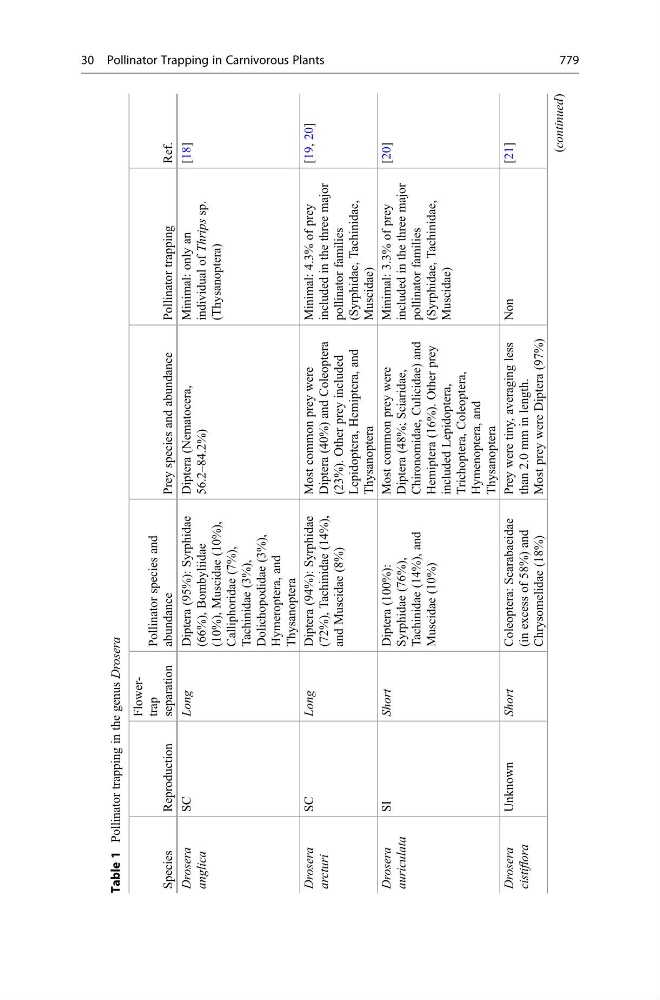
Table 1
Pollinator trapping in the genus Drosera
Species
Reproduction
Flowertrap
separation
Pollinator species and
abundance
Prey species and abundance
Pollinator trapping
Ref.
Drosera
anglica
SC
Long
Diptera (95%): Syrphidae
(66%), Bombyliidae
(10%), Muscidae (10%),
Calliphoridae (7%),
Tachinidae (3%),
Dolichopodidae (3%),
Hymeroptera, and
Thysanoptera
Diptera (Nematocera,
56.2–84.2%)
Minimal: only an
individual of Thrips sp.
(Thysanoptera)
[18]
Drosera
arcturi
SC
Long
Diptera (94%): Syrphidae
(72%), Tachinidae (14%),
and Muscidae (8%)
Most common prey were
Diptera (40%) and Coleoptera
(23%). Other prey included
Lepidoptera, Hemiptera, and
Thysanoptera
Minimal: 4.3% of prey
included in the three major
pollinator families
(Syrphidae, Tachinidae,
Muscidae)
[19, 20]
Drosera
auriculata
SI
Short
Diptera (100%):
Syrphidae (76%),
Tachinidae (14%), and
Muscidae (10%)
Most common prey were
Diptera (48%; Sciaridae,
Chironomidae, Culicidae) and
Hemiptera (16%). Other prey
included Lepidoptera,
Trichoptera, Coleoptera,
Hymenoptera, and
Thysanoptera
Minimal: 3.3% of prey
included in the three major
pollinator families
(Syrphidae, Tachinidae,
Muscidae)
[20]
Drosera
cistiflora
Unknown
Short
Coleoptera: Scarabaeidae
(in excess of 58%) and
Chrysomelidae (18%)
Prey were tiny, averaging less
than 2.0 mm in length.
Most prey were Diptera (97%)
Non
[21]
(continued)
30 Pollinator Trapping in Carnivorous Plants
779