

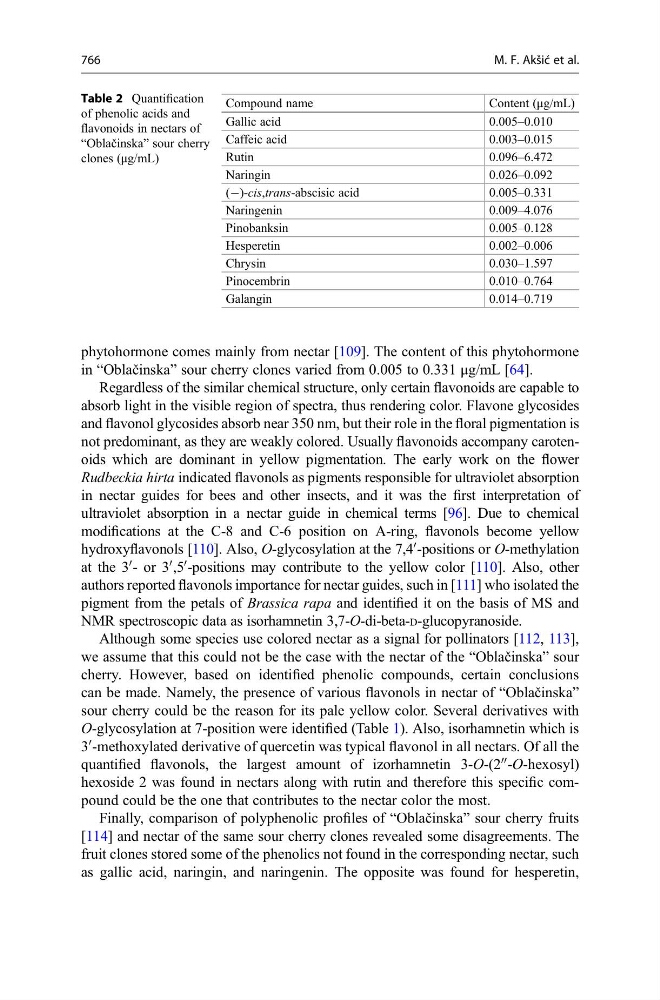
phytohormone comes mainly from nectar [109]. The content of this phytohormone
in “Oblačinska” sour cherry clones varied from 0.005 to 0.331 μg/mL [64].
Regardless of the similar chemical structure, only certain flavonoids are capable to
absorb light in the visible region of spectra, thus rendering color. Flavone glycosides
and flavonol glycosides absorb near 350 nm, but their role in the floral pigmentation is
not predominant, as they are weakly colored. Usually flavonoids accompany carotenoids which are dominant in yellow pigmentation. The early work on the flower
Rudbeckia hirta indicated flavonols as pigments responsible for ultraviolet absorption
in nectar guides for bees and other insects, and it was the first interpretation of
ultraviolet absorption in a nectar guide in chemical terms [96]. Due to chemical
modifications at the C-8 and C-6 position on A-ring, flavonols become yellow
hydroxyflavonols [110]. Also, O-glycosylation at the 7,4
0 -positions or O-methylation
at the 3
0 - or 3
0 ,5
0 -positions may contribute to the yellow color [110]. Also, other
authors reported flavonols importance for nectar guides, such in [111] who isolated the
pigment from the petals of Brassica rapa and identified it on the basis of MS and
NMR spectroscopic data as isorhamnetin 3,7-O-di-beta-D-glucopyranoside.
Although some species use colored nectar as a signal for pollinators [112, 113],
we assume that this could not be the case with the nectar of the “Oblačinska” sour
cherry. However, based on identified phenolic compounds, certain conclusions
can be made. Namely, the presence of various flavonols in nectar of “Oblačinska”
sour cherry could be the reason for its pale yellow color. Several derivatives with
O-glycosylation at 7-position were identified (Table 1). Also, isorhamnetin which is
3
0 -methoxylated derivative of quercetin was typical flavonol in all nectars. Of all the
quantified flavonols, the largest amount of izorhamnetin 3-O-(2
00 -O-hexosyl)
hexoside 2 was found in nectars along with rutin and therefore this specific compound could be the one that contributes to the nectar color the most.
Finally, comparison of polyphenolic profiles of “Oblačinska” sour cherry fruits
[114] and nectar of the same sour cherry clones revealed some disagreements. The
fruit clones stored some of the phenolics not found in the corresponding nectar, such
as gallic acid, naringin, and naringenin. The opposite was found for hesperetin,
Table 2 Quantification
of phenolic acids and
flavonoids in nectars of
“Oblačinska” sour cherry
clones (μg/mL)
Compound name
Content (μg/mL)
Gallic acid
0.005–0.010
Caffeic acid
0.003–0.015
Rutin
0.096–6.472
Naringin
0.026–0.092
(À)-cis,trans-abscisic acid
0.005–0.331
Naringenin
0.009–4.076
Pinobanksin
0.005–0.128
Hesperetin
0.002–0.006
Chrysin
0.030–1.597
Pinocembrin
0.010–0.764
Galangin
0.014–0.719
766
M. F. Akšić et al.