

early angiosperms was floral secretion and not pollen [9, 105–107].Gymnosperms
(e.g., Cupressaceae and Pinaceae) produce ovular secretions that are rich in sugars,
comparable to the nectar of angiosperms, suggesting that ancestral populations
of gymnosperms were already insect-pollinated [107]. Nowadays, the large
fossil record of insects and plants has reshaped our understanding of pollinator
evolution, and it is widely accepted that the first flowering plants had a generalist
pollination mode and that pollination by beetles, moths, and flies all evolved in
angiosperms simultaneously [108–112].
In the evolutionary history of angiosperms, floral nectaries first appeared
in Nymphaeales (Fig. 7) [105, 113–116]. The floral nectaries of early angiosperms
O
O
HO
OH
OH
OH
OH
Quercetin
O
O
HO
OH
OH
OH
OH
OH
OH
O
O
HO
OH
OH
O
O
O
HO
OH
OH
OH
N
N
H
N
N
N
N
O
N
O
N
N
O
O
O
O
OH
HO
HO
OH
HO
OH
OH
HO
HO
O
O
O
O
Geraniol
Linalool
Jasmone
2-Nonanone
A
Kaempferol
Myricetin
Isorhamnetin
Aurone
Nicotine
Anabasine
Caffeine
Amygdalin
B
C
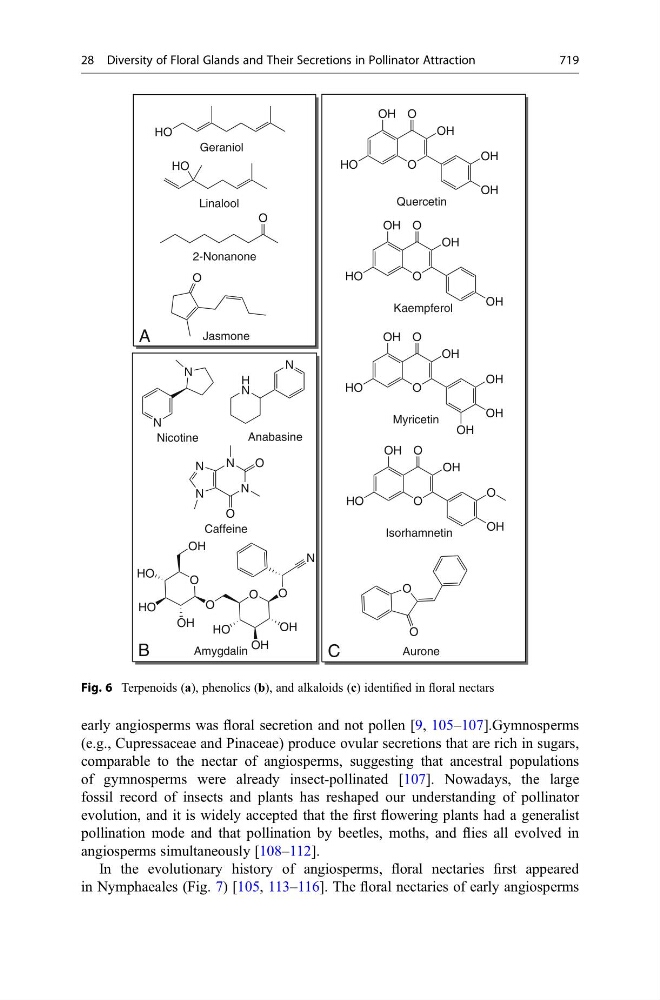
Fig. 6 Terpenoids (a), phenolics (b), and alkaloids (c) identified in floral nectars
28 Diversity of Floral Glands and Their Secretions in Pollinator Attraction
719