

or unsaturation of fatty acids, to cope with abiotic stresses, may lead to changes in
the fatty acids composition and eventually lowering the beverage quality [185].
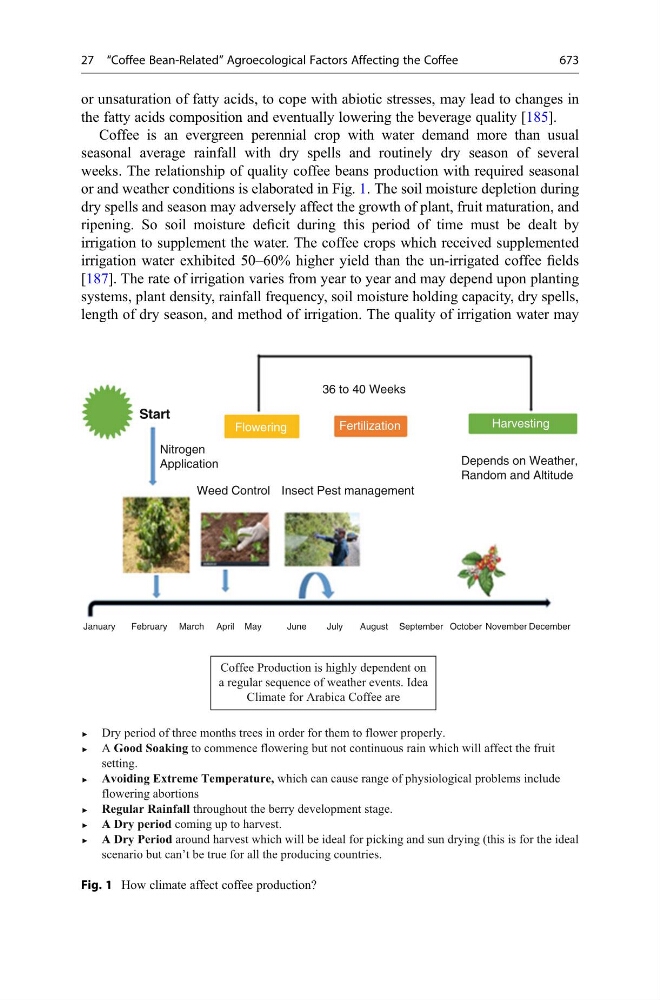
Coffee is an evergreen perennial crop with water demand more than usual
seasonal average rainfall with dry spells and routinely dry season of several
weeks. The relationship of quality coffee beans production with required seasonal
or and weather conditions is elaborated in Fig. 1. The soil moisture depletion during
dry spells and season may adversely affect the growth of plant, fruit maturation, and
ripening. So soil moisture deficit during this period of time must be dealt by
irrigation to supplement the water. The coffee crops which received supplemented
irrigation water exhibited 50–60% higher yield than the un-irrigated coffee fields
[187]. The rate of irrigation varies from year to year and may depend upon planting
systems, plant density, rainfall frequency, soil moisture holding capacity, dry spells,
length of dry season, and method of irrigation. The quality of irrigation water may
Nitrogen
Application
January
February March April May
June
July
August September October November December
Insect Pest management
Weed Control
Depends on Weather,
Random and Altitude
Harvesting
Fertilization
36 to 40 Weeks
Flowering
Start
►
Dry period of three months trees in order for them to flower properly.
►
A Good Soaking to commence flowering but not continuous rain which will affect the fruit
setting.
►
Avoiding Extreme Temperature, which can cause range of physiological problems include
flowering abortions
►
Regular Rainfall throughout the berry development stage.
►
A Dry period coming up to harvest.
►
A Dry Period around harvest which will be ideal for picking and sun drying (this is for the ideal
scenario but can’t be true for all the producing countries.
Coffee Production is highly dependent on
a regular sequence of weather events. Idea
Climate for Arabica Coffee are
Fig. 1 How climate affect coffee production?
27 “Coffee Bean-Related” Agroecological Factors Affecting the Coffee
673