

applications of sorghum water extract with eucalyptus, sesame (Sesamum indicum L.),
sunflower, tobacco (Nicotiana tabacum L.), and Brassica sp. efficiently controlled
the weeds such as littleseed canarygrass and wild oat in wheat [142].
3.6
Use of Allelopathic Water Extracts with Reduced Doses of
Herbicides
Although, sole application of allelopathic water extracts is beneficial and ecofriendly for weed control, nonetheless fair weed control is not achieved with this.
The combined use of allelopathic water extracts with reduced doses of herbicides
may be more helpful to control different weed biotypes (Table 4; [6, 79, 157]). For
example, Cheema et al. [158] compared the standard dose of atrazine (300 g a.i.
ha
À1 ) with the combined application of sorghum water extract (12 L ha
À1 ) and
reduced dose of atrazine (50, 100, and 150 g a.i. ha
À1 ). They found that the
combined application of sorghum water extract (12 L ha
À1 ) and reduced dose of
atrazine (150 g a.i. ha
À1 ) was as useful as the standard dose of herbicide for
controlling different weeds such as field bindweed, purple nutsedge, and horse
purslane. In a similar study, the combined application of sorghum water extract
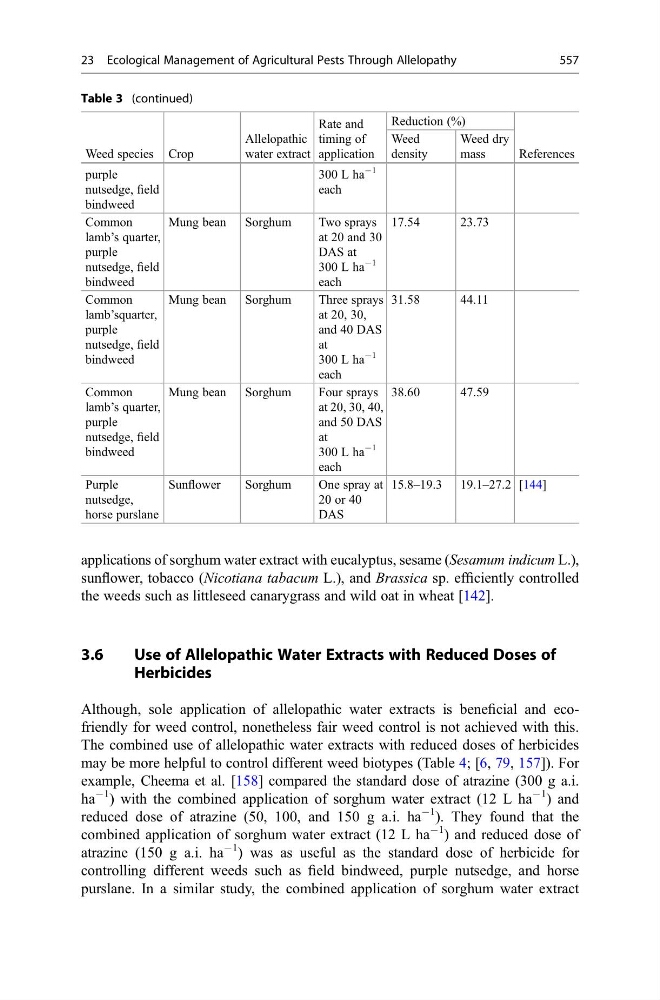
Table 3 (continued)
Weed species Crop
Allelopathic
water extract
Rate and
timing of
application
Reduction (%)
References
Weed
density
Weed dry
mass
purple
nutsedge, field
bindweed
300 L ha
À1
each
Common
lamb’s quarter,
purple
nutsedge, field
bindweed
Mung bean Sorghum
Two sprays
at 20 and 30
DAS at
300 L ha
À1
each
17.54
23.73
Common
lamb’squarter,
purple
nutsedge, field
bindweed
Mung bean Sorghum
Three sprays
at 20, 30,
and 40 DAS
at
300 L ha
À1
each
31.58
44.11
Common
lamb’s quarter,
purple
nutsedge, field
bindweed
Mung bean Sorghum
Four sprays
at 20, 30, 40,
and 50 DAS
at
300 L ha
À1
each
38.60
47.59
Purple
nutsedge,
horse purslane
Sunflower
Sorghum
One spray at
20 or 40
DAS
15.8–19.3 19.1–27.2 [144]
23 Ecological Management of Agricultural Pests Through Allelopathy
557
sunflower, tobacco (Nicotiana tabacum L.), and Brassica sp. efficiently controlled
the weeds such as littleseed canarygrass and wild oat in wheat [142].
3.6
Use of Allelopathic Water Extracts with Reduced Doses of
Herbicides
Although, sole application of allelopathic water extracts is beneficial and ecofriendly for weed control, nonetheless fair weed control is not achieved with this.
The combined use of allelopathic water extracts with reduced doses of herbicides
may be more helpful to control different weed biotypes (Table 4; [6, 79, 157]). For
example, Cheema et al. [158] compared the standard dose of atrazine (300 g a.i.
ha
À1 ) with the combined application of sorghum water extract (12 L ha
À1 ) and
reduced dose of atrazine (50, 100, and 150 g a.i. ha
À1 ). They found that the
combined application of sorghum water extract (12 L ha
À1 ) and reduced dose of
atrazine (150 g a.i. ha
À1 ) was as useful as the standard dose of herbicide for
controlling different weeds such as field bindweed, purple nutsedge, and horse
purslane. In a similar study, the combined application of sorghum water extract
Table 3 (continued)
Weed species Crop
Allelopathic
water extract
Rate and
timing of
application
Reduction (%)
References
Weed
density
Weed dry
mass
purple
nutsedge, field
bindweed
300 L ha
À1
each
Common
lamb’s quarter,
purple
nutsedge, field
bindweed
Mung bean Sorghum
Two sprays
at 20 and 30
DAS at
300 L ha
À1
each
17.54
23.73
Common
lamb’squarter,
purple
nutsedge, field
bindweed
Mung bean Sorghum
Three sprays
at 20, 30,
and 40 DAS
at
300 L ha
À1
each
31.58
44.11
Common
lamb’s quarter,
purple
nutsedge, field
bindweed
Mung bean Sorghum
Four sprays
at 20, 30, 40,
and 50 DAS
at
300 L ha
À1
each
38.60
47.59
Purple
nutsedge,
horse purslane
Sunflower
Sorghum
One spray at
20 or 40
DAS
15.8–19.3 19.1–27.2 [144]
23 Ecological Management of Agricultural Pests Through Allelopathy
557