

a high quantity of nitrogen (30%) in the sole crop of pea than pea-barley intercrop [104]. In conclusion, weed density and biomass can be reduced with substantial
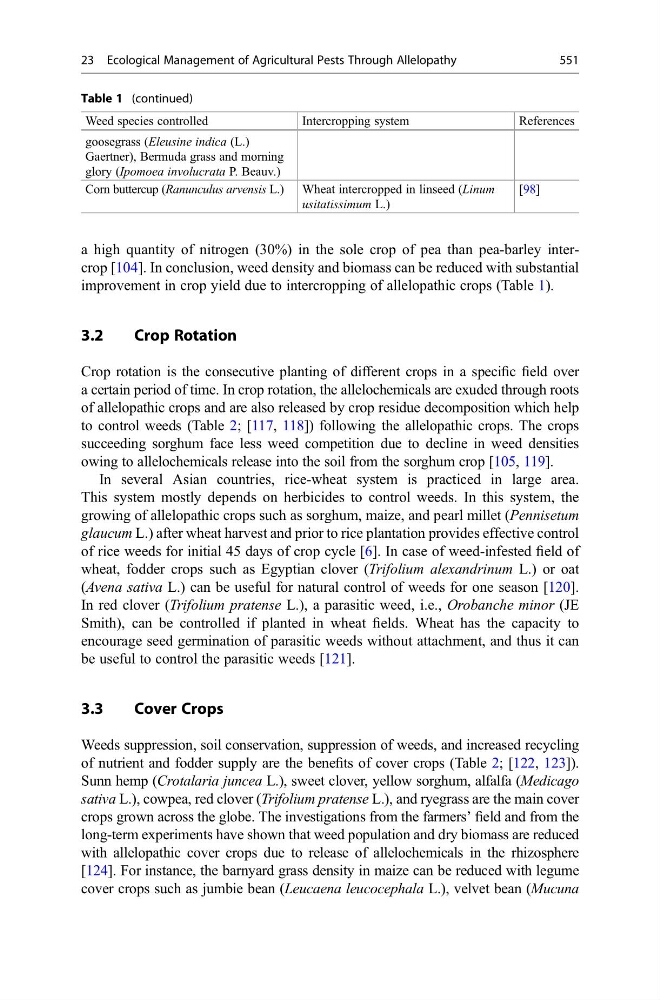
improvement in crop yield due to intercropping of allelopathic crops (Table 1).
3.2
Crop Rotation
Crop rotation is the consecutive planting of different crops in a specific field over
a certain period of time. In crop rotation, the allelochemicals are exuded through roots
of allelopathic crops and are also released by crop residue decomposition which help
to control weeds (Table 2; [117, 118]) following the allelopathic crops. The crops
succeeding sorghum face less weed competition due to decline in weed densities
owing to allelochemicals release into the soil from the sorghum crop [105, 119].
In several Asian countries, rice-wheat system is practiced in large area.
This system mostly depends on herbicides to control weeds. In this system, the
growing of allelopathic crops such as sorghum, maize, and pearl millet (Pennisetum
glaucum L.) after wheat harvest and prior to rice plantation provides effective control
of rice weeds for initial 45 days of crop cycle [6]. In case of weed-infested field of
wheat, fodder crops such as Egyptian clover (Trifolium alexandrinum L.) or oat
(Avena sativa L.) can be useful for natural control of weeds for one season [120].
In red clover (Trifolium pratense L.), a parasitic weed, i.e., Orobanche minor (JE
Smith), can be controlled if planted in wheat fields. Wheat has the capacity to
encourage seed germination of parasitic weeds without attachment, and thus it can
be useful to control the parasitic weeds [121].
3.3
Cover Crops
Weeds suppression, soil conservation, suppression of weeds, and increased recycling
of nutrient and fodder supply are the benefits of cover crops (Table 2; [122, 123]).
Sunn hemp (Crotalaria juncea L.), sweet clover, yellow sorghum, alfalfa (Medicago
sativa L.), cowpea, red clover (Trifolium pratense L.), and ryegrass are the main cover
crops grown across the globe. The investigations from the farmers’ field and from the
long-term experiments have shown that weed population and dry biomass are reduced
with allelopathic cover crops due to release of allelochemicals in the rhizosphere
[124]. For instance, the barnyard grass density in maize can be reduced with legume
cover crops such as jumbie bean (Leucaena leucocephala L.), velvet bean (Mucuna
Table 1 (continued)
Weed species controlled
Intercropping system
References
goosegrass (Eleusine indica (L.)
Gaertner), Bermuda grass and morning
glory (Ipomoea involucrata P. Beauv.)
Corn buttercup (Ranunculus arvensis L.) Wheat intercropped in linseed (Linum
usitatissimum L.)
[98]
23 Ecological Management of Agricultural Pests Through Allelopathy
551
improvement in crop yield due to intercropping of allelopathic crops (Table 1).
3.2
Crop Rotation
Crop rotation is the consecutive planting of different crops in a specific field over
a certain period of time. In crop rotation, the allelochemicals are exuded through roots
of allelopathic crops and are also released by crop residue decomposition which help
to control weeds (Table 2; [117, 118]) following the allelopathic crops. The crops
succeeding sorghum face less weed competition due to decline in weed densities
owing to allelochemicals release into the soil from the sorghum crop [105, 119].
In several Asian countries, rice-wheat system is practiced in large area.
This system mostly depends on herbicides to control weeds. In this system, the
growing of allelopathic crops such as sorghum, maize, and pearl millet (Pennisetum
glaucum L.) after wheat harvest and prior to rice plantation provides effective control
of rice weeds for initial 45 days of crop cycle [6]. In case of weed-infested field of
wheat, fodder crops such as Egyptian clover (Trifolium alexandrinum L.) or oat
(Avena sativa L.) can be useful for natural control of weeds for one season [120].
In red clover (Trifolium pratense L.), a parasitic weed, i.e., Orobanche minor (JE
Smith), can be controlled if planted in wheat fields. Wheat has the capacity to
encourage seed germination of parasitic weeds without attachment, and thus it can
be useful to control the parasitic weeds [121].
3.3
Cover Crops
Weeds suppression, soil conservation, suppression of weeds, and increased recycling
of nutrient and fodder supply are the benefits of cover crops (Table 2; [122, 123]).
Sunn hemp (Crotalaria juncea L.), sweet clover, yellow sorghum, alfalfa (Medicago
sativa L.), cowpea, red clover (Trifolium pratense L.), and ryegrass are the main cover
crops grown across the globe. The investigations from the farmers’ field and from the
long-term experiments have shown that weed population and dry biomass are reduced
with allelopathic cover crops due to release of allelochemicals in the rhizosphere
[124]. For instance, the barnyard grass density in maize can be reduced with legume
cover crops such as jumbie bean (Leucaena leucocephala L.), velvet bean (Mucuna
Table 1 (continued)
Weed species controlled
Intercropping system
References
goosegrass (Eleusine indica (L.)
Gaertner), Bermuda grass and morning
glory (Ipomoea involucrata P. Beauv.)
Corn buttercup (Ranunculus arvensis L.) Wheat intercropped in linseed (Linum
usitatissimum L.)
[98]
23 Ecological Management of Agricultural Pests Through Allelopathy
551