

drastically reduced for all response functions effectively leading to strong allelopathy. Furthermore, in the strong suppression regime, species richness either saturates
or decreases slowly after reaches a maximum. The maxima occur after ten or more
invasion events, depending on the response function to toxins. At the maxima,
the average number of species in the communities never exceeds 38. So, the system
of interacting species becomes unstable, and the networks stop to grow, consistent
with the limit found by May [38]. Beyond these upper bounds, the number of
surviving species decreases continuously after each SIE until rest only one (a
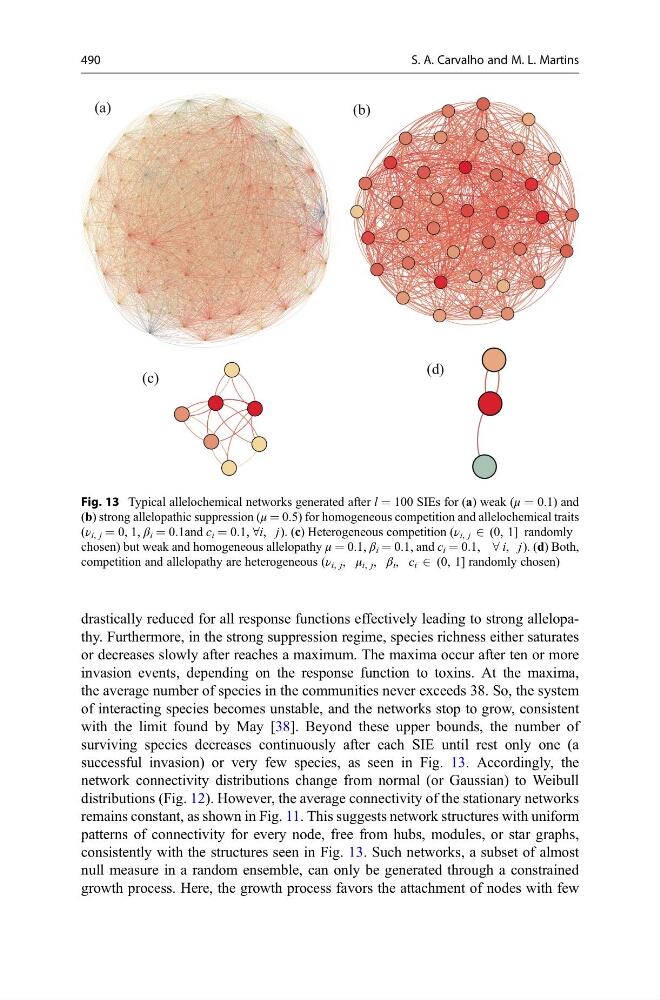
successful invasion) or very few species, as seen in Fig. 13. Accordingly, the
network connectivity distributions change from normal (or Gaussian) to Weibull
distributions (Fig. 12). However, the average connectivity of the stationary networks
remains constant, as shown in Fig. 11. This suggests network structures with uniform
patterns of connectivity for every node, free from hubs, modules, or star graphs,
consistently with the structures seen in Fig. 13. Such networks, a subset of almost
null measure in a random ensemble, can only be generated through a constrained
growth process. Here, the growth process favors the attachment of nodes with few
(a)
(b)
(c)
(d)
Fig. 13 Typical allelochemical networks generated after l = 100 SIEs for (a) weak (μ = 0.1) and
(b) strong allelopathic suppression (μ = 0.5) for homogeneous competition and allelochemical traits
(ν i, j = 0, 1, β i = 0.1and c i = 0.1, 8i, j). (c) Heterogeneous competition (ν i, j (0, 1] randomly
chosen) but weak and homogeneous allelopathy μ = 0.1, β i = 0.1, and c i = 0.1, 8 i, j). (d) Both,
competition and allelopathy are heterogeneous (ν i, j , μ i, j , β i , c i (0, 1] randomly chosen)
490
S. A. Carvalho and M. L. Martins
or decreases slowly after reaches a maximum. The maxima occur after ten or more
invasion events, depending on the response function to toxins. At the maxima,
the average number of species in the communities never exceeds 38. So, the system
of interacting species becomes unstable, and the networks stop to grow, consistent
with the limit found by May [38]. Beyond these upper bounds, the number of
surviving species decreases continuously after each SIE until rest only one (a
successful invasion) or very few species, as seen in Fig. 13. Accordingly, the
network connectivity distributions change from normal (or Gaussian) to Weibull
distributions (Fig. 12). However, the average connectivity of the stationary networks
remains constant, as shown in Fig. 11. This suggests network structures with uniform
patterns of connectivity for every node, free from hubs, modules, or star graphs,
consistently with the structures seen in Fig. 13. Such networks, a subset of almost
null measure in a random ensemble, can only be generated through a constrained
growth process. Here, the growth process favors the attachment of nodes with few
(a)
(b)
(c)
(d)
Fig. 13 Typical allelochemical networks generated after l = 100 SIEs for (a) weak (μ = 0.1) and
(b) strong allelopathic suppression (μ = 0.5) for homogeneous competition and allelochemical traits
(ν i, j = 0, 1, β i = 0.1and c i = 0.1, 8i, j). (c) Heterogeneous competition (ν i, j (0, 1] randomly
chosen) but weak and homogeneous allelopathy μ = 0.1, β i = 0.1, and c i = 0.1, 8 i, j). (d) Both,
competition and allelopathy are heterogeneous (ν i, j , μ i, j , β i , c i (0, 1] randomly chosen)
490
S. A. Carvalho and M. L. Martins