

allelopathy. So, the interaction network is sparsely connected (C(n) $ 0.5) at both
weak and strong allelochemical suppression. Furthermore, the connectivity initially
increases up to n $ 10 and saturates to a constant value and, for sensitive response
functions (Φ
(3, 5)
), exhibits significant fluctuations at strong allelopathic regime.
This behavior is very distinct from the power law scaling for large n values observed
in random networks, C(n) $ n
À1 [31], and a model for growing random networks
based on global stability, C(n) $ n
À1.2 [18]. Therefore, our results indicate that the
communities generated by the SIE dynamics markedly differ from random networks
involving positive and negative interactions.
The degree distributions P(k) for allelochemical interaction networks generated
by the SIE dynamics are shown in Fig. 12. The distribution P(k) gives the probability
that a randomly selected node in a network has k links, i.e., it is connected to k nodes.
Normal (Gaussian) and Weibull distributions were observed for in-degree distributions P(k
in
) depending on the mortality μ and the functional response to allelopathy.
For strong allelopathic suppression and functional responses Φ
(1,3,5) , P(k
in
) is a
Weibull distribution. In contrast, at weak allelopathic suppression and for the
response functions Φ
(4, 6) at the strong regime, P(k
in ) is Gaussian distributed. The
apparent anisotropies observed in the insets for Φ
(1,2,4,6) are very weak, as supported
0
20
40
60
80
100
0
25
50
75
100
40
60
80
100
50
75
100
0
20
40
60
80
100
0
6
12
18
24
0
20
40
60
80
100
0
25
50
75
100
μ=0.1
μ=0.1
μ=0.5
μ=0.5
Φ
(2)
Φ
(2)
Φ
(4)
Φ
(4)
Φ
(6)
Φ
(6)
Φ
(5)
Φ
(3)
Φ
(1)
Φ
(1)
Φ
(3)
Φ
(5)
Diversity
n SIE
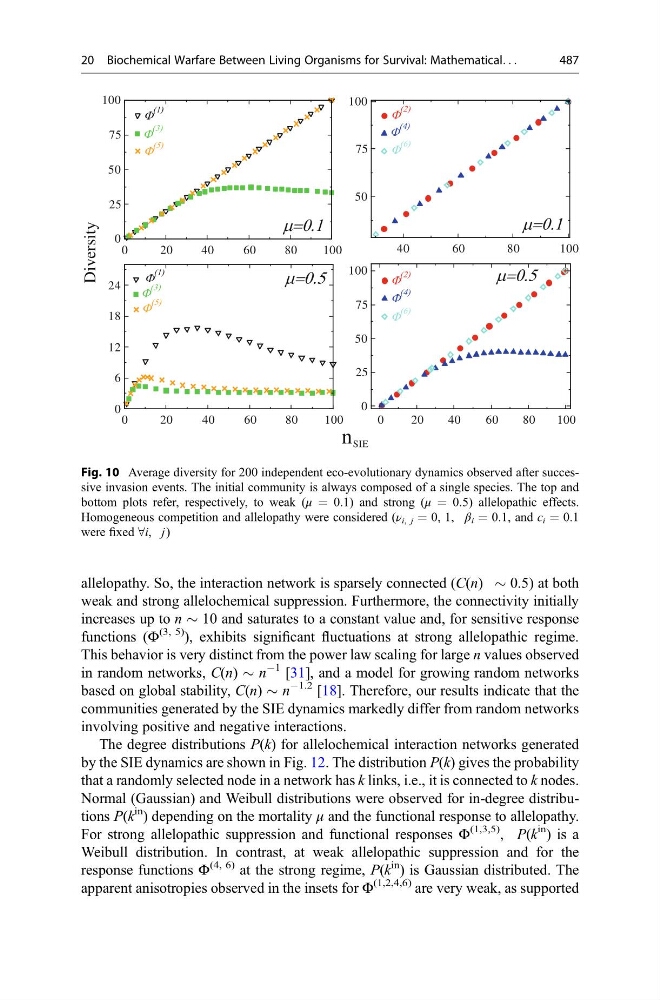
Fig. 10 Average diversity for 200 independent eco-evolutionary dynamics observed after successive invasion events. The initial community is always composed of a single species. The top and
bottom plots refer, respectively, to weak (μ = 0.1) and strong (μ = 0.5) allelopathic effects.
Homogeneous competition and allelopathy were considered (ν i, j = 0, 1, β i = 0.1, and c i = 0.1
were fixed 8i, j)
20 Biochemical Warfare Between Living Organisms for Survival: Mathematical. . .
487
weak and strong allelochemical suppression. Furthermore, the connectivity initially
increases up to n $ 10 and saturates to a constant value and, for sensitive response
functions (Φ
(3, 5)
), exhibits significant fluctuations at strong allelopathic regime.
This behavior is very distinct from the power law scaling for large n values observed
in random networks, C(n) $ n
À1 [31], and a model for growing random networks
based on global stability, C(n) $ n
À1.2 [18]. Therefore, our results indicate that the
communities generated by the SIE dynamics markedly differ from random networks
involving positive and negative interactions.
The degree distributions P(k) for allelochemical interaction networks generated
by the SIE dynamics are shown in Fig. 12. The distribution P(k) gives the probability
that a randomly selected node in a network has k links, i.e., it is connected to k nodes.
Normal (Gaussian) and Weibull distributions were observed for in-degree distributions P(k
in
) depending on the mortality μ and the functional response to allelopathy.
For strong allelopathic suppression and functional responses Φ
(1,3,5) , P(k
in
) is a
Weibull distribution. In contrast, at weak allelopathic suppression and for the
response functions Φ
(4, 6) at the strong regime, P(k
in ) is Gaussian distributed. The
apparent anisotropies observed in the insets for Φ
(1,2,4,6) are very weak, as supported
0
20
40
60
80
100
0
25
50
75
100
40
60
80
100
50
75
100
0
20
40
60
80
100
0
6
12
18
24
0
20
40
60
80
100
0
25
50
75
100
μ=0.1
μ=0.1
μ=0.5
μ=0.5
Φ
(2)
Φ
(2)
Φ
(4)
Φ
(4)
Φ
(6)
Φ
(6)
Φ
(5)
Φ
(3)
Φ
(1)
Φ
(1)
Φ
(3)
Φ
(5)
Diversity
n SIE
Fig. 10 Average diversity for 200 independent eco-evolutionary dynamics observed after successive invasion events. The initial community is always composed of a single species. The top and
bottom plots refer, respectively, to weak (μ = 0.1) and strong (μ = 0.5) allelopathic effects.
Homogeneous competition and allelopathy were considered (ν i, j = 0, 1, β i = 0.1, and c i = 0.1
were fixed 8i, j)
20 Biochemical Warfare Between Living Organisms for Survival: Mathematical. . .
487