

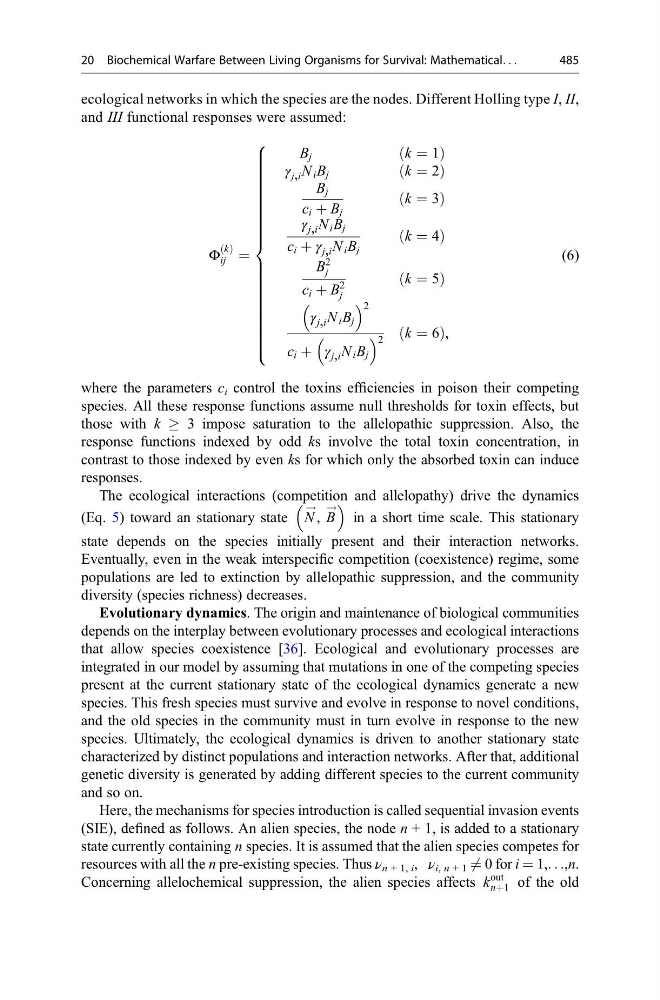
ecological networks in which the species are the nodes. Different Holling type I, II,
and III functional responses were assumed:
Φ
k
ð Þ
ij ¼
B j
k ¼ 1
ð
Þ
γ j,i N i B j
k ¼ 2
ð
Þ
B j
c i þ B j
k ¼ 3
ð
Þ
γ j,i N i B j
c i þ γ j,i N i B j
k ¼ 4
ð
Þ
B
2
j
c i þ B
2
j
k ¼ 5
ð
Þ
γ j,i N i B j
2
c i þ γ j,i N i B j
2 k ¼ 6
ð
Þ,
8
> > > > > > > > > > > > > > > > > > > <
> > > > > > > > > > > > > > > > > > > :
(6)
where the parameters c i control the toxins efficiencies in poison their competing
species. All these response functions assume null thresholds for toxin effects, but
those with k ! 3 impose saturation to the allelopathic suppression. Also, the
response functions indexed by odd ks involve the total toxin concentration, in
contrast to those indexed by even ks for which only the absorbed toxin can induce
responses.
The ecological interactions (competition and allelopathy) drive the dynamics
(Eq. 5) toward an stationary state N
! , B
!
in a short time scale. This stationary
state depends on the species initially present and their interaction networks.
Eventually, even in the weak interspecific competition (coexistence) regime, some
populations are led to extinction by allelopathic suppression, and the community
diversity (species richness) decreases.
Evolutionary dynamics. The origin and maintenance of biological communities
depends on the interplay between evolutionary processes and ecological interactions
that allow species coexistence [36]. Ecological and evolutionary processes are
integrated in our model by assuming that mutations in one of the competing species
present at the current stationary state of the ecological dynamics generate a new
species. This fresh species must survive and evolve in response to novel conditions,
and the old species in the community must in turn evolve in response to the new
species. Ultimately, the ecological dynamics is driven to another stationary state
characterized by distinct populations and interaction networks. After that, additional
genetic diversity is generated by adding different species to the current community
and so on.
Here, the mechanisms for species introduction is called sequential invasion events
(SIE), defined as follows. An alien species, the node n + 1, is added to a stationary
state currently containing n species. It is assumed that the alien species competes for
resources with all the n pre-existing species. Thus ν n + 1, i , ν i, n + 1 6
¼ 0 for i = 1,. . .,n.
Concerning allelochemical suppression, the alien species affects k
out
nþ1 of the old
20 Biochemical Warfare Between Living Organisms for Survival: Mathematical. . .
485
and III functional responses were assumed:
Φ
k
ð Þ
ij ¼
B j
k ¼ 1
ð
Þ
γ j,i N i B j
k ¼ 2
ð
Þ
B j
c i þ B j
k ¼ 3
ð
Þ
γ j,i N i B j
c i þ γ j,i N i B j
k ¼ 4
ð
Þ
B
2
j
c i þ B
2
j
k ¼ 5
ð
Þ
γ j,i N i B j
2
c i þ γ j,i N i B j
2 k ¼ 6
ð
Þ,
8
> > > > > > > > > > > > > > > > > > > <
> > > > > > > > > > > > > > > > > > > :
(6)
where the parameters c i control the toxins efficiencies in poison their competing
species. All these response functions assume null thresholds for toxin effects, but
those with k ! 3 impose saturation to the allelopathic suppression. Also, the
response functions indexed by odd ks involve the total toxin concentration, in
contrast to those indexed by even ks for which only the absorbed toxin can induce
responses.
The ecological interactions (competition and allelopathy) drive the dynamics
(Eq. 5) toward an stationary state N
! , B
!
in a short time scale. This stationary
state depends on the species initially present and their interaction networks.
Eventually, even in the weak interspecific competition (coexistence) regime, some
populations are led to extinction by allelopathic suppression, and the community
diversity (species richness) decreases.
Evolutionary dynamics. The origin and maintenance of biological communities
depends on the interplay between evolutionary processes and ecological interactions
that allow species coexistence [36]. Ecological and evolutionary processes are
integrated in our model by assuming that mutations in one of the competing species
present at the current stationary state of the ecological dynamics generate a new
species. This fresh species must survive and evolve in response to novel conditions,
and the old species in the community must in turn evolve in response to the new
species. Ultimately, the ecological dynamics is driven to another stationary state
characterized by distinct populations and interaction networks. After that, additional
genetic diversity is generated by adding different species to the current community
and so on.
Here, the mechanisms for species introduction is called sequential invasion events
(SIE), defined as follows. An alien species, the node n + 1, is added to a stationary
state currently containing n species. It is assumed that the alien species competes for
resources with all the n pre-existing species. Thus ν n + 1, i , ν i, n + 1 6
¼ 0 for i = 1,. . .,n.
Concerning allelochemical suppression, the alien species affects k
out
nþ1 of the old
20 Biochemical Warfare Between Living Organisms for Survival: Mathematical. . .
485