

(ν 1 + [μ(β À δ)/δ(c À 1) + β] > 1), the native species is extinct. This result neatly
demonstrates the advantage of secreting an allelopathic compound. The invader
species is able to extinct the native competitor even having a competition coefficient
ν 1 < 1. Furthermore, it is worth to notice that the chemical nature of the allelotoxin
neatly affects the competition outcome. Indeed, a nonvolatile (small δ), powerful
(large μ), and easily released (large β) allelochemical potentially transforms a
“weak” species (ν 1 < 1) in a highly successful invader. Figure 2 illustrates typical
outcomes for an invasion process starting from a single central focus.
2.2
Allelochemical Warfare
The next natural step is, instead of considering only one species endowed with
allelochemical weapons, to study the arms race involving two allelopathic organisms. In reference [28] such an extension was done. There, the following system of
dimensionless partial differential equations was proposed:
I
N
0
0
0.25
0.5
0.75
1
0.25
0.5
0.75
1
N
0
0.25
0.5
0.75
1
a
d
b
c
I
0
0.25
0.5
0.75
1
N
N
0
0.25
0.5
0.75
1
I
0
0.25
0.5
0.75
1
I
0
0
0.25
0.5
0.75
1
0.25
0.5
0.75
1
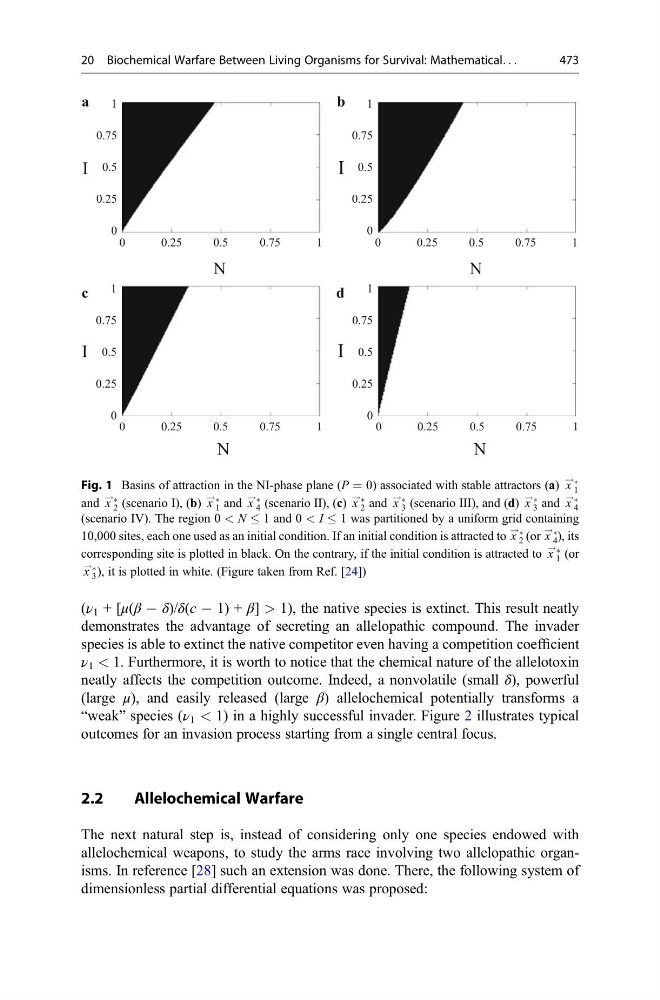
Fig. 1 Basins of attraction in the NI-phase plane (P = 0) associated with stable attractors (a) x
! Ã
1
and x
! Ã
2 (scenario I), (b) x
! Ã
1 and x
! Ã
4 (scenario II), (c) x
! Ã
2 and x
! Ã
3 (scenario III), and (d) x
! Ã
3 and x
! Ã
4
(scenario IV). The region 0 < N 1 and 0 < I 1 was partitioned by a uniform grid containing
10,000 sites, each one used as an initial condition. If an initial condition is attracted to x
! Ã
2 (or x
! Ã
4 ), its
corresponding site is plotted in black. On the contrary, if the initial condition is attracted to x
! Ã
1 (or
x
! Ã
3 ), it is plotted in white. (Figure taken from Ref. [24])
20 Biochemical Warfare Between Living Organisms for Survival: Mathematical. . .
473
demonstrates the advantage of secreting an allelopathic compound. The invader
species is able to extinct the native competitor even having a competition coefficient
ν 1 < 1. Furthermore, it is worth to notice that the chemical nature of the allelotoxin
neatly affects the competition outcome. Indeed, a nonvolatile (small δ), powerful
(large μ), and easily released (large β) allelochemical potentially transforms a
“weak” species (ν 1 < 1) in a highly successful invader. Figure 2 illustrates typical
outcomes for an invasion process starting from a single central focus.
2.2
Allelochemical Warfare
The next natural step is, instead of considering only one species endowed with
allelochemical weapons, to study the arms race involving two allelopathic organisms. In reference [28] such an extension was done. There, the following system of
dimensionless partial differential equations was proposed:
I
N
0
0
0.25
0.5
0.75
1
0.25
0.5
0.75
1
N
0
0.25
0.5
0.75
1
a
d
b
c
I
0
0.25
0.5
0.75
1
N
N
0
0.25
0.5
0.75
1
I
0
0.25
0.5
0.75
1
I
0
0
0.25
0.5
0.75
1
0.25
0.5
0.75
1
Fig. 1 Basins of attraction in the NI-phase plane (P = 0) associated with stable attractors (a) x
! Ã
1
and x
! Ã
2 (scenario I), (b) x
! Ã
1 and x
! Ã
4 (scenario II), (c) x
! Ã
2 and x
! Ã
3 (scenario III), and (d) x
! Ã
3 and x
! Ã
4
(scenario IV). The region 0 < N 1 and 0 < I 1 was partitioned by a uniform grid containing
10,000 sites, each one used as an initial condition. If an initial condition is attracted to x
! Ã
2 (or x
! Ã
4 ), its
corresponding site is plotted in black. On the contrary, if the initial condition is attracted to x
! Ã
1 (or
x
! Ã
3 ), it is plotted in white. (Figure taken from Ref. [24])
20 Biochemical Warfare Between Living Organisms for Survival: Mathematical. . .
473