

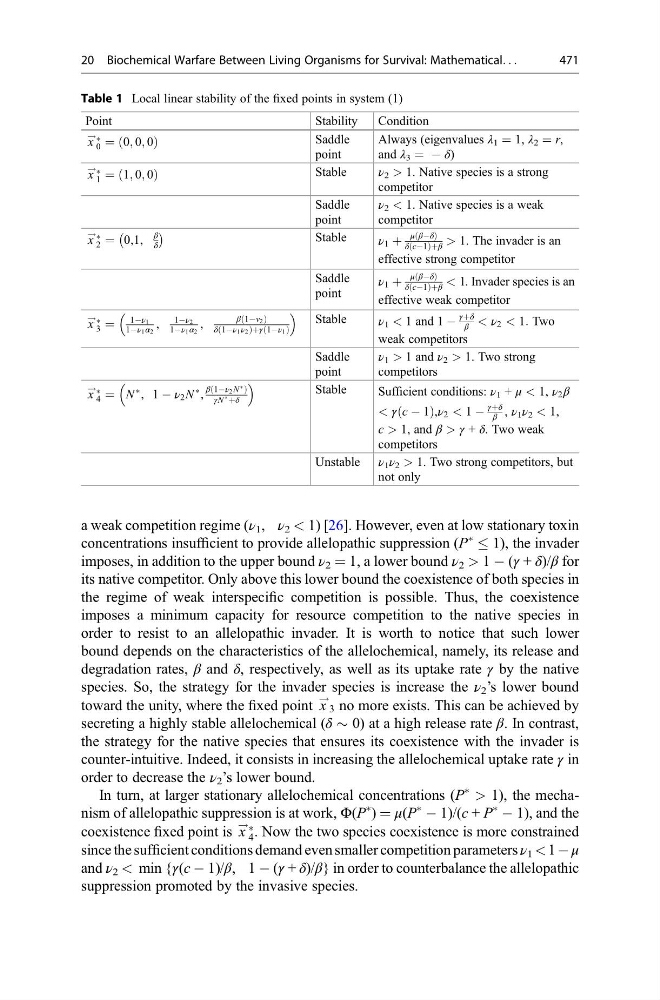
a weak competition regime (ν 1 , ν 2 < 1) [26]. However, even at low stationary toxin
concentrations insufficient to provide allelopathic suppression (P
Ã
1), the invader
imposes, in addition to the upper bound ν 2 = 1, a lower bound ν 2 > 1 À (γ + δ)/β for
its native competitor. Only above this lower bound the coexistence of both species in
the regime of weak interspecific competition is possible. Thus, the coexistence
imposes a minimum capacity for resource competition to the native species in
order to resist to an allelopathic invader. It is worth to notice that such lower
bound depends on the characteristics of the allelochemical, namely, its release and
degradation rates, β and δ, respectively, as well as its uptake rate γ by the native
species. So, the strategy for the invader species is increase the ν 2 ’s lower bound
toward the unity, where the fixed point x
!
3 no more exists. This can be achieved by
secreting a highly stable allelochemical (δ $ 0) at a high release rate β. In contrast,
the strategy for the native species that ensures its coexistence with the invader is
counter-intuitive. Indeed, it consists in increasing the allelochemical uptake rate γ in
order to decrease the ν 2 ’s lower bound.
In turn, at larger stationary allelochemical concentrations (P
Ã
> 1), the mechanism of allelopathic suppression is at work, Φ(P
à ) = μ(P
Ã
À 1)/(c + P
Ã
À 1), and the
coexistence fixed point is x
! Ã
4 . Now the two species coexistence is more constrained
since the sufficient conditions demand even smaller competition parameters ν 1 < 1 À μ
and ν 2 < min {γ(c À 1)/β, 1 À (γ + δ)/β} in order to counterbalance the allelopathic
suppression promoted by the invasive species.
Table 1 Local linear stability of the fixed points in system (1)
Point
Stability
Condition
x
! Ã
0 ¼ 0; 0; 0
ð
Þ
Saddle
point
Always (eigenvalues λ 1 = 1, λ 2 = r,
and λ 3 = À δ)
x
! Ã
1 ¼ 1; 0; 0
ð
Þ
Stable
ν 2 > 1. Native species is a strong
competitor
Saddle
point
ν 2 < 1. Native species is a weak
competitor
x
! Ã
2 ¼ 0,1,
β
δ
À
Á
Stable
ν 1 þ
μ βÀδ
ð
Þ
δ cÀ1
ð
Þþβ > 1. The invader is an
effective strong competitor
Saddle
point
ν 1 þ
μ βÀδ
ð
Þ
δ cÀ1
ð
Þþβ < 1. Invader species is an
effective weak competitor
x
! Ã
3 ¼
1Àν1
1Àν1α2 ,
1Àν2
1Àν1α2 ,
β 1Àv2
ð
Þ
δ 1Àν1ν2
ð
Þ þ γ 1Àν1
ð
Þ
Stable
ν 1 < 1 and 1 À
γþδ
β < ν 2 < 1: Two
weak competitors
Saddle
point
ν 1 > 1 and ν 2 > 1. Two strong
competitors
x
! Ã
4 ¼ N
à , 1 À ν 2 N
à ,
β 1Àν2N
Ã
ð
Þ
γN
à þδ
Stable
Sufficient conditions: ν 1 + μ < 1, ν 2 β
< γ c À 1
ð
Þ,ν 2 < 1 À
γþδ
β , ν 1 ν 2 < 1,
c > 1, and β > γ + δ. Two weak
competitors
Unstable ν 1 ν 2 > 1. Two strong competitors, but
not only
20 Biochemical Warfare Between Living Organisms for Survival: Mathematical. . .
471
concentrations insufficient to provide allelopathic suppression (P
Ã
1), the invader
imposes, in addition to the upper bound ν 2 = 1, a lower bound ν 2 > 1 À (γ + δ)/β for
its native competitor. Only above this lower bound the coexistence of both species in
the regime of weak interspecific competition is possible. Thus, the coexistence
imposes a minimum capacity for resource competition to the native species in
order to resist to an allelopathic invader. It is worth to notice that such lower
bound depends on the characteristics of the allelochemical, namely, its release and
degradation rates, β and δ, respectively, as well as its uptake rate γ by the native
species. So, the strategy for the invader species is increase the ν 2 ’s lower bound
toward the unity, where the fixed point x
!
3 no more exists. This can be achieved by
secreting a highly stable allelochemical (δ $ 0) at a high release rate β. In contrast,
the strategy for the native species that ensures its coexistence with the invader is
counter-intuitive. Indeed, it consists in increasing the allelochemical uptake rate γ in
order to decrease the ν 2 ’s lower bound.
In turn, at larger stationary allelochemical concentrations (P
Ã
> 1), the mechanism of allelopathic suppression is at work, Φ(P
à ) = μ(P
Ã
À 1)/(c + P
Ã
À 1), and the
coexistence fixed point is x
! Ã
4 . Now the two species coexistence is more constrained
since the sufficient conditions demand even smaller competition parameters ν 1 < 1 À μ
and ν 2 < min {γ(c À 1)/β, 1 À (γ + δ)/β} in order to counterbalance the allelopathic
suppression promoted by the invasive species.
Table 1 Local linear stability of the fixed points in system (1)
Point
Stability
Condition
x
! Ã
0 ¼ 0; 0; 0
ð
Þ
Saddle
point
Always (eigenvalues λ 1 = 1, λ 2 = r,
and λ 3 = À δ)
x
! Ã
1 ¼ 1; 0; 0
ð
Þ
Stable
ν 2 > 1. Native species is a strong
competitor
Saddle
point
ν 2 < 1. Native species is a weak
competitor
x
! Ã
2 ¼ 0,1,
β
δ
À
Á
Stable
ν 1 þ
μ βÀδ
ð
Þ
δ cÀ1
ð
Þþβ > 1. The invader is an
effective strong competitor
Saddle
point
ν 1 þ
μ βÀδ
ð
Þ
δ cÀ1
ð
Þþβ < 1. Invader species is an
effective weak competitor
x
! Ã
3 ¼
1Àν1
1Àν1α2 ,
1Àν2
1Àν1α2 ,
β 1Àv2
ð
Þ
δ 1Àν1ν2
ð
Þ þ γ 1Àν1
ð
Þ
Stable
ν 1 < 1 and 1 À
γþδ
β < ν 2 < 1: Two
weak competitors
Saddle
point
ν 1 > 1 and ν 2 > 1. Two strong
competitors
x
! Ã
4 ¼ N
à , 1 À ν 2 N
à ,
β 1Àν2N
Ã
ð
Þ
γN
à þδ
Stable
Sufficient conditions: ν 1 + μ < 1, ν 2 β
< γ c À 1
ð
Þ,ν 2 < 1 À
γþδ
β , ν 1 ν 2 < 1,
c > 1, and β > γ + δ. Two weak
competitors
Unstable ν 1 ν 2 > 1. Two strong competitors, but
not only
20 Biochemical Warfare Between Living Organisms for Survival: Mathematical. . .
471