

2.1
Allelopathically Mediated Invasion
Let us start by considering the population dynamics of two competing species in
which one of them (an invader) produces a secondary metabolite that affects the
other. We assume that the populations and the released allelochemical are homogeneously mixing as, for instance, when microcin-producing and microcin-sensitive
bacteria are grown in liquid cultures. Then spatial fluctuations and correlations can
be neglected, and the ecological dynamics can be described by dimensionless
ordinary differential equations. Accordingly reference [24], these equations are the
following:
_
N ¼ N 1 À N À v 1 I
ð
ÞÀN Φ P
ð Þ
_
I ¼ rI 1 À I À v 2 N
ð
Þ
_
P ¼ βI À γNP À δP
(1)
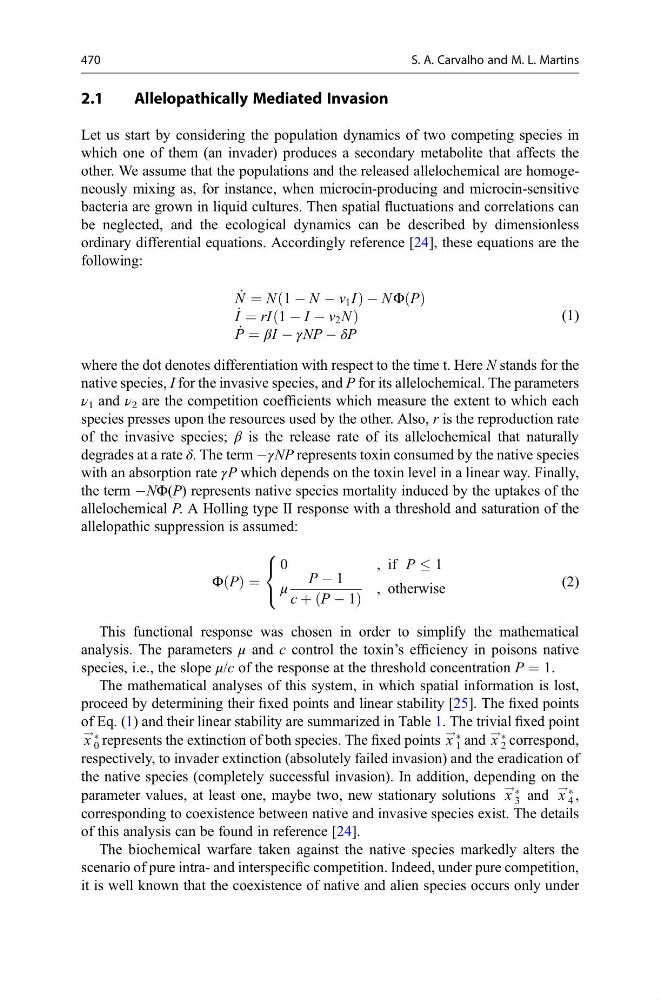
where the dot denotes differentiation with respect to the time t. Here N stands for the
native species, I for the invasive species, and P for its allelochemical. The parameters
ν 1 and ν 2 are the competition coefficients which measure the extent to which each
species presses upon the resources used by the other. Also, r is the reproduction rate
of the invasive species; β is the release rate of its allelochemical that naturally
degrades at a rate δ. The term ÀγNP represents toxin consumed by the native species
with an absorption rate γP which depends on the toxin level in a linear way. Finally,
the term ÀNΦ(P) represents native species mortality induced by the uptakes of the
allelochemical P. A Holling type II response with a threshold and saturation of the
allelopathic suppression is assumed:
Φ P
ð Þ ¼
0
,i fP 1
μ
P À 1
c þ P À 1
ð
Þ
, otherwise
8
<
:
(2)
This functional response was chosen in order to simplify the mathematical
analysis. The parameters μ and c control the toxin’s efficiency in poisons native
species, i.e., the slope μ/c of the response at the threshold concentration P = 1.
The mathematical analyses of this system, in which spatial information is lost,
proceed by determining their fixed points and linear stability [25]. The fixed points
of Eq. (1) and their linear stability are summarized in Table 1. The trivial fixed point
x
! Ã
0 represents the extinction of both species. The fixed points x
! Ã
1 and x
! Ã
2 correspond,
respectively, to invader extinction (absolutely failed invasion) and the eradication of
the native species (completely successful invasion). In addition, depending on the
parameter values, at least one, maybe two, new stationary solutions x
! Ã
3 and x
! Ã
4 ,
corresponding to coexistence between native and invasive species exist. The details
of this analysis can be found in reference [24].
The biochemical warfare taken against the native species markedly alters the
scenario of pure intra- and interspecific competition. Indeed, under pure competition,
it is well known that the coexistence of native and alien species occurs only under
470
S. A. Carvalho and M. L. Martins
Allelopathically Mediated Invasion
Let us start by considering the population dynamics of two competing species in
which one of them (an invader) produces a secondary metabolite that affects the
other. We assume that the populations and the released allelochemical are homogeneously mixing as, for instance, when microcin-producing and microcin-sensitive
bacteria are grown in liquid cultures. Then spatial fluctuations and correlations can
be neglected, and the ecological dynamics can be described by dimensionless
ordinary differential equations. Accordingly reference [24], these equations are the
following:
_
N ¼ N 1 À N À v 1 I
ð
ÞÀN Φ P
ð Þ
_
I ¼ rI 1 À I À v 2 N
ð
Þ
_
P ¼ βI À γNP À δP
(1)
where the dot denotes differentiation with respect to the time t. Here N stands for the
native species, I for the invasive species, and P for its allelochemical. The parameters
ν 1 and ν 2 are the competition coefficients which measure the extent to which each
species presses upon the resources used by the other. Also, r is the reproduction rate
of the invasive species; β is the release rate of its allelochemical that naturally
degrades at a rate δ. The term ÀγNP represents toxin consumed by the native species
with an absorption rate γP which depends on the toxin level in a linear way. Finally,
the term ÀNΦ(P) represents native species mortality induced by the uptakes of the
allelochemical P. A Holling type II response with a threshold and saturation of the
allelopathic suppression is assumed:
Φ P
ð Þ ¼
0
,i fP 1
μ
P À 1
c þ P À 1
ð
Þ
, otherwise
8
<
:
(2)
This functional response was chosen in order to simplify the mathematical
analysis. The parameters μ and c control the toxin’s efficiency in poisons native
species, i.e., the slope μ/c of the response at the threshold concentration P = 1.
The mathematical analyses of this system, in which spatial information is lost,
proceed by determining their fixed points and linear stability [25]. The fixed points
of Eq. (1) and their linear stability are summarized in Table 1. The trivial fixed point
x
! Ã
0 represents the extinction of both species. The fixed points x
! Ã
1 and x
! Ã
2 correspond,
respectively, to invader extinction (absolutely failed invasion) and the eradication of
the native species (completely successful invasion). In addition, depending on the
parameter values, at least one, maybe two, new stationary solutions x
! Ã
3 and x
! Ã
4 ,
corresponding to coexistence between native and invasive species exist. The details
of this analysis can be found in reference [24].
The biochemical warfare taken against the native species markedly alters the
scenario of pure intra- and interspecific competition. Indeed, under pure competition,
it is well known that the coexistence of native and alien species occurs only under
470
S. A. Carvalho and M. L. Martins