

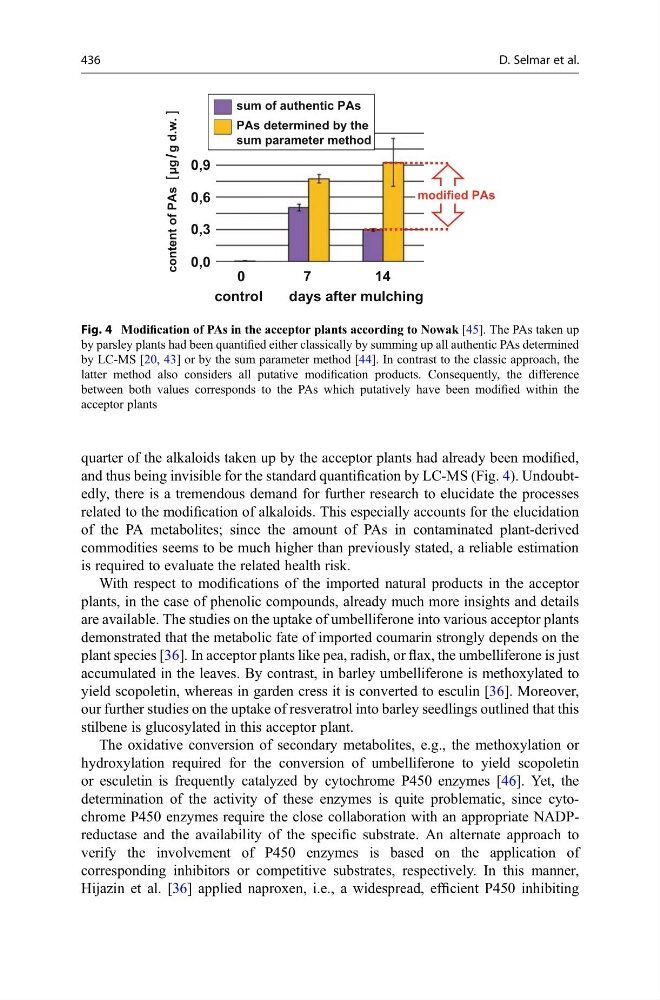
quarter of the alkaloids taken up by the acceptor plants had already been modified,
and thus being invisible for the standard quantification by LC-MS (Fig. 4). Undoubtedly, there is a tremendous demand for further research to elucidate the processes
related to the modification of alkaloids. This especially accounts for the elucidation
of the PA metabolites; since the amount of PAs in contaminated plant-derived
commodities seems to be much higher than previously stated, a reliable estimation
is required to evaluate the related health risk.
With respect to modifications of the imported natural products in the acceptor
plants, in the case of phenolic compounds, already much more insights and details
are available. The studies on the uptake of umbelliferone into various acceptor plants
demonstrated that the metabolic fate of imported coumarin strongly depends on the
plant species [36]. In acceptor plants like pea, radish, or flax, the umbelliferone is just
accumulated in the leaves. By contrast, in barley umbelliferone is methoxylated to
yield scopoletin, whereas in garden cress it is converted to esculin [36]. Moreover,
our further studies on the uptake of resveratrol into barley seedlings outlined that this
stilbene is glucosylated in this acceptor plant.
The oxidative conversion of secondary metabolites, e.g., the methoxylation or
hydroxylation required for the conversion of umbelliferone to yield scopoletin
or esculetin is frequently catalyzed by cytochrome P450 enzymes [46]. Yet, the
determination of the activity of these enzymes is quite problematic, since cytochrome P450 enzymes require the close collaboration with an appropriate NADPreductase and the availability of the specific substrate. An alternate approach to
verify the involvement of P450 enzymes is based on the application of
corresponding inhibitors or competitive substrates, respectively. In this manner,
Hijazin et al. [36] applied naproxen, i.e., a widespread, efficient P450 inhibiting
0
7
1 4
days after mulching
sum of authentic PAs
PAs determined by the
sum parameter method
0,0
0,3
0,6
0,9
s
A
P
f
o
t
n
e
t
n
o
c
[ µg
/
.
w
.
d
g
]
control
modified PAs
/
Fig. 4 Modification of PAs in the acceptor plants according to Nowak [45]. The PAs taken up
by parsley plants had been quantified either classically by summing up all authentic PAs determined
by LC-MS [20, 43] or by the sum parameter method [44]. In contrast to the classic approach, the
latter method also considers all putative modification products. Consequently, the difference
between both values corresponds to the PAs which putatively have been modified within the
acceptor plants
436
D. Selmar et al.
and thus being invisible for the standard quantification by LC-MS (Fig. 4). Undoubtedly, there is a tremendous demand for further research to elucidate the processes
related to the modification of alkaloids. This especially accounts for the elucidation
of the PA metabolites; since the amount of PAs in contaminated plant-derived
commodities seems to be much higher than previously stated, a reliable estimation
is required to evaluate the related health risk.
With respect to modifications of the imported natural products in the acceptor
plants, in the case of phenolic compounds, already much more insights and details
are available. The studies on the uptake of umbelliferone into various acceptor plants
demonstrated that the metabolic fate of imported coumarin strongly depends on the
plant species [36]. In acceptor plants like pea, radish, or flax, the umbelliferone is just
accumulated in the leaves. By contrast, in barley umbelliferone is methoxylated to
yield scopoletin, whereas in garden cress it is converted to esculin [36]. Moreover,
our further studies on the uptake of resveratrol into barley seedlings outlined that this
stilbene is glucosylated in this acceptor plant.
The oxidative conversion of secondary metabolites, e.g., the methoxylation or
hydroxylation required for the conversion of umbelliferone to yield scopoletin
or esculetin is frequently catalyzed by cytochrome P450 enzymes [46]. Yet, the
determination of the activity of these enzymes is quite problematic, since cytochrome P450 enzymes require the close collaboration with an appropriate NADPreductase and the availability of the specific substrate. An alternate approach to
verify the involvement of P450 enzymes is based on the application of
corresponding inhibitors or competitive substrates, respectively. In this manner,
Hijazin et al. [36] applied naproxen, i.e., a widespread, efficient P450 inhibiting
0
7
1 4
days after mulching
sum of authentic PAs
PAs determined by the
sum parameter method
0,0
0,3
0,6
0,9
s
A
P
f
o
t
n
e
t
n
o
c
[ µg
/
.
w
.
d
g
]
control
modified PAs
/
Fig. 4 Modification of PAs in the acceptor plants according to Nowak [45]. The PAs taken up
by parsley plants had been quantified either classically by summing up all authentic PAs determined
by LC-MS [20, 43] or by the sum parameter method [44]. In contrast to the classic approach, the
latter method also considers all putative modification products. Consequently, the difference
between both values corresponds to the PAs which putatively have been modified within the
acceptor plants
436
D. Selmar et al.