

4
Modification of Imported Substances in the Acceptor
Plants
A detailed evaluation of the contents of alkaloids imported into the acceptor plants
displayed that the content of nicotine [18] as well as of the PAs [20] decreased by
the time. In this context, it has to be considered that xenobiotics, which are taken up
from the soil, frequently are modified within the acceptor plants, e.g., by oxidation,
hydroxylation, and by conjugation with glucose [40, 41]. According to the so-called
green liver concept, these reactions are proposed to be part of a deliberate detoxification of xenobiotics [40, 42]. Consequently, it is not far to conclude that the timedependent decrease in the PA concentration in the acceptor plants maybe also caused
by a modification of the imported alkaloids. Yet, in this particular case, it has to
be noted that the quantification of PAs was performed by the employment of
a standard LC-MS method, which is based on summing up the individual contents
of 27 genuine PAs [20, 43]. In consequence, only the original, already known PAs –
previously present in the donor plant – are determined and not their putative
derivatives. Fortunately, an alternative method is available, i.e., the so-called sum
parameter method. This approach is based on a HPLC-ESI-MS determination of the
necine base [44]. Hence this method considers also the putative modification
products of the imported PAs, too. Accordingly, the difference of the values between
both procedures of quantification corresponds to the PAs, which putatively have
been modified within the acceptor plants (Fig. 4). By doing so, it became apparent
that the concentration of PAs in the acceptor plants is far higher than previously
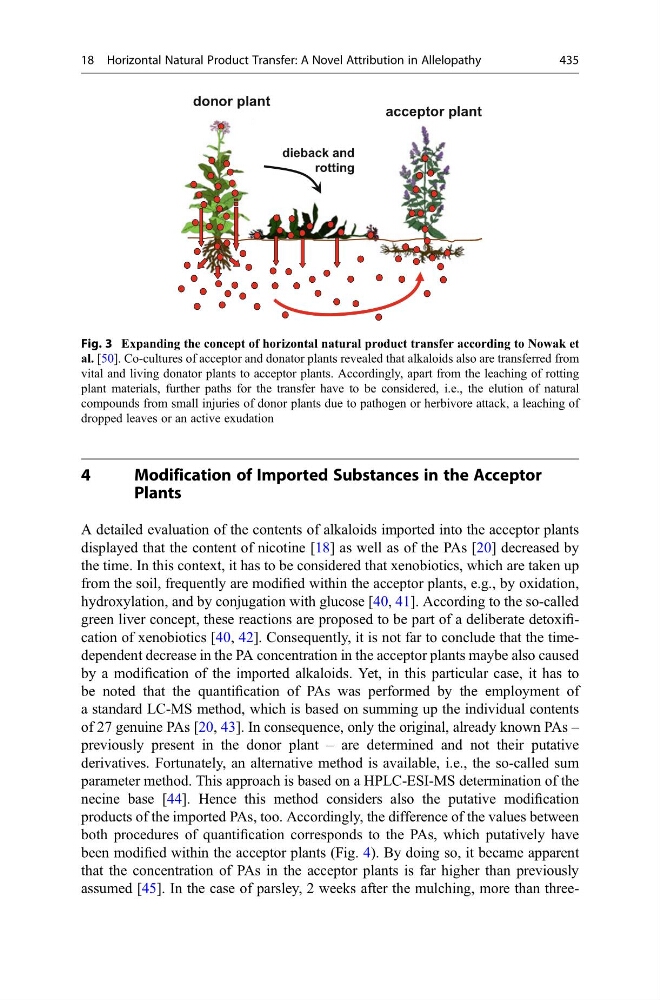
assumed [45]. In the case of parsley, 2 weeks after the mulching, more than threedonor plant
acceptor plant
dieback and
rotting
Fig. 3 Expanding the concept of horizontal natural product transfer according to Nowak et
al. [50]. Co-cultures of acceptor and donator plants revealed that alkaloids also are transferred from
vital and living donator plants to acceptor plants. Accordingly, apart from the leaching of rotting
plant materials, further paths for the transfer have to be considered, i.e., the elution of natural
compounds from small injuries of donor plants due to pathogen or herbivore attack, a leaching of
dropped leaves or an active exudation
18 Horizontal Natural Product Transfer: A Novel Attribution in Allelopathy
435
Modification of Imported Substances in the Acceptor
Plants
A detailed evaluation of the contents of alkaloids imported into the acceptor plants
displayed that the content of nicotine [18] as well as of the PAs [20] decreased by
the time. In this context, it has to be considered that xenobiotics, which are taken up
from the soil, frequently are modified within the acceptor plants, e.g., by oxidation,
hydroxylation, and by conjugation with glucose [40, 41]. According to the so-called
green liver concept, these reactions are proposed to be part of a deliberate detoxification of xenobiotics [40, 42]. Consequently, it is not far to conclude that the timedependent decrease in the PA concentration in the acceptor plants maybe also caused
by a modification of the imported alkaloids. Yet, in this particular case, it has to
be noted that the quantification of PAs was performed by the employment of
a standard LC-MS method, which is based on summing up the individual contents
of 27 genuine PAs [20, 43]. In consequence, only the original, already known PAs –
previously present in the donor plant – are determined and not their putative
derivatives. Fortunately, an alternative method is available, i.e., the so-called sum
parameter method. This approach is based on a HPLC-ESI-MS determination of the
necine base [44]. Hence this method considers also the putative modification
products of the imported PAs, too. Accordingly, the difference of the values between
both procedures of quantification corresponds to the PAs, which putatively have
been modified within the acceptor plants (Fig. 4). By doing so, it became apparent
that the concentration of PAs in the acceptor plants is far higher than previously
assumed [45]. In the case of parsley, 2 weeks after the mulching, more than threedonor plant
acceptor plant
dieback and
rotting
Fig. 3 Expanding the concept of horizontal natural product transfer according to Nowak et
al. [50]. Co-cultures of acceptor and donator plants revealed that alkaloids also are transferred from
vital and living donator plants to acceptor plants. Accordingly, apart from the leaching of rotting
plant materials, further paths for the transfer have to be considered, i.e., the elution of natural
compounds from small injuries of donor plants due to pathogen or herbivore attack, a leaching of
dropped leaves or an active exudation
18 Horizontal Natural Product Transfer: A Novel Attribution in Allelopathy
435