

On the basis of chemical structure and composition, elicitors are classified into six
different groups, namely: enzymes, fatty acid amino acid conjugates (FACs), fatty
acids, peptides, esters, and benzyl cyanide (Table 1). Of these, enzymes, fatty acids,
FACs, and peptides are present in the oral secretions, whereas esters and benzyl
cyanide are secreted in oviposition fluids during egg deposition [7, 9, 10]. Each type
of elicitor has a different mode of action and effect. We have discussed the congruity
and irregularity of several elicitors in the following sections.
2.1
Elicitors from Oral Secretions
2.1.1 Enzymes
One of the first insect elicitor to be identified and reported was an enzyme elicitor, βglucosidase, from Pieris brassicae regurgitate [11, 12]. This β-glucosidase activates
the plant defense and triggers the release of an array of volatiles in cabbage, lima
beans, and corn plants [4, 13]. These released volatiles attract the parasitoid Cotesia
glomerata. Thus, the β-glucosidase in P. brassicae induces indirect plant defense
[11]. Along with chewing herbivore, this type of elicitor is also found in sucking
insects. Nilaparvata lugens exhibits β-glucosidase, causing an increase in the levels
of Jasmonic acid (JA), hydrogen peroxide (H 2 O 2 ), and ethylene [14]. These induce
Paleozoic
Mesozoic
Cenozoic
Sil
Devon Carbon
Perm
Trias
Jura
Creta
Pale Neo
400
350
300
250
200
150
100
50
0
Bryophytes
Gymnosperms
Angiosperms
Time (million years)
Terpenoids
CH 3
CH 3
CH 3
CH 3
CH 3
CH 3
CH 3
CH 3
CH 3
CH 3
H 3 C
O
O
OH
HO
OH
OH
HO
HO
H 3 C
H 2 C
H 3 C
Sesquiterpenes
Triterpenes
Qualitative and quantitative expansion in plant chemical diversity
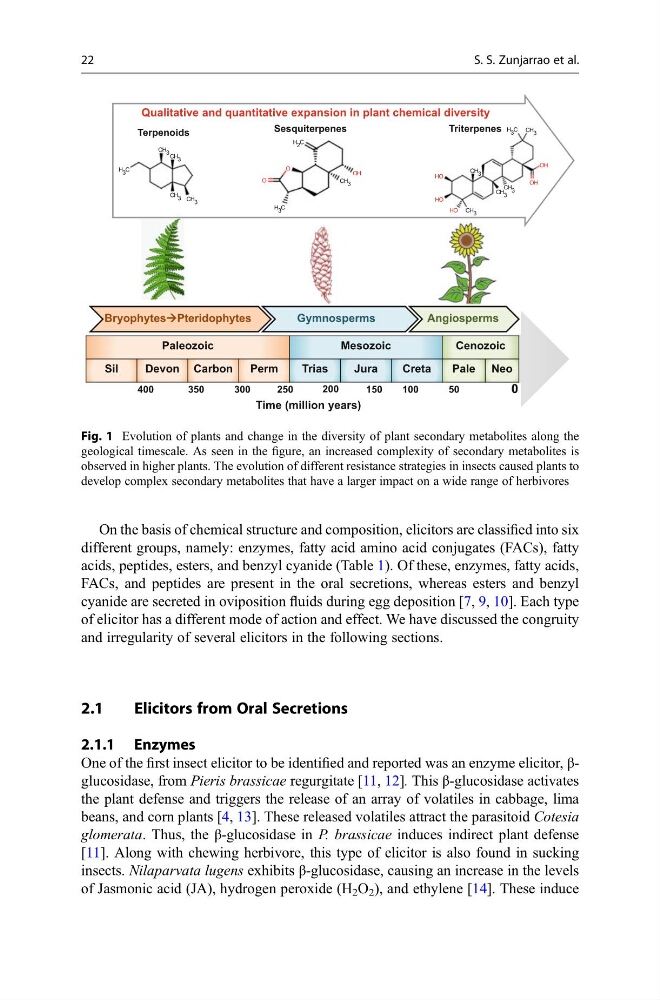
Fig. 1 Evolution of plants and change in the diversity of plant secondary metabolites along the
geological timescale. As seen in the figure, an increased complexity of secondary metabolites is
observed in higher plants. The evolution of different resistance strategies in insects caused plants to
develop complex secondary metabolites that have a larger impact on a wide range of herbivores
22
S. S. Zunjarrao et al.
different groups, namely: enzymes, fatty acid amino acid conjugates (FACs), fatty
acids, peptides, esters, and benzyl cyanide (Table 1). Of these, enzymes, fatty acids,
FACs, and peptides are present in the oral secretions, whereas esters and benzyl
cyanide are secreted in oviposition fluids during egg deposition [7, 9, 10]. Each type
of elicitor has a different mode of action and effect. We have discussed the congruity
and irregularity of several elicitors in the following sections.
2.1
Elicitors from Oral Secretions
2.1.1 Enzymes
One of the first insect elicitor to be identified and reported was an enzyme elicitor, βglucosidase, from Pieris brassicae regurgitate [11, 12]. This β-glucosidase activates
the plant defense and triggers the release of an array of volatiles in cabbage, lima
beans, and corn plants [4, 13]. These released volatiles attract the parasitoid Cotesia
glomerata. Thus, the β-glucosidase in P. brassicae induces indirect plant defense
[11]. Along with chewing herbivore, this type of elicitor is also found in sucking
insects. Nilaparvata lugens exhibits β-glucosidase, causing an increase in the levels
of Jasmonic acid (JA), hydrogen peroxide (H 2 O 2 ), and ethylene [14]. These induce
Paleozoic
Mesozoic
Cenozoic
Sil
Devon Carbon
Perm
Trias
Jura
Creta
Pale Neo
400
350
300
250
200
150
100
50
0
Bryophytes
Gymnosperms
Angiosperms
Time (million years)
Terpenoids
CH 3
CH 3
CH 3
CH 3
CH 3
CH 3
CH 3
CH 3
CH 3
CH 3
H 3 C
O
O
OH
HO
OH
OH
HO
HO
H 3 C
H 2 C
H 3 C
Sesquiterpenes
Triterpenes
Qualitative and quantitative expansion in plant chemical diversity
Fig. 1 Evolution of plants and change in the diversity of plant secondary metabolites along the
geological timescale. As seen in the figure, an increased complexity of secondary metabolites is
observed in higher plants. The evolution of different resistance strategies in insects caused plants to
develop complex secondary metabolites that have a larger impact on a wide range of herbivores
22
S. S. Zunjarrao et al.