

metabolism, sharing acetyl-CoA as precursor [109, 112]. There is evidence that
1-octen-3-ol acts as a sexual hormone and also attracts numerous insect species [113].
In truffles, 1-octen-3-ol might attract the fly Suillia pallida or the beetle Leiodes
cinnamomea to fruiting bodies [114]. More recently it was reported that 1-octen-3-ol
and 6-PP, both compounds produced by T. atroviride, reduced the attack of the fall
armyworm Spodoptera frugiperda in maize leaves [115]. Furthermore, it was
reported that T. atroviride associated with maize roots and infested with S.
frugiperda in the leaves, likely released some plant or fungal VOCs that attracted
female wasps of Campoletis sonorensis, the natural enemy of S. frugiperda [116].
In that work, a key role for the fungal metabolite 6-PP was found by attracting to
C. sonorensis wasps and thereby increasing the number of parasitized larvae [116].
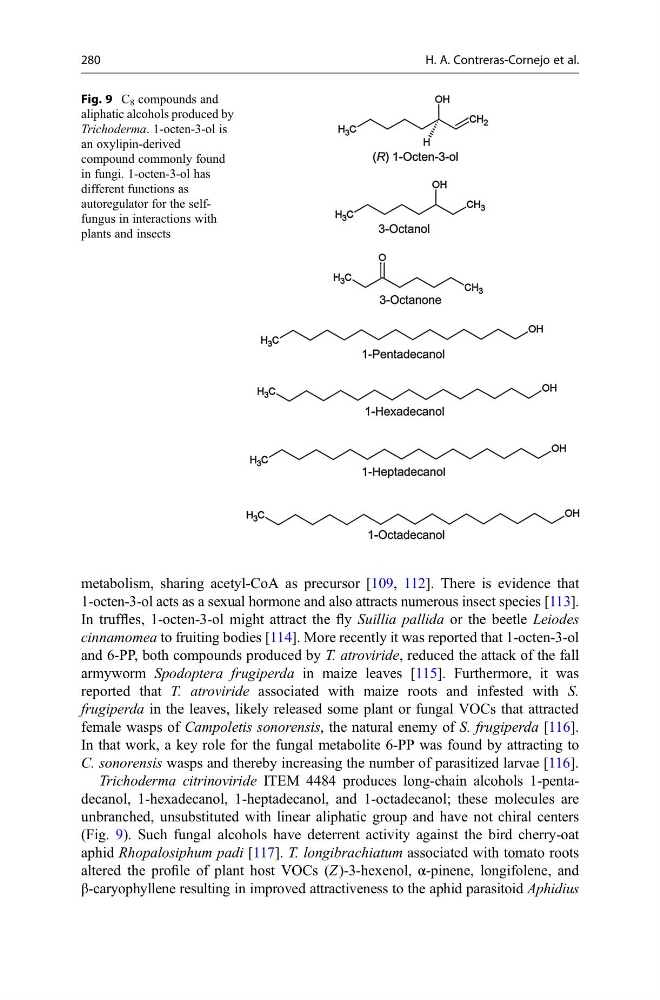
Trichoderma citrinoviride ITEM 4484 produces long-chain alcohols 1-pentadecanol, 1-hexadecanol, 1-heptadecanol, and 1-octadecanol; these molecules are
unbranched, unsubstituted with linear aliphatic group and have not chiral centers
(Fig. 9). Such fungal alcohols have deterrent activity against the bird cherry-oat
aphid Rhopalosiphum padi [117]. T. longibrachiatum associated with tomato roots
altered the profile of plant host VOCs (Z )-3-hexenol, α-pinene, longifolene, and
β-caryophyllene resulting in improved attractiveness to the aphid parasitoid Aphidius
Fig. 9 C 8 compounds and
aliphatic alcohols produced by
Trichoderma. 1-octen-3-ol is
an oxylipin-derived
compound commonly found
in fungi. 1-octen-3-ol has
different functions as
autoregulator for the selffungus in interactions with
plants and insects
280
H. A. Contreras-Cornejo et al.
1-octen-3-ol acts as a sexual hormone and also attracts numerous insect species [113].
In truffles, 1-octen-3-ol might attract the fly Suillia pallida or the beetle Leiodes
cinnamomea to fruiting bodies [114]. More recently it was reported that 1-octen-3-ol
and 6-PP, both compounds produced by T. atroviride, reduced the attack of the fall
armyworm Spodoptera frugiperda in maize leaves [115]. Furthermore, it was
reported that T. atroviride associated with maize roots and infested with S.
frugiperda in the leaves, likely released some plant or fungal VOCs that attracted
female wasps of Campoletis sonorensis, the natural enemy of S. frugiperda [116].
In that work, a key role for the fungal metabolite 6-PP was found by attracting to
C. sonorensis wasps and thereby increasing the number of parasitized larvae [116].
Trichoderma citrinoviride ITEM 4484 produces long-chain alcohols 1-pentadecanol, 1-hexadecanol, 1-heptadecanol, and 1-octadecanol; these molecules are
unbranched, unsubstituted with linear aliphatic group and have not chiral centers
(Fig. 9). Such fungal alcohols have deterrent activity against the bird cherry-oat
aphid Rhopalosiphum padi [117]. T. longibrachiatum associated with tomato roots
altered the profile of plant host VOCs (Z )-3-hexenol, α-pinene, longifolene, and
β-caryophyllene resulting in improved attractiveness to the aphid parasitoid Aphidius
Fig. 9 C 8 compounds and
aliphatic alcohols produced by
Trichoderma. 1-octen-3-ol is
an oxylipin-derived
compound commonly found
in fungi. 1-octen-3-ol has
different functions as
autoregulator for the selffungus in interactions with
plants and insects
280
H. A. Contreras-Cornejo et al.