

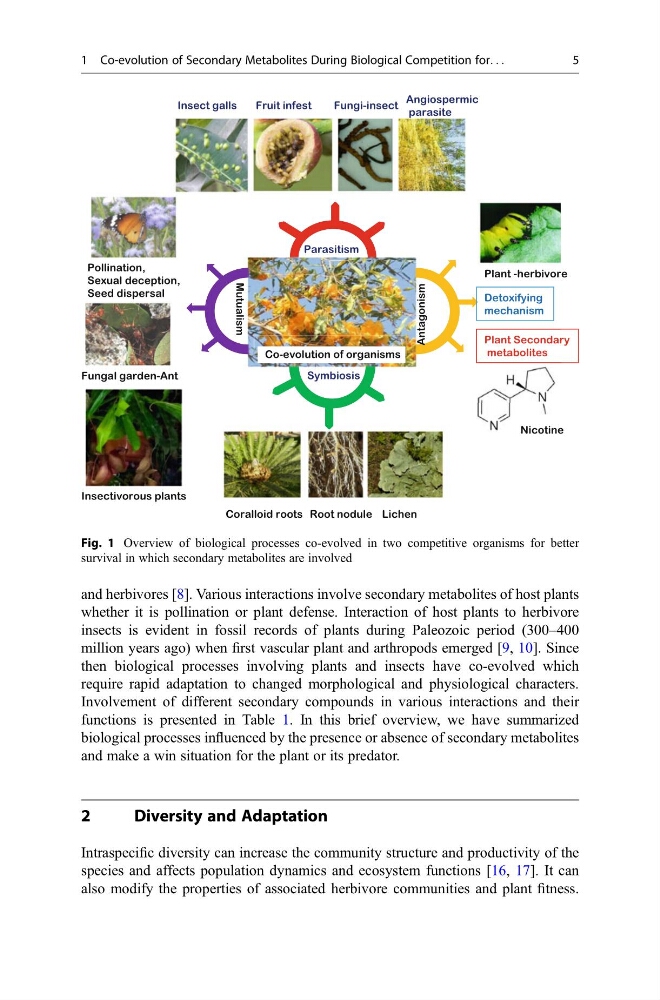
and herbivores [8]. Various interactions involve secondary metabolites of host plants
whether it is pollination or plant defense. Interaction of host plants to herbivore
insects is evident in fossil records of plants during Paleozoic period (300–400
million years ago) when first vascular plant and arthropods emerged [9, 10]. Since
then biological processes involving plants and insects have co-evolved which
require rapid adaptation to changed morphological and physiological characters.
Involvement of different secondary compounds in various interactions and their
functions is presented in Table 1. In this brief overview, we have summarized
biological processes influenced by the presence or absence of secondary metabolites
and make a win situation for the plant or its predator.
2
Diversity and Adaptation
Intraspecific diversity can increase the community structure and productivity of the
species and affects population dynamics and ecosystem functions [16, 17]. It can
also modify the properties of associated herbivore communities and plant fitness.
Antagonism
Mutualism
Coralloid roots
Insect galls
Angiospermic
parasite
Fungi-insect
Fruit infest
Root nodule Lichen
Plant -herbivore
Plant Secondary
metabolites
Detoxifying
mechanism
Fungal garden-Ant
Insectivorous plants
Pollination,
Sexual deception,
Seed dispersal
Nicotine
Parasitism
Symbiosis
Anta A
gonism
Mutualism
Plant -herbivor
Plant Secondar
metabolites
Detoxify f f ing
mechanism
Fungal garden-Ant
nsectivorous plants
Pollination,
Sexual deception,
Seed dispersal
Nicotine
Parasitism
Symbiosis
Co-evolution of organisms
Fig. 1 Overview of biological processes co-evolved in two competitive organisms for better
survival in which secondary metabolites are involved
1 Co-evolution of Secondary Metabolites During Biological Competition for. . .
5
whether it is pollination or plant defense. Interaction of host plants to herbivore
insects is evident in fossil records of plants during Paleozoic period (300–400
million years ago) when first vascular plant and arthropods emerged [9, 10]. Since
then biological processes involving plants and insects have co-evolved which
require rapid adaptation to changed morphological and physiological characters.
Involvement of different secondary compounds in various interactions and their
functions is presented in Table 1. In this brief overview, we have summarized
biological processes influenced by the presence or absence of secondary metabolites
and make a win situation for the plant or its predator.
2
Diversity and Adaptation
Intraspecific diversity can increase the community structure and productivity of the
species and affects population dynamics and ecosystem functions [16, 17]. It can
also modify the properties of associated herbivore communities and plant fitness.
Antagonism
Mutualism
Coralloid roots
Insect galls
Angiospermic
parasite
Fungi-insect
Fruit infest
Root nodule Lichen
Plant -herbivore
Plant Secondary
metabolites
Detoxifying
mechanism
Fungal garden-Ant
Insectivorous plants
Pollination,
Sexual deception,
Seed dispersal
Nicotine
Parasitism
Symbiosis
Anta A
gonism
Mutualism
Plant -herbivor
Plant Secondar
metabolites
Detoxify f f ing
mechanism
Fungal garden-Ant
nsectivorous plants
Pollination,
Sexual deception,
Seed dispersal
Nicotine
Parasitism
Symbiosis
Co-evolution of organisms
Fig. 1 Overview of biological processes co-evolved in two competitive organisms for better
survival in which secondary metabolites are involved
1 Co-evolution of Secondary Metabolites During Biological Competition for. . .
5