

5.1.6 Fusarins
Fusarins A, C, and D are a group of SMs built of a polyene chain linked to the
2-pyrrolidone ring. Additionally, fusarin C contains an epoxide group on the pyrrolidone
ring, unlike fusarins A and D. First report on fusarin C produced by maize pathogen
F. moniliforme (now F. verticillioides) has been published in 1981 in North America
[184]. These mycotoxins are also produced by other Fusaria, e.g., F. fujikuroi,
F. graminearum, and F. venenatum [167, 171, 185, 186]. Toxicity of fusarin C was
not very widely investigated, but it was recognized by the International Agency for
Research on Cancer as possible carcinogenic for human [187, 188]. Its mutagenic
effect is probably related to the interaction of the epoxide group with DNA [189].
Enzymes involved in fusarin C biosynthesis are encoded by nine genes included
in the FUS cluster. There are two versions of the FUS cluster organization. The first
scheme is represented by F. fujikuroi, F. verticillioides, and F. graminearum, where
the FUS1-FUS9 genes are arranged one after another. The second one occurs in F.
solani and in F. circinatum (which does not produce fusarins), where the genes
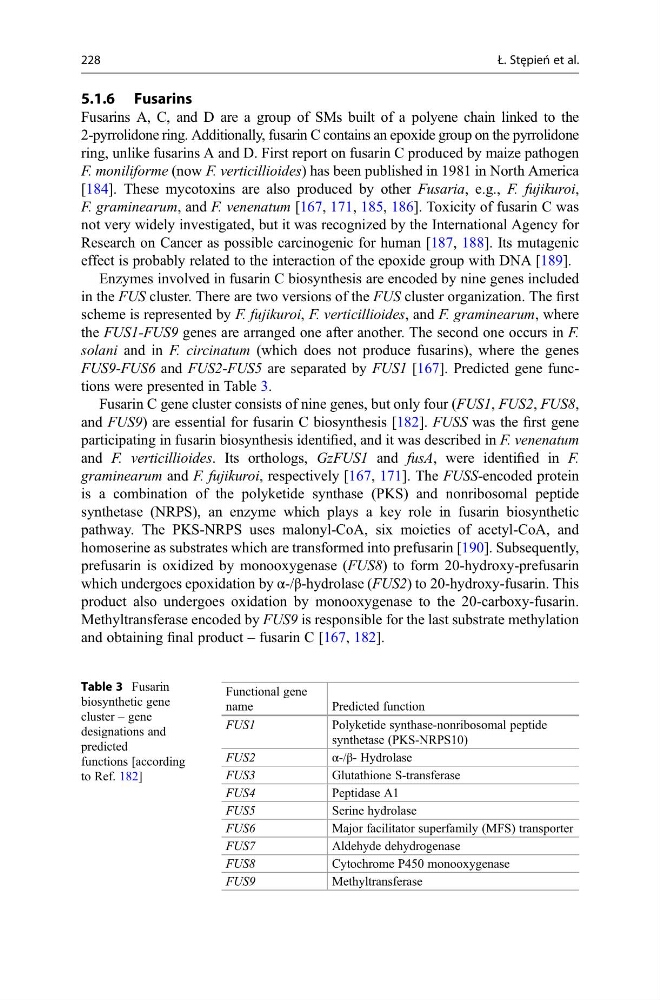
FUS9-FUS6 and FUS2-FUS5 are separated by FUS1 [167]. Predicted gene functions were presented in Table 3.
Fusarin C gene cluster consists of nine genes, but only four (FUS1, FUS2, FUS8,
and FUS9) are essential for fusarin C biosynthesis [182]. FUSS was the first gene
participating in fusarin biosynthesis identified, and it was described in F. venenatum
and F. verticillioides. Its orthologs, GzFUS1 and fusA, were identified in F.
graminearum and F. fujikuroi, respectively [167, 171]. The FUSS-encoded protein
is a combination of the polyketide synthase (PKS) and nonribosomal peptide
synthetase (NRPS), an enzyme which plays a key role in fusarin biosynthetic
pathway. The PKS-NRPS uses malonyl-CoA, six moieties of acetyl-CoA, and
homoserine as substrates which are transformed into prefusarin [190]. Subsequently,
prefusarin is oxidized by monooxygenase (FUS8) to form 20-hydroxy-prefusarin
which undergoes epoxidation by α-/β-hydrolase (FUS2) to 20-hydroxy-fusarin. This
product also undergoes oxidation by monooxygenase to the 20-carboxy-fusarin.
Methyltransferase encoded by FUS9 is responsible for the last substrate methylation
and obtaining final product – fusarin C [167, 182].
Table 3 Fusarin
biosynthetic gene
cluster – gene
designations and
predicted
functions [according
to Ref. 182]
Functional gene
name
Predicted function
FUS1
Polyketide synthase-nonribosomal peptide
synthetase (PKS-NRPS10)
FUS2
α-/β- Hydrolase
FUS3
Glutathione S-transferase
FUS4
Peptidase A1
FUS5
Serine hydrolase
FUS6
Major facilitator superfamily (MFS) transporter
FUS7
Aldehyde dehydrogenase
FUS8
Cytochrome P450 monooxygenase
FUS9
Methyltransferase
228
Ł. Stępień et al.
Fusarins A, C, and D are a group of SMs built of a polyene chain linked to the
2-pyrrolidone ring. Additionally, fusarin C contains an epoxide group on the pyrrolidone
ring, unlike fusarins A and D. First report on fusarin C produced by maize pathogen
F. moniliforme (now F. verticillioides) has been published in 1981 in North America
[184]. These mycotoxins are also produced by other Fusaria, e.g., F. fujikuroi,
F. graminearum, and F. venenatum [167, 171, 185, 186]. Toxicity of fusarin C was
not very widely investigated, but it was recognized by the International Agency for
Research on Cancer as possible carcinogenic for human [187, 188]. Its mutagenic
effect is probably related to the interaction of the epoxide group with DNA [189].
Enzymes involved in fusarin C biosynthesis are encoded by nine genes included
in the FUS cluster. There are two versions of the FUS cluster organization. The first
scheme is represented by F. fujikuroi, F. verticillioides, and F. graminearum, where
the FUS1-FUS9 genes are arranged one after another. The second one occurs in F.
solani and in F. circinatum (which does not produce fusarins), where the genes
FUS9-FUS6 and FUS2-FUS5 are separated by FUS1 [167]. Predicted gene functions were presented in Table 3.
Fusarin C gene cluster consists of nine genes, but only four (FUS1, FUS2, FUS8,
and FUS9) are essential for fusarin C biosynthesis [182]. FUSS was the first gene
participating in fusarin biosynthesis identified, and it was described in F. venenatum
and F. verticillioides. Its orthologs, GzFUS1 and fusA, were identified in F.
graminearum and F. fujikuroi, respectively [167, 171]. The FUSS-encoded protein
is a combination of the polyketide synthase (PKS) and nonribosomal peptide
synthetase (NRPS), an enzyme which plays a key role in fusarin biosynthetic
pathway. The PKS-NRPS uses malonyl-CoA, six moieties of acetyl-CoA, and
homoserine as substrates which are transformed into prefusarin [190]. Subsequently,
prefusarin is oxidized by monooxygenase (FUS8) to form 20-hydroxy-prefusarin
which undergoes epoxidation by α-/β-hydrolase (FUS2) to 20-hydroxy-fusarin. This
product also undergoes oxidation by monooxygenase to the 20-carboxy-fusarin.
Methyltransferase encoded by FUS9 is responsible for the last substrate methylation
and obtaining final product – fusarin C [167, 182].
Table 3 Fusarin
biosynthetic gene
cluster – gene
designations and
predicted
functions [according
to Ref. 182]
Functional gene
name
Predicted function
FUS1
Polyketide synthase-nonribosomal peptide
synthetase (PKS-NRPS10)
FUS2
α-/β- Hydrolase
FUS3
Glutathione S-transferase
FUS4
Peptidase A1
FUS5
Serine hydrolase
FUS6
Major facilitator superfamily (MFS) transporter
FUS7
Aldehyde dehydrogenase
FUS8
Cytochrome P450 monooxygenase
FUS9
Methyltransferase
228
Ł. Stępień et al.