

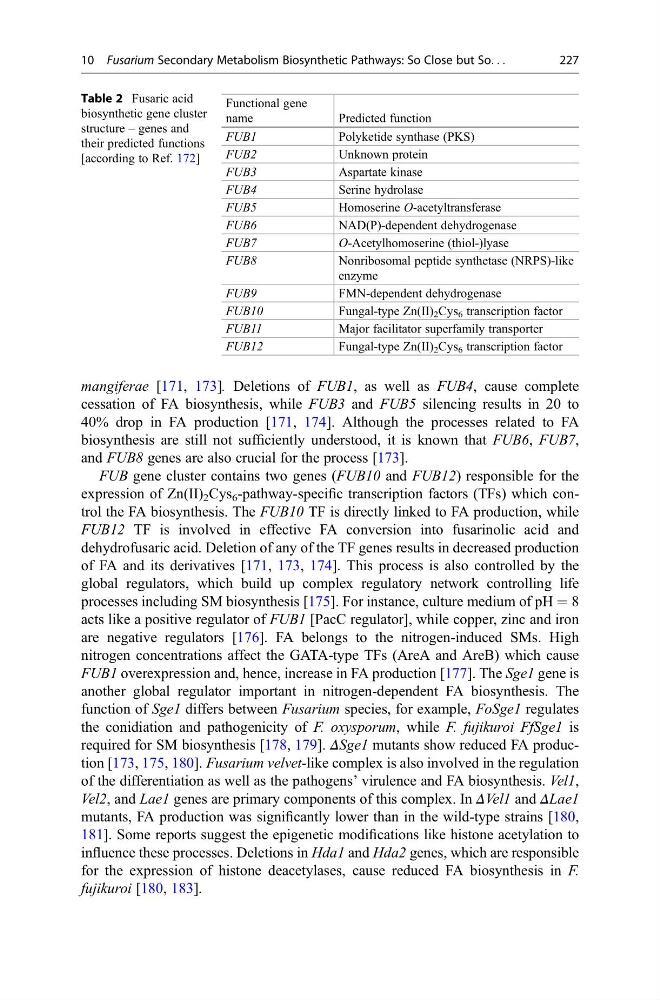
mangiferae [171, 173]. Deletions of FUB1, as well as FUB4, cause complete
cessation of FA biosynthesis, while FUB3 and FUB5 silencing results in 20 to
40% drop in FA production [171, 174]. Although the processes related to FA
biosynthesis are still not sufficiently understood, it is known that FUB6, FUB7,
and FUB8 genes are also crucial for the process [173].
FUB gene cluster contains two genes (FUB10 and FUB12) responsible for the
expression of Zn(II) 2 Cys 6 -pathway-specific transcription factors (TFs) which control the FA biosynthesis. The FUB10 TF is directly linked to FA production, while
FUB12 TF is involved in effective FA conversion into fusarinolic acid and
dehydrofusaric acid. Deletion of any of the TF genes results in decreased production
of FA and its derivatives [171, 173, 174]. This process is also controlled by the
global regulators, which build up complex regulatory network controlling life
processes including SM biosynthesis [175]. For instance, culture medium of pH = 8
acts like a positive regulator of FUB1 [PacC regulator], while copper, zinc and iron
are negative regulators [176]. FA belongs to the nitrogen-induced SMs. High
nitrogen concentrations affect the GATA-type TFs (AreA and AreB) which cause
FUB1 overexpression and, hence, increase in FA production [177]. The Sge1 gene is
another global regulator important in nitrogen-dependent FA biosynthesis. The
function of Sge1 differs between Fusarium species, for example, FoSge1 regulates
the conidiation and pathogenicity of F. oxysporum, while F. fujikuroi FfSge1 is
required for SM biosynthesis [178, 179]. ΔSge1 mutants show reduced FA production [173, 175, 180]. Fusarium velvet-like complex is also involved in the regulation
of the differentiation as well as the pathogens’ virulence and FA biosynthesis. Vel1,
Vel2, and Lae1 genes are primary components of this complex. In ΔVel1 and ΔLae1
mutants, FA production was significantly lower than in the wild-type strains [180,
181]. Some reports suggest the epigenetic modifications like histone acetylation to
influence these processes. Deletions in Hda1 and Hda2 genes, which are responsible
for the expression of histone deacetylases, cause reduced FA biosynthesis in F.
fujikuroi [180, 183].
Table 2 Fusaric acid
biosynthetic gene cluster
structure – genes and
their predicted functions
[according to Ref. 172]
Functional gene
name
Predicted function
FUB1
Polyketide synthase (PKS)
FUB2
Unknown protein
FUB3
Aspartate kinase
FUB4
Serine hydrolase
FUB5
Homoserine O-acetyltransferase
FUB6
NAD(P)-dependent dehydrogenase
FUB7
O-Acetylhomoserine (thiol-)lyase
FUB8
Nonribosomal peptide synthetase (NRPS)-like
enzyme
FUB9
FMN-dependent dehydrogenase
FUB10
Fungal-type Zn(II) 2 Cys 6 transcription factor
FUB11
Major facilitator superfamily transporter
FUB12
Fungal-type Zn(II) 2 Cys 6 transcription factor
10 Fusarium Secondary Metabolism Biosynthetic Pathways: So Close but So. . .
227
cessation of FA biosynthesis, while FUB3 and FUB5 silencing results in 20 to
40% drop in FA production [171, 174]. Although the processes related to FA
biosynthesis are still not sufficiently understood, it is known that FUB6, FUB7,
and FUB8 genes are also crucial for the process [173].
FUB gene cluster contains two genes (FUB10 and FUB12) responsible for the
expression of Zn(II) 2 Cys 6 -pathway-specific transcription factors (TFs) which control the FA biosynthesis. The FUB10 TF is directly linked to FA production, while
FUB12 TF is involved in effective FA conversion into fusarinolic acid and
dehydrofusaric acid. Deletion of any of the TF genes results in decreased production
of FA and its derivatives [171, 173, 174]. This process is also controlled by the
global regulators, which build up complex regulatory network controlling life
processes including SM biosynthesis [175]. For instance, culture medium of pH = 8
acts like a positive regulator of FUB1 [PacC regulator], while copper, zinc and iron
are negative regulators [176]. FA belongs to the nitrogen-induced SMs. High
nitrogen concentrations affect the GATA-type TFs (AreA and AreB) which cause
FUB1 overexpression and, hence, increase in FA production [177]. The Sge1 gene is
another global regulator important in nitrogen-dependent FA biosynthesis. The
function of Sge1 differs between Fusarium species, for example, FoSge1 regulates
the conidiation and pathogenicity of F. oxysporum, while F. fujikuroi FfSge1 is
required for SM biosynthesis [178, 179]. ΔSge1 mutants show reduced FA production [173, 175, 180]. Fusarium velvet-like complex is also involved in the regulation
of the differentiation as well as the pathogens’ virulence and FA biosynthesis. Vel1,
Vel2, and Lae1 genes are primary components of this complex. In ΔVel1 and ΔLae1
mutants, FA production was significantly lower than in the wild-type strains [180,
181]. Some reports suggest the epigenetic modifications like histone acetylation to
influence these processes. Deletions in Hda1 and Hda2 genes, which are responsible
for the expression of histone deacetylases, cause reduced FA biosynthesis in F.
fujikuroi [180, 183].
Table 2 Fusaric acid
biosynthetic gene cluster
structure – genes and
their predicted functions
[according to Ref. 172]
Functional gene
name
Predicted function
FUB1
Polyketide synthase (PKS)
FUB2
Unknown protein
FUB3
Aspartate kinase
FUB4
Serine hydrolase
FUB5
Homoserine O-acetyltransferase
FUB6
NAD(P)-dependent dehydrogenase
FUB7
O-Acetylhomoserine (thiol-)lyase
FUB8
Nonribosomal peptide synthetase (NRPS)-like
enzyme
FUB9
FMN-dependent dehydrogenase
FUB10
Fungal-type Zn(II) 2 Cys 6 transcription factor
FUB11
Major facilitator superfamily transporter
FUB12
Fungal-type Zn(II) 2 Cys 6 transcription factor
10 Fusarium Secondary Metabolism Biosynthetic Pathways: So Close but So. . .
227