

The major group of these organic compounds which are found in lichens are
products of secondary metabolism. The amount of secondary metabolites varies
usually between 0.1% to 10% of dry weight of thallus but sometimes up to 30%
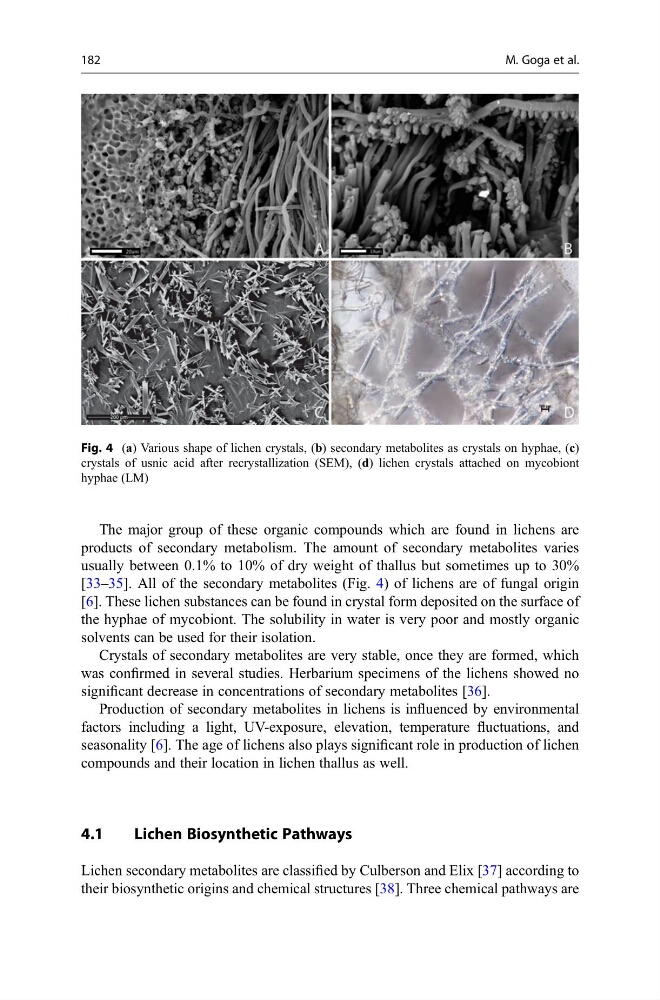
[33–35]. All of the secondary metabolites (Fig. 4) of lichens are of fungal origin
[6]. These lichen substances can be found in crystal form deposited on the surface of
the hyphae of mycobiont. The solubility in water is very poor and mostly organic
solvents can be used for their isolation.
Crystals of secondary metabolites are very stable, once they are formed, which
was confirmed in several studies. Herbarium specimens of the lichens showed no
significant decrease in concentrations of secondary metabolites [36].
Production of secondary metabolites in lichens is influenced by environmental
factors including a light, UV-exposure, elevation, temperature fluctuations, and
seasonality [6]. The age of lichens also plays significant role in production of lichen
compounds and their location in lichen thallus as well.
4.1
Lichen Biosynthetic Pathways
Lichen secondary metabolites are classified by Culberson and Elix [37] according to
their biosynthetic origins and chemical structures [38]. Three chemical pathways are
Fig. 4 (a) Various shape of lichen crystals, (b) secondary metabolites as crystals on hyphae, (c)
crystals of usnic acid after recrystallization (SEM), (d) lichen crystals attached on mycobiont
hyphae (LM)
182
M. Goga et al.
products of secondary metabolism. The amount of secondary metabolites varies
usually between 0.1% to 10% of dry weight of thallus but sometimes up to 30%
[33–35]. All of the secondary metabolites (Fig. 4) of lichens are of fungal origin
[6]. These lichen substances can be found in crystal form deposited on the surface of
the hyphae of mycobiont. The solubility in water is very poor and mostly organic
solvents can be used for their isolation.
Crystals of secondary metabolites are very stable, once they are formed, which
was confirmed in several studies. Herbarium specimens of the lichens showed no
significant decrease in concentrations of secondary metabolites [36].
Production of secondary metabolites in lichens is influenced by environmental
factors including a light, UV-exposure, elevation, temperature fluctuations, and
seasonality [6]. The age of lichens also plays significant role in production of lichen
compounds and their location in lichen thallus as well.
4.1
Lichen Biosynthetic Pathways
Lichen secondary metabolites are classified by Culberson and Elix [37] according to
their biosynthetic origins and chemical structures [38]. Three chemical pathways are
Fig. 4 (a) Various shape of lichen crystals, (b) secondary metabolites as crystals on hyphae, (c)
crystals of usnic acid after recrystallization (SEM), (d) lichen crystals attached on mycobiont
hyphae (LM)
182
M. Goga et al.