

and secondary (extracellular). More than 1000 lichen substances are already known.
The isolation, identification, and structures are described in the handbook of Huneck
and Yoshimura [29].
Into the products of primary metabolism, we can include amino acids, amines,
peptides, proteins, polyols, saccharides (mono-, oligo-, poly-) carotenoids, and
vitamins, which are bound in the cell walls and the protoplasts. Most of them are
soluble in water and can be extracted with boiling water [30]. Some of the primary
metabolites are produced by fungal and some of them by photosynthetic partner.
Many of these primary metabolites are not specific only for lichens and can be easily
found in free-living fungi, algae, as well as higher plants [31]. Lichens dispose a
similar amount of free amino acids as do the other plants. Lichen thallus present from
1.6% to 11.4% dry weight of nitrogen compounds [31], 1.5 to 24 mg/g dry weight of
carotenoids, and 3–5% dry weight of polysaccharides [32].
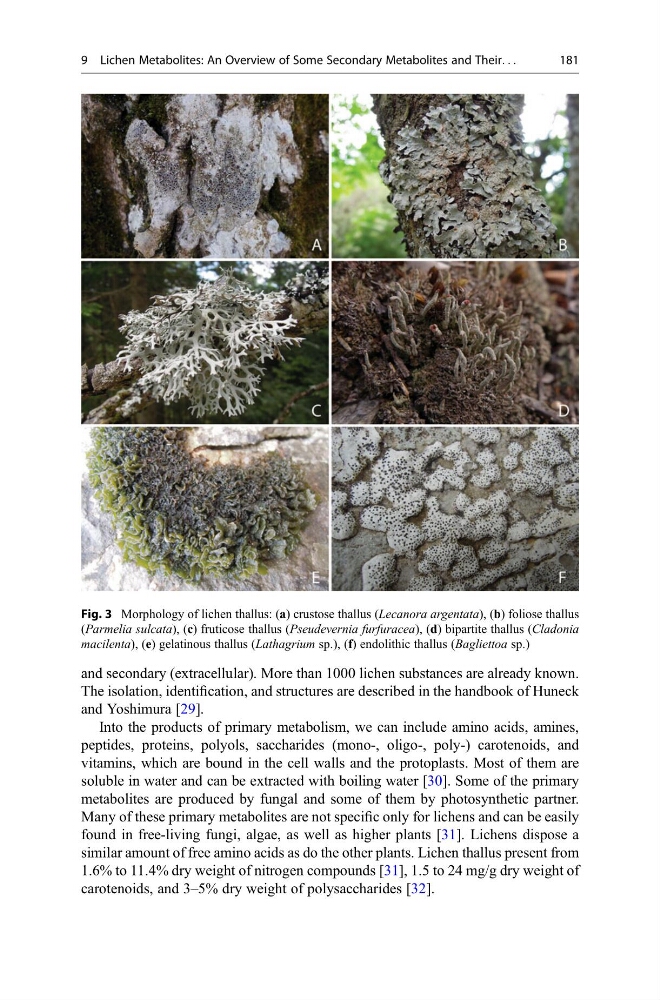
Fig. 3 Morphology of lichen thallus: (a) crustose thallus (Lecanora argentata), (b) foliose thallus
(Parmelia sulcata), (c) fruticose thallus (Pseudevernia furfuracea), (d) bipartite thallus (Cladonia
macilenta), (e) gelatinous thallus (Lathagrium sp.), (f) endolithic thallus (Bagliettoa sp.)
9 Lichen Metabolites: An Overview of Some Secondary Metabolites and Their. . .
181
The isolation, identification, and structures are described in the handbook of Huneck
and Yoshimura [29].
Into the products of primary metabolism, we can include amino acids, amines,
peptides, proteins, polyols, saccharides (mono-, oligo-, poly-) carotenoids, and
vitamins, which are bound in the cell walls and the protoplasts. Most of them are
soluble in water and can be extracted with boiling water [30]. Some of the primary
metabolites are produced by fungal and some of them by photosynthetic partner.
Many of these primary metabolites are not specific only for lichens and can be easily
found in free-living fungi, algae, as well as higher plants [31]. Lichens dispose a
similar amount of free amino acids as do the other plants. Lichen thallus present from
1.6% to 11.4% dry weight of nitrogen compounds [31], 1.5 to 24 mg/g dry weight of
carotenoids, and 3–5% dry weight of polysaccharides [32].
Fig. 3 Morphology of lichen thallus: (a) crustose thallus (Lecanora argentata), (b) foliose thallus
(Parmelia sulcata), (c) fruticose thallus (Pseudevernia furfuracea), (d) bipartite thallus (Cladonia
macilenta), (e) gelatinous thallus (Lathagrium sp.), (f) endolithic thallus (Bagliettoa sp.)
9 Lichen Metabolites: An Overview of Some Secondary Metabolites and Their. . .
181