

improvement of their fitness to a common environment (Posidonia oceanica leaves),
as in the case of the rapid sex shift exhibited by the model shrimp. The described
process is due to a very specific apoptogenic effect, physiologically restricted by the
shrimp to the tissues of its A.G., as an adaptation to the generic apoptogenic activity
[67] triggered by diatoms for anti-grazing purposes [68]. These observations indicate
the need to distinguish between the concept of “competitive co-evolution” [4], as an
agonist alternative to the “cooperation co-evolution” taking into account that a
continuous range of intermediate adaptations may be documented in various
organisms.
Acknowledgments The English text was kindly revised by Mrs. R. Messina.
References
1. Dubilier N, Bergin C, Lott C (2008) Symbiotic diversity in marine animals: the art of harnessing
chemosynthesis. Nat Rev Microbiol 6:725–740
2. Ehrlich PR, Raven PH (1964) Butterflies and plants: a study in coevolution. Evolution
18:586–608
3. Ehrlich PR (1958) The comparative morphology, phylogeny and higher classification of the
butterflies (Lepidoptera: Papilionoidea). Univ Kansas Sci Bull 39:305–370
4. Nuismer S (2018) Introduction to coevolutionary theory. ISBN-10: 1-319-12981-1; ISBN-13:
978-1-319-12981-1
5. Perc M, Szolnoki A (2010) Coevolutionary games – a mini review. Biosystems 99:109–125
6. Axelrod R, Hamilton WD (1981) The evolution of cooperation. Science 211:1390–1396
7. Dethier VG (1954) Evolution of feeding preferences in phytophagous insects. Evolution
8:33–54
8. Lubchenco J, Gaines SD (1981) A unified approach to marine plant-herbivore interactions.
I. Populations and communities. Annu Rev Ecol Syst 12:405–437
9. Cronin G, Hay ME (1996) Susceptibility to herbivores depends on recent history of both plant
and animal. Ecology 77(5):1531–1537
10. Fontana A, d’Ippolito G, Cutignano A, Romano G, Lamari N, Gallucci AM, Cimino G,
Miralto A, Ianora A (2007) LOX-induced lipid peroxidation mechanism responsible for the
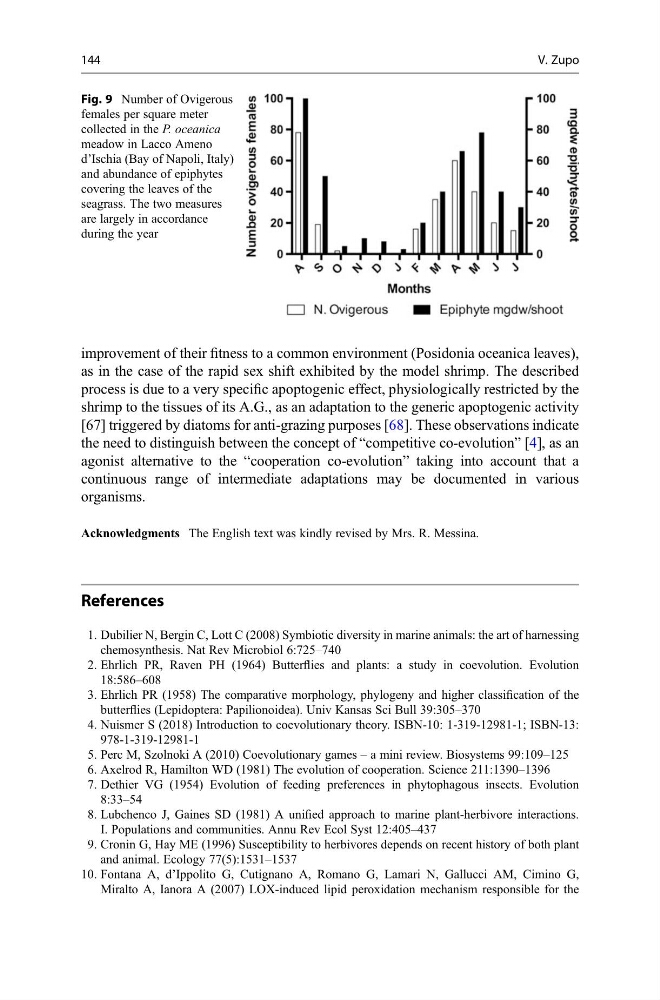
Fig. 9 Number of Ovigerous
females per square meter
collected in the P. oceanica
meadow in Lacco Ameno
d’Ischia (Bay of Napoli, Italy)
and abundance of epiphytes
covering the leaves of the
seagrass. The two measures
are largely in accordance
during the year
144
V. Zupo
as in the case of the rapid sex shift exhibited by the model shrimp. The described
process is due to a very specific apoptogenic effect, physiologically restricted by the
shrimp to the tissues of its A.G., as an adaptation to the generic apoptogenic activity
[67] triggered by diatoms for anti-grazing purposes [68]. These observations indicate
the need to distinguish between the concept of “competitive co-evolution” [4], as an
agonist alternative to the “cooperation co-evolution” taking into account that a
continuous range of intermediate adaptations may be documented in various
organisms.
Acknowledgments The English text was kindly revised by Mrs. R. Messina.
References
1. Dubilier N, Bergin C, Lott C (2008) Symbiotic diversity in marine animals: the art of harnessing
chemosynthesis. Nat Rev Microbiol 6:725–740
2. Ehrlich PR, Raven PH (1964) Butterflies and plants: a study in coevolution. Evolution
18:586–608
3. Ehrlich PR (1958) The comparative morphology, phylogeny and higher classification of the
butterflies (Lepidoptera: Papilionoidea). Univ Kansas Sci Bull 39:305–370
4. Nuismer S (2018) Introduction to coevolutionary theory. ISBN-10: 1-319-12981-1; ISBN-13:
978-1-319-12981-1
5. Perc M, Szolnoki A (2010) Coevolutionary games – a mini review. Biosystems 99:109–125
6. Axelrod R, Hamilton WD (1981) The evolution of cooperation. Science 211:1390–1396
7. Dethier VG (1954) Evolution of feeding preferences in phytophagous insects. Evolution
8:33–54
8. Lubchenco J, Gaines SD (1981) A unified approach to marine plant-herbivore interactions.
I. Populations and communities. Annu Rev Ecol Syst 12:405–437
9. Cronin G, Hay ME (1996) Susceptibility to herbivores depends on recent history of both plant
and animal. Ecology 77(5):1531–1537
10. Fontana A, d’Ippolito G, Cutignano A, Romano G, Lamari N, Gallucci AM, Cimino G,
Miralto A, Ianora A (2007) LOX-induced lipid peroxidation mechanism responsible for the
Fig. 9 Number of Ovigerous
females per square meter
collected in the P. oceanica
meadow in Lacco Ameno
d’Ischia (Bay of Napoli, Italy)
and abundance of epiphytes
covering the leaves of the
seagrass. The two measures
are largely in accordance
during the year
144
V. Zupo