

co-evolution studies, some generalities can be drawn from the observed patterns, if
we wish to understand the arrangements of use of different plant groups by invertebrates, to understand general forces ruling their co-evolutionary adaptations. In
particular, the case here reported indicates that in the frame of “competitive coevolution”, the chemical weapons produced by a species may be used for different
purposes by their competitors/consumers, even without incorporating or modifying
their structure [16, 17], but simply evolving physiological adaptations that lead to
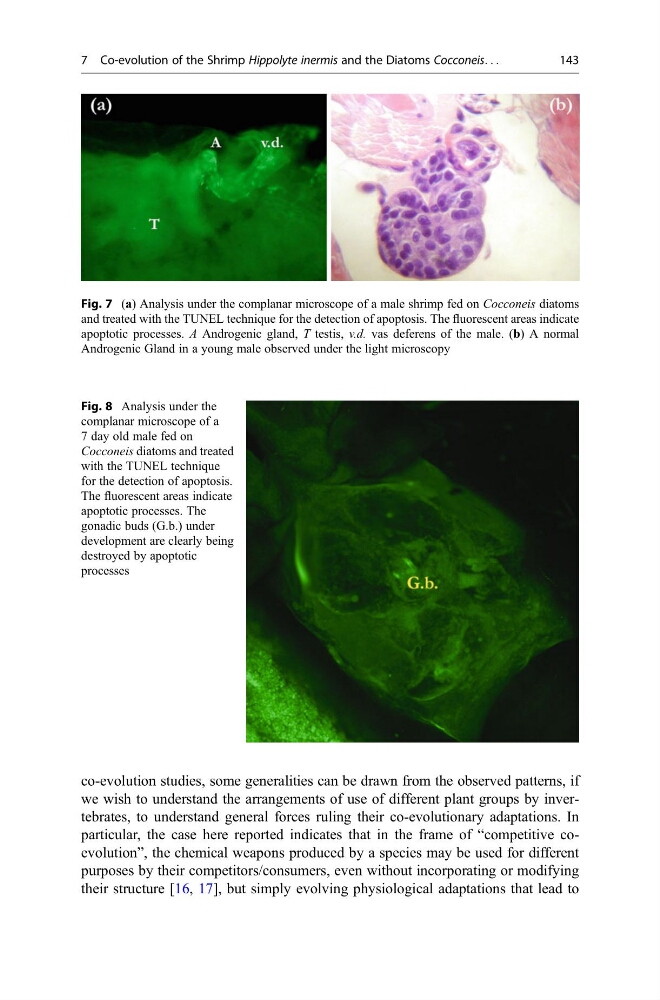
Fig. 7 (a) Analysis under the complanar microscope of a male shrimp fed on Cocconeis diatoms
and treated with the TUNEL technique for the detection of apoptosis. The fluorescent areas indicate
apoptotic processes. A Androgenic gland, T testis, v.d. vas deferens of the male. (b) A normal
Androgenic Gland in a young male observed under the light microscopy
Fig. 8 Analysis under the
complanar microscope of a
7 day old male fed on
Cocconeis diatoms and treated
with the TUNEL technique
for the detection of apoptosis.
The fluorescent areas indicate
apoptotic processes. The
gonadic buds (G.b.) under
development are clearly being
destroyed by apoptotic
processes
7 Co-evolution of the Shrimp Hippolyte inermis and the Diatoms Cocconeis. . .
143
we wish to understand the arrangements of use of different plant groups by invertebrates, to understand general forces ruling their co-evolutionary adaptations. In
particular, the case here reported indicates that in the frame of “competitive coevolution”, the chemical weapons produced by a species may be used for different
purposes by their competitors/consumers, even without incorporating or modifying
their structure [16, 17], but simply evolving physiological adaptations that lead to
Fig. 7 (a) Analysis under the complanar microscope of a male shrimp fed on Cocconeis diatoms
and treated with the TUNEL technique for the detection of apoptosis. The fluorescent areas indicate
apoptotic processes. A Androgenic gland, T testis, v.d. vas deferens of the male. (b) A normal
Androgenic Gland in a young male observed under the light microscopy
Fig. 8 Analysis under the
complanar microscope of a
7 day old male fed on
Cocconeis diatoms and treated
with the TUNEL technique
for the detection of apoptosis.
The fluorescent areas indicate
apoptotic processes. The
gonadic buds (G.b.) under
development are clearly being
destroyed by apoptotic
processes
7 Co-evolution of the Shrimp Hippolyte inermis and the Diatoms Cocconeis. . .
143