

shrimps normally develop an A.G. in the first phases of their post-larval life and loose
it during their life. While the gland regresses, testis tissues are transformed into an
ovary. During the process a new intermediate gonadic stage named “ovotestis” is
produced and this phase is stabilized in some species, producing contemporary
hermaphroditism [60]. In H. inermis the destruction of the A.G. is a very rapid
process, often completed during a single molting cycle, and it leads to the rapid sex
shift to female sex [61]. The sex reversal was initially supposed to be completed after
about 1 year [62], as observed in other hippolytid shrimps. In contrast, it has been
demonstrated [53] that the shrimp is characterized by two reproduction bursts (in
spring and in fall) exhibiting very different properties. Individuals born in spring feed
on diatoms of the genus Cocconeis [63] and they develop both as males and females,
appearing as a gonochoristic species [64]. Individuals born in fall are out of the
Cocconeis blooms on Posidonia leaves and their guts do not contain these diatoms
[63]. They produce young males (Fig. 6), that shift their sex to females after about 1
year [53], according to a proterandric strategy.
It has been demonstrated [54] that the process observed in spring is due to the
apoptosis of the A.G., triggered by compounds present in the ingested diatoms, able
to destroy selectively the gland tissues (Fig. 7). The process is rather rapid (it takes
place from the 5th to the 12th day of post-larval growth [44] and it is immediately
followed by the destruction of the shrimp testes, along with the vas deferens (Fig. 8).
This leads to the shift to the female sex and this peculiar life strategy (double
period of reproduction with different sexual strategy applied by young individuals
and a variable proportion of resources invested in large and small females, respectively) may be viewed as a smart stratagem to increase mating opportunities and
adjust sex allocations [65, 66], seasonally, in order to improve its fitness to a high
predation pressure [53]. The process is in perfect coherence with the abundance of
epiphytes covering the leaf stratum, with which the life cycle of the shrimp is
synchronized (Fig. 9).
A M J J A S O N D J F M A M J J A S O N D J F M A
0
10
20
30
P f
P m
F1 a
F1 b
F2 a
F2 b
Y1
Y2
Y3
Month
Size (mm)
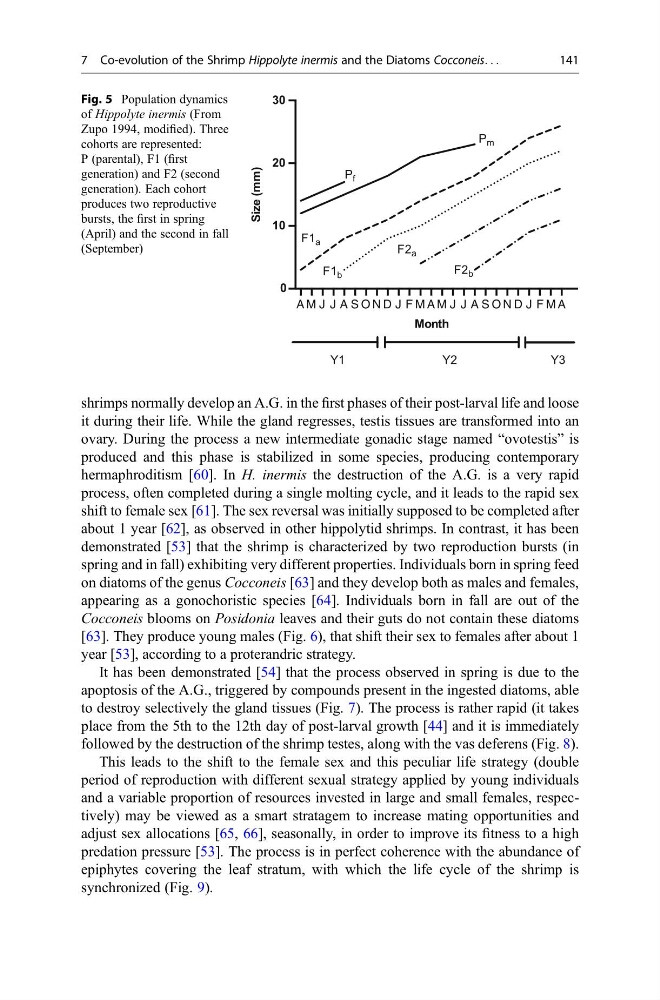
Fig. 5 Population dynamics
of Hippolyte inermis (From
Zupo 1994, modified). Three
cohorts are represented:
P (parental), F1 (first
generation) and F2 (second
generation). Each cohort
produces two reproductive
bursts, the first in spring
(April) and the second in fall
(September)
7 Co-evolution of the Shrimp Hippolyte inermis and the Diatoms Cocconeis. . .
141
it during their life. While the gland regresses, testis tissues are transformed into an
ovary. During the process a new intermediate gonadic stage named “ovotestis” is
produced and this phase is stabilized in some species, producing contemporary
hermaphroditism [60]. In H. inermis the destruction of the A.G. is a very rapid
process, often completed during a single molting cycle, and it leads to the rapid sex
shift to female sex [61]. The sex reversal was initially supposed to be completed after
about 1 year [62], as observed in other hippolytid shrimps. In contrast, it has been
demonstrated [53] that the shrimp is characterized by two reproduction bursts (in
spring and in fall) exhibiting very different properties. Individuals born in spring feed
on diatoms of the genus Cocconeis [63] and they develop both as males and females,
appearing as a gonochoristic species [64]. Individuals born in fall are out of the
Cocconeis blooms on Posidonia leaves and their guts do not contain these diatoms
[63]. They produce young males (Fig. 6), that shift their sex to females after about 1
year [53], according to a proterandric strategy.
It has been demonstrated [54] that the process observed in spring is due to the
apoptosis of the A.G., triggered by compounds present in the ingested diatoms, able
to destroy selectively the gland tissues (Fig. 7). The process is rather rapid (it takes
place from the 5th to the 12th day of post-larval growth [44] and it is immediately
followed by the destruction of the shrimp testes, along with the vas deferens (Fig. 8).
This leads to the shift to the female sex and this peculiar life strategy (double
period of reproduction with different sexual strategy applied by young individuals
and a variable proportion of resources invested in large and small females, respectively) may be viewed as a smart stratagem to increase mating opportunities and
adjust sex allocations [65, 66], seasonally, in order to improve its fitness to a high
predation pressure [53]. The process is in perfect coherence with the abundance of
epiphytes covering the leaf stratum, with which the life cycle of the shrimp is
synchronized (Fig. 9).
A M J J A S O N D J F M A M J J A S O N D J F M A
0
10
20
30
P f
P m
F1 a
F1 b
F2 a
F2 b
Y1
Y2
Y3
Month
Size (mm)
Fig. 5 Population dynamics
of Hippolyte inermis (From
Zupo 1994, modified). Three
cohorts are represented:
P (parental), F1 (first
generation) and F2 (second
generation). Each cohort
produces two reproductive
bursts, the first in spring
(April) and the second in fall
(September)
7 Co-evolution of the Shrimp Hippolyte inermis and the Diatoms Cocconeis. . .
141