

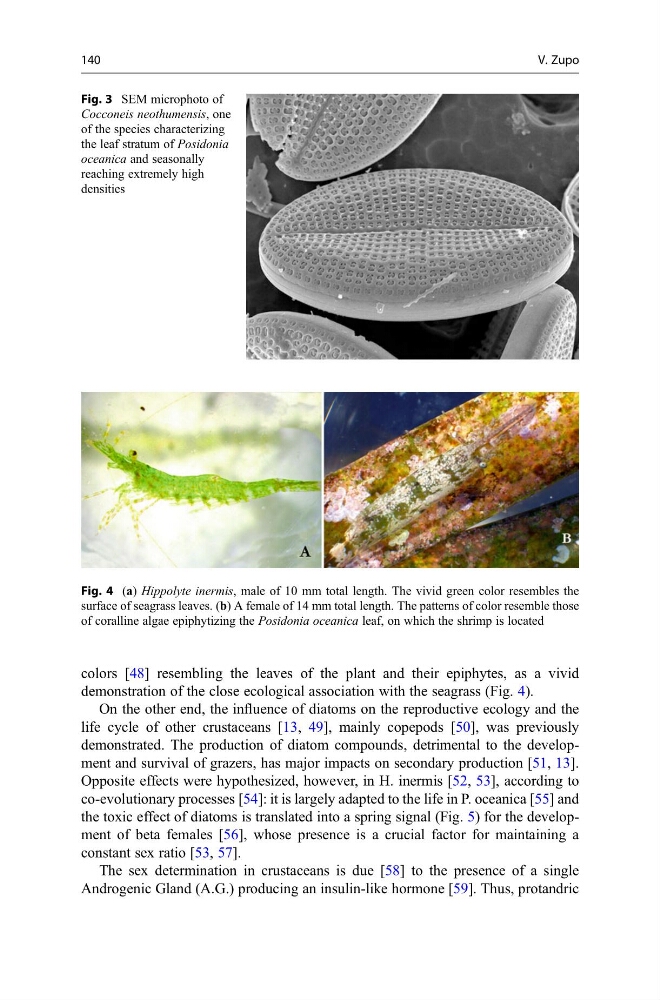
colors [48] resembling the leaves of the plant and their epiphytes, as a vivid
demonstration of the close ecological association with the seagrass (Fig. 4).
On the other end, the influence of diatoms on the reproductive ecology and the
life cycle of other crustaceans [13, 49], mainly copepods [50], was previously
demonstrated. The production of diatom compounds, detrimental to the development and survival of grazers, has major impacts on secondary production [51, 13].
Opposite effects were hypothesized, however, in H. inermis [52, 53], according to
co-evolutionary processes [54]: it is largely adapted to the life in P. oceanica [55] and
the toxic effect of diatoms is translated into a spring signal (Fig. 5) for the development of beta females [56], whose presence is a crucial factor for maintaining a
constant sex ratio [53, 57].
The sex determination in crustaceans is due [58] to the presence of a single
Androgenic Gland (A.G.) producing an insulin-like hormone [59]. Thus, protandric
Fig. 3 SEM microphoto of
Cocconeis neothumensis, one
of the species characterizing
the leaf stratum of Posidonia
oceanica and seasonally
reaching extremely high
densities
Fig. 4 (a) Hippolyte inermis, male of 10 mm total length. The vivid green color resembles the
surface of seagrass leaves. (b) A female of 14 mm total length. The patterns of color resemble those
of coralline algae epiphytizing the Posidonia oceanica leaf, on which the shrimp is located
140
V. Zupo
demonstration of the close ecological association with the seagrass (Fig. 4).
On the other end, the influence of diatoms on the reproductive ecology and the
life cycle of other crustaceans [13, 49], mainly copepods [50], was previously
demonstrated. The production of diatom compounds, detrimental to the development and survival of grazers, has major impacts on secondary production [51, 13].
Opposite effects were hypothesized, however, in H. inermis [52, 53], according to
co-evolutionary processes [54]: it is largely adapted to the life in P. oceanica [55] and
the toxic effect of diatoms is translated into a spring signal (Fig. 5) for the development of beta females [56], whose presence is a crucial factor for maintaining a
constant sex ratio [53, 57].
The sex determination in crustaceans is due [58] to the presence of a single
Androgenic Gland (A.G.) producing an insulin-like hormone [59]. Thus, protandric
Fig. 3 SEM microphoto of
Cocconeis neothumensis, one
of the species characterizing
the leaf stratum of Posidonia
oceanica and seasonally
reaching extremely high
densities
Fig. 4 (a) Hippolyte inermis, male of 10 mm total length. The vivid green color resembles the
surface of seagrass leaves. (b) A female of 14 mm total length. The patterns of color resemble those
of coralline algae epiphytizing the Posidonia oceanica leaf, on which the shrimp is located
140
V. Zupo