

of this alga in colonizing seagrass meadows. If confirmed, the allelopathic effects of
1 would become a major conservation issue, especially toward seagrass communities
that are considered the most productive and complex marine ecosystems in the
Mediterranean [14]. However, in addition to C. cylindracea, compound 1 has been
isolated from other Caulerpa species, including Caulerpa prolifera that is endemic
of the Mediterranean [15], and it has been shown to be the most abundant metabolite
of the highly invasive C. taxifolia [16]. However, differently from C. taxifolia and C.
prolifera, C. cylindracea features a drastic decrease of its biomass in winter that
could led to the caulerpenyne accumulation in the substrate leading to suppression of
possible competitors [13]. Caulerpenyne (1) also showed a panel of biological
activities of interest in pharmacology and biotechnology. It was found to be neurotoxic [17], to act as tubulin assembly inhibitor [18], antiproliferative and pro-apoptotic agent [19, 20], and as inhibitor of various enzymes, including alpha-amilase
[21], lipoxygenase [22, 23], and xanthine oxidase [24]. Among the actions of
potential ecotoxicological interest, it has been described that 1 acts as an inhibitor
of cytochrome P450 dependent activities [25], which are important for the clearance
of xenobiotics, and a potent noncompetitive inhibitor of zebrafish Oatp1d1 [26], a
protein with a crucial role in absorption, distribution, metabolism, and elimination
processes [27].
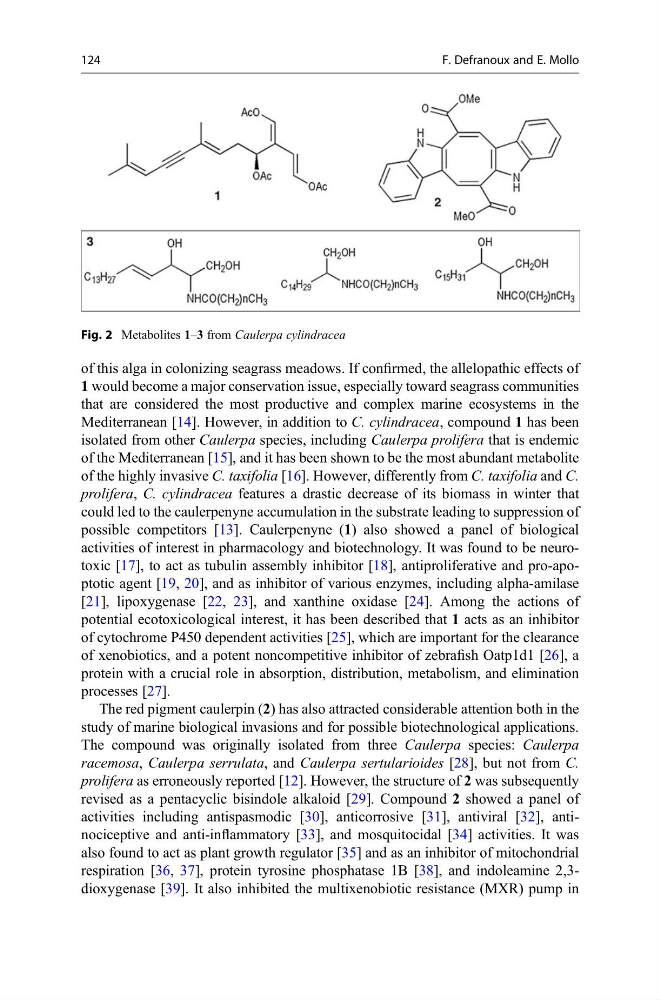
The red pigment caulerpin (2) has also attracted considerable attention both in the
study of marine biological invasions and for possible biotechnological applications.
The compound was originally isolated from three Caulerpa species: Caulerpa
racemosa, Caulerpa serrulata, and Caulerpa sertularioides [28], but not from C.
prolifera as erroneously reported [12]. However, the structure of 2 was subsequently
revised as a pentacyclic bisindole alkaloid [29]. Compound 2 showed a panel of
activities including antispasmodic [30], anticorrosive [31], antiviral [32], antinociceptive and anti-inflammatory [33], and mosquitocidal [34] activities. It was
also found to act as plant growth regulator [35] and as an inhibitor of mitochondrial
respiration [36, 37], protein tyrosine phosphatase 1B [38], and indoleamine 2,3dioxygenase [39]. It also inhibited the multixenobiotic resistance (MXR) pump in
Fig. 2 Metabolites 1–3 from Caulerpa cylindracea
124
F. Defranoux and E. Mollo
1 would become a major conservation issue, especially toward seagrass communities
that are considered the most productive and complex marine ecosystems in the
Mediterranean [14]. However, in addition to C. cylindracea, compound 1 has been
isolated from other Caulerpa species, including Caulerpa prolifera that is endemic
of the Mediterranean [15], and it has been shown to be the most abundant metabolite
of the highly invasive C. taxifolia [16]. However, differently from C. taxifolia and C.
prolifera, C. cylindracea features a drastic decrease of its biomass in winter that
could led to the caulerpenyne accumulation in the substrate leading to suppression of
possible competitors [13]. Caulerpenyne (1) also showed a panel of biological
activities of interest in pharmacology and biotechnology. It was found to be neurotoxic [17], to act as tubulin assembly inhibitor [18], antiproliferative and pro-apoptotic agent [19, 20], and as inhibitor of various enzymes, including alpha-amilase
[21], lipoxygenase [22, 23], and xanthine oxidase [24]. Among the actions of
potential ecotoxicological interest, it has been described that 1 acts as an inhibitor
of cytochrome P450 dependent activities [25], which are important for the clearance
of xenobiotics, and a potent noncompetitive inhibitor of zebrafish Oatp1d1 [26], a
protein with a crucial role in absorption, distribution, metabolism, and elimination
processes [27].
The red pigment caulerpin (2) has also attracted considerable attention both in the
study of marine biological invasions and for possible biotechnological applications.
The compound was originally isolated from three Caulerpa species: Caulerpa
racemosa, Caulerpa serrulata, and Caulerpa sertularioides [28], but not from C.
prolifera as erroneously reported [12]. However, the structure of 2 was subsequently
revised as a pentacyclic bisindole alkaloid [29]. Compound 2 showed a panel of
activities including antispasmodic [30], anticorrosive [31], antiviral [32], antinociceptive and anti-inflammatory [33], and mosquitocidal [34] activities. It was
also found to act as plant growth regulator [35] and as an inhibitor of mitochondrial
respiration [36, 37], protein tyrosine phosphatase 1B [38], and indoleamine 2,3dioxygenase [39]. It also inhibited the multixenobiotic resistance (MXR) pump in
Fig. 2 Metabolites 1–3 from Caulerpa cylindracea
124
F. Defranoux and E. Mollo