

ecosystems. The available information on the pharmaceutically relevant activities of
the alien metabolites will also be summarized paving the way for future researches
that could clarify whether the properties that make those compounds important as
drug candidates may be closely related to their impact on marine ecosystems.
2
Bioactive Metabolites from the Invasive Green Alga
Caulerpa cylindracea
Marine green algae belonging to the genus Caulerpa are especially known to contain
bioactive terpenes and alkaloids [12], among which the sesquiterpenoid
caulerpenyne showing a diacetoxybutadiene moiety (1) and the bisindolic alkaloid
caulerpin (2) have been especially investigated for their possible impact on the native
Mediterranean community. The compounds have been isolated, in fact, from two
Caulerpa species that have become invasive in the Mediterranean Sea: Caulerpa
taxifolia, a feather-like species that has been included in the in the IUCN list of the
100 world’s worst invasive species [9], and Caulerpa cylindracea, previously
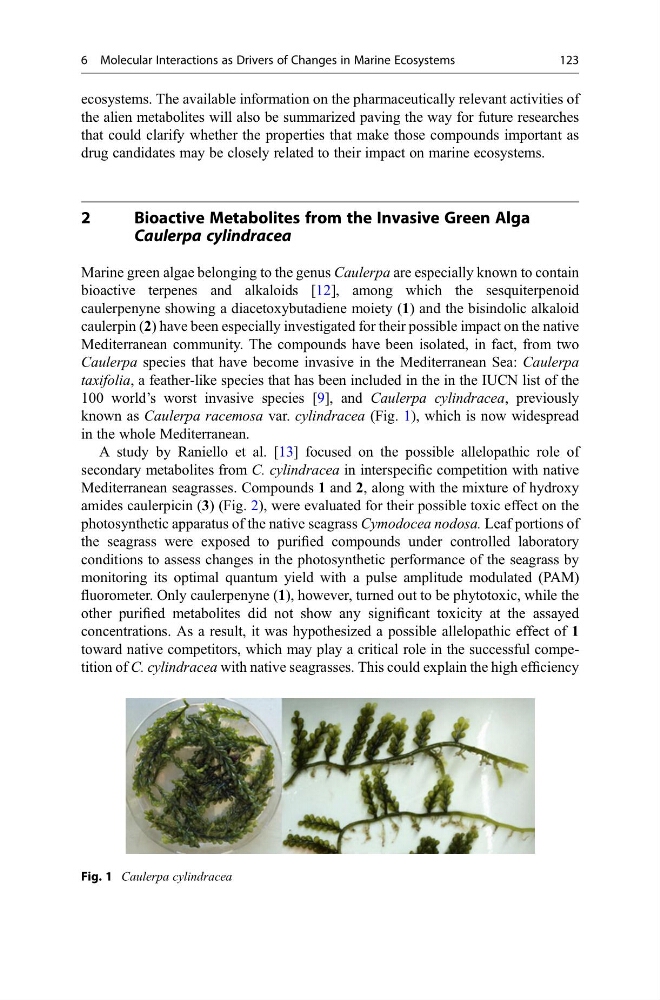
known as Caulerpa racemosa var. cylindracea (Fig. 1), which is now widespread
in the whole Mediterranean.
A study by Raniello et al. [13] focused on the possible allelopathic role of
secondary metabolites from C. cylindracea in interspecific competition with native
Mediterranean seagrasses. Compounds 1 and 2, along with the mixture of hydroxy
amides caulerpicin (3) (Fig. 2), were evaluated for their possible toxic effect on the
photosynthetic apparatus of the native seagrass Cymodocea nodosa. Leaf portions of
the seagrass were exposed to purified compounds under controlled laboratory
conditions to assess changes in the photosynthetic performance of the seagrass by
monitoring its optimal quantum yield with a pulse amplitude modulated (PAM)
fluorometer. Only caulerpenyne (1), however, turned out to be phytotoxic, while the
other purified metabolites did not show any significant toxicity at the assayed
concentrations. As a result, it was hypothesized a possible allelopathic effect of 1
toward native competitors, which may play a critical role in the successful competition of C. cylindracea with native seagrasses. This could explain the high efficiency
Fig. 1 Caulerpa cylindracea
6 Molecular Interactions as Drivers of Changes in Marine Ecosystems
123
the alien metabolites will also be summarized paving the way for future researches
that could clarify whether the properties that make those compounds important as
drug candidates may be closely related to their impact on marine ecosystems.
2
Bioactive Metabolites from the Invasive Green Alga
Caulerpa cylindracea
Marine green algae belonging to the genus Caulerpa are especially known to contain
bioactive terpenes and alkaloids [12], among which the sesquiterpenoid
caulerpenyne showing a diacetoxybutadiene moiety (1) and the bisindolic alkaloid
caulerpin (2) have been especially investigated for their possible impact on the native
Mediterranean community. The compounds have been isolated, in fact, from two
Caulerpa species that have become invasive in the Mediterranean Sea: Caulerpa
taxifolia, a feather-like species that has been included in the in the IUCN list of the
100 world’s worst invasive species [9], and Caulerpa cylindracea, previously
known as Caulerpa racemosa var. cylindracea (Fig. 1), which is now widespread
in the whole Mediterranean.
A study by Raniello et al. [13] focused on the possible allelopathic role of
secondary metabolites from C. cylindracea in interspecific competition with native
Mediterranean seagrasses. Compounds 1 and 2, along with the mixture of hydroxy
amides caulerpicin (3) (Fig. 2), were evaluated for their possible toxic effect on the
photosynthetic apparatus of the native seagrass Cymodocea nodosa. Leaf portions of
the seagrass were exposed to purified compounds under controlled laboratory
conditions to assess changes in the photosynthetic performance of the seagrass by
monitoring its optimal quantum yield with a pulse amplitude modulated (PAM)
fluorometer. Only caulerpenyne (1), however, turned out to be phytotoxic, while the
other purified metabolites did not show any significant toxicity at the assayed
concentrations. As a result, it was hypothesized a possible allelopathic effect of 1
toward native competitors, which may play a critical role in the successful competition of C. cylindracea with native seagrasses. This could explain the high efficiency
Fig. 1 Caulerpa cylindracea
6 Molecular Interactions as Drivers of Changes in Marine Ecosystems
123