

develop without assimilates drawn from their host plants because they are unable to
perform photosynthesis [23, 57] or their photosynthetic capacity is very weak
[50]. Even though dodder plants possess a functional photosynthetic apparatus
within a ring of cells surrounding vascular tissue [50], the amount of organic matter
produced there is too small to provide for the plant sufficiently, so that 99% of the
required carbon is still drawn from the host [58].
After finding an appropriate host plant, the first physical contact initiates the
attachment phase, in which the parasitic epidermal and parenchymal cells begin to
differentiate into a secondary meristem and develop prehaustoria, also known as
adhesive disk [59, 60]. Important signals initiating and controlling this prehaustorium formation include mechanical pressure, osmotic potential, and phytohormones such as cytokinins and auxin [1, 61]. The prehaustorial cells start to
produce and secrete adhesive substances, such as pectins and other polysaccharides,
reinforcing the adhesion [47]. During the attachment phase, host cells in the proximity of Cuscuta haustoria respond with an increase in cytosolic calcium, detectable
in host plants expressing aequorin as calcium reporter. Within the initial several
hours of contact, Cuscuta also induces the host plant to produce its own sticky
substances, such as arabinogalactan proteins, to promote adhesion [62]. These
glycoproteins are secreted by the host plant and localized to the cell wall where
they can force the adhesion together with other sticky components such as pectins.
The attachment phase is followed by penetration phase as prehaustoria develop
into parasitic haustoria that penetrate the host stem through a fissure. This breach is
effected by mechanical pressure [1] and is supported by biochemical degradation of
host cell walls caused by secreted hydrolytic enzymes such as methylesterases [46]
or complexes of lytic enzymes consisting of pectinases and cellulases [48]. Cells at
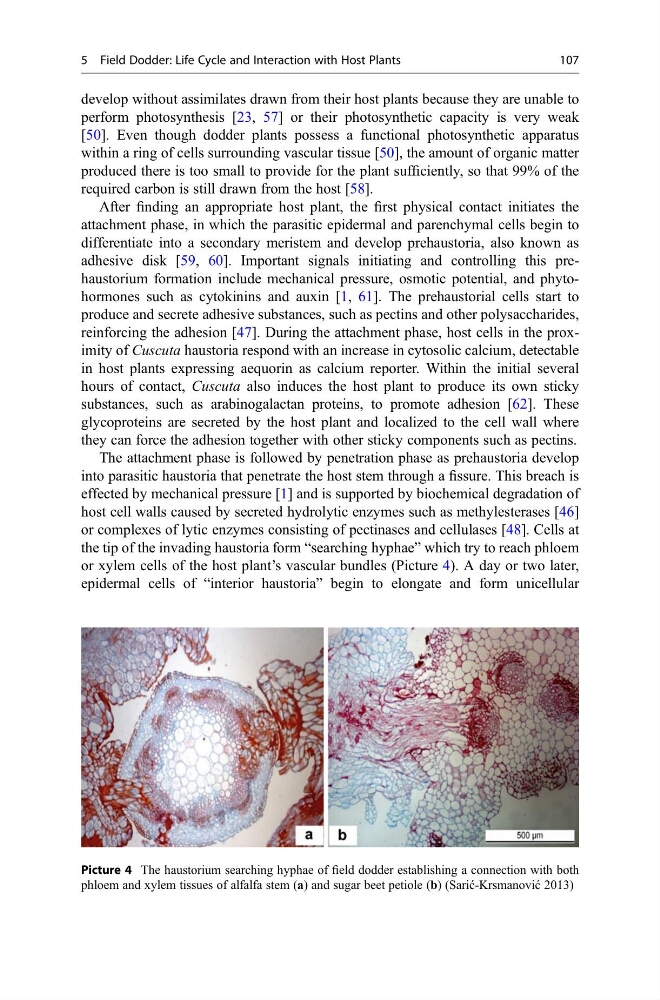
the tip of the invading haustoria form “searching hyphae” which try to reach phloem
or xylem cells of the host plant’s vascular bundles (Picture 4). A day or two later,
epidermal cells of “interior haustoria” begin to elongate and form unicellular
Picture 4 The haustorium searching hyphae of field dodder establishing a connection with both
phloem and xylem tissues of alfalfa stem (a) and sugar beet petiole (b) (Sarić-Krsmanović 2013)
5 Field Dodder: Life Cycle and Interaction with Host Plants
107
perform photosynthesis [23, 57] or their photosynthetic capacity is very weak
[50]. Even though dodder plants possess a functional photosynthetic apparatus
within a ring of cells surrounding vascular tissue [50], the amount of organic matter
produced there is too small to provide for the plant sufficiently, so that 99% of the
required carbon is still drawn from the host [58].
After finding an appropriate host plant, the first physical contact initiates the
attachment phase, in which the parasitic epidermal and parenchymal cells begin to
differentiate into a secondary meristem and develop prehaustoria, also known as
adhesive disk [59, 60]. Important signals initiating and controlling this prehaustorium formation include mechanical pressure, osmotic potential, and phytohormones such as cytokinins and auxin [1, 61]. The prehaustorial cells start to
produce and secrete adhesive substances, such as pectins and other polysaccharides,
reinforcing the adhesion [47]. During the attachment phase, host cells in the proximity of Cuscuta haustoria respond with an increase in cytosolic calcium, detectable
in host plants expressing aequorin as calcium reporter. Within the initial several
hours of contact, Cuscuta also induces the host plant to produce its own sticky
substances, such as arabinogalactan proteins, to promote adhesion [62]. These
glycoproteins are secreted by the host plant and localized to the cell wall where
they can force the adhesion together with other sticky components such as pectins.
The attachment phase is followed by penetration phase as prehaustoria develop
into parasitic haustoria that penetrate the host stem through a fissure. This breach is
effected by mechanical pressure [1] and is supported by biochemical degradation of
host cell walls caused by secreted hydrolytic enzymes such as methylesterases [46]
or complexes of lytic enzymes consisting of pectinases and cellulases [48]. Cells at
the tip of the invading haustoria form “searching hyphae” which try to reach phloem
or xylem cells of the host plant’s vascular bundles (Picture 4). A day or two later,
epidermal cells of “interior haustoria” begin to elongate and form unicellular
Picture 4 The haustorium searching hyphae of field dodder establishing a connection with both
phloem and xylem tissues of alfalfa stem (a) and sugar beet petiole (b) (Sarić-Krsmanović 2013)
5 Field Dodder: Life Cycle and Interaction with Host Plants
107