

campestris seedlings in the dark. Saric-Krsmanovic et al. [49] examined the effect of
host seeds on germination and initial growth of seedlings of field dodder plants in the
dark, and under white light, the seeds of four host plants were used (watermelon, red
clover, alfalfa, and sugar beet). The data of host seeds showed that light was a
significant initial factor (83–95%, control 95%) for stimulating seed germination of
field dodder plants, apart from host presence (73–79%, control 80%). Cuscuta can
also change from one host to another and back. If the plant needs special volatile
chemicals to search for a host, it is difficult to explain why it can parasitize so many
different plants except there is a strong overlap between the volatile compositions of
the various plants.
3.2
Attachment and Haustorium Development
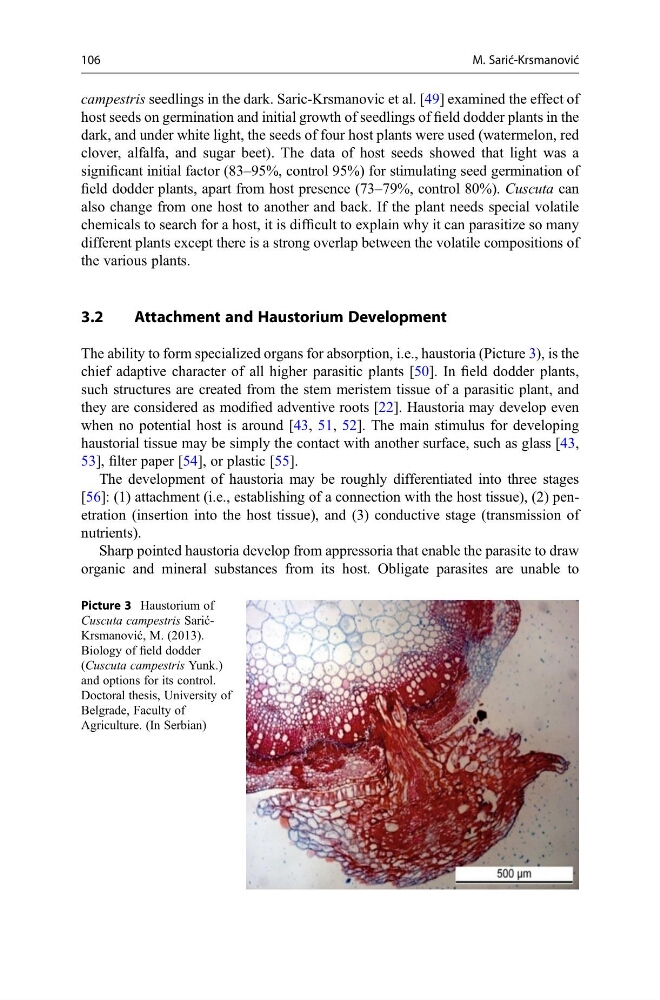
The ability to form specialized organs for absorption, i.e., haustoria (Picture 3), is the
chief adaptive character of all higher parasitic plants [50]. In field dodder plants,
such structures are created from the stem meristem tissue of a parasitic plant, and
they are considered as modified adventive roots [22]. Haustoria may develop even
when no potential host is around [43, 51, 52]. The main stimulus for developing
haustorial tissue may be simply the contact with another surface, such as glass [43,
53], filter paper [54], or plastic [55].
The development of haustoria may be roughly differentiated into three stages
[56]: (1) attachment (i.e., establishing of a connection with the host tissue), (2) penetration (insertion into the host tissue), and (3) conductive stage (transmission of
nutrients).
Sharp pointed haustoria develop from appressoria that enable the parasite to draw
organic and mineral substances from its host. Obligate parasites are unable to
Picture 3 Haustorium of
Cuscuta campestris SarićKrsmanović, M. (2013).
Biology of field dodder
(Cuscuta campestris Yunk.)
and options for its control.
Doctoral thesis, University of
Belgrade, Faculty of
Agriculture. (In Serbian)
106
M. Sarić-Krsmanović
host seeds on germination and initial growth of seedlings of field dodder plants in the
dark, and under white light, the seeds of four host plants were used (watermelon, red
clover, alfalfa, and sugar beet). The data of host seeds showed that light was a
significant initial factor (83–95%, control 95%) for stimulating seed germination of
field dodder plants, apart from host presence (73–79%, control 80%). Cuscuta can
also change from one host to another and back. If the plant needs special volatile
chemicals to search for a host, it is difficult to explain why it can parasitize so many
different plants except there is a strong overlap between the volatile compositions of
the various plants.
3.2
Attachment and Haustorium Development
The ability to form specialized organs for absorption, i.e., haustoria (Picture 3), is the
chief adaptive character of all higher parasitic plants [50]. In field dodder plants,
such structures are created from the stem meristem tissue of a parasitic plant, and
they are considered as modified adventive roots [22]. Haustoria may develop even
when no potential host is around [43, 51, 52]. The main stimulus for developing
haustorial tissue may be simply the contact with another surface, such as glass [43,
53], filter paper [54], or plastic [55].
The development of haustoria may be roughly differentiated into three stages
[56]: (1) attachment (i.e., establishing of a connection with the host tissue), (2) penetration (insertion into the host tissue), and (3) conductive stage (transmission of
nutrients).
Sharp pointed haustoria develop from appressoria that enable the parasite to draw
organic and mineral substances from its host. Obligate parasites are unable to
Picture 3 Haustorium of
Cuscuta campestris SarićKrsmanović, M. (2013).
Biology of field dodder
(Cuscuta campestris Yunk.)
and options for its control.
Doctoral thesis, University of
Belgrade, Faculty of
Agriculture. (In Serbian)
106
M. Sarić-Krsmanović