

4 Water Resources in Poland and Their Use
59
Table 4.7 Primary melioration [4]
Year Rivers and canals
Embankments
Usable
capacity
of water
reservoirs
in dam 3
Drainage pump
stations
Lenght
(km)
Of which
regulated
(km)
Lenght (km)
Protected
area in
thousands
ha
Number
Area of
interaction
in
thousands
ha
1990 72,577 37,923
8148
1004.3
163,408
609
571.4
2003 73,812 39,972
8450
1074.9
261,334
574
601.4
2016 75,297 43,442
8451
1091.2
279,955
579
616.1
the country experiencing structural water deficits. The intensification of agriculture requires securing water supply in the period of growth of plants, which occurs
through land melioration. The measures involve the application of the regulation of
water outflow and inflow, in accordance with the production requirements of crops.
Incomplete functioning of melioration facilities leads to negative changes in the
environment, and particularly to the overdrying of the ground, which is extremely
dangerous for organic soils. Their dehydration reduces the retention resources of the
catchment and launches an intensive process of mineralisation of organic substance,
degrading natural water resources.
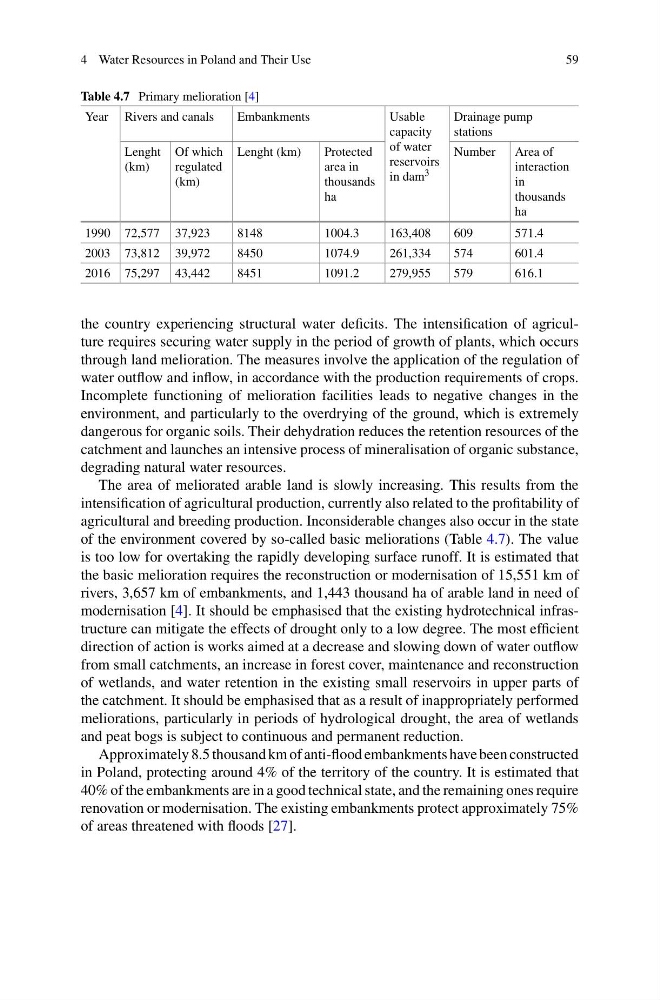
The area of meliorated arable land is slowly increasing. This results from the
intensification of agricultural production, currently also related to the profitability of
agricultural and breeding production. Inconsiderable changes also occur in the state
of the environment covered by so-called basic meliorations (Table 4.7). The value
is too low for overtaking the rapidly developing surface runoff. It is estimated that
the basic melioration requires the reconstruction or modernisation of 15,551 km of
rivers, 3,657 km of embankments, and 1,443 thousand ha of arable land in need of
modernisation [4]. It should be emphasised that the existing hydrotechnical infrastructure can mitigate the effects of drought only to a low degree. The most efficient
direction of action is works aimed at a decrease and slowing down of water outflow
from small catchments, an increase in forest cover, maintenance and reconstruction
of wetlands, and water retention in the existing small reservoirs in upper parts of
the catchment. It should be emphasised that as a result of inappropriately performed
meliorations, particularly in periods of hydrological drought, the area of wetlands
and peat bogs is subject to continuous and permanent reduction.
Approximately 8.5 thousand km of anti-flood embankments have been constructed
in Poland, protecting around 4% of the territory of the country. It is estimated that
40% of the embankments are in a good technical state, and the remaining ones require
renovation or modernisation. The existing embankments protect approximately 75%
of areas threatened with floods [27].
59
Table 4.7 Primary melioration [4]
Year Rivers and canals
Embankments
Usable
capacity
of water
reservoirs
in dam 3
Drainage pump
stations
Lenght
(km)
Of which
regulated
(km)
Lenght (km)
Protected
area in
thousands
ha
Number
Area of
interaction
in
thousands
ha
1990 72,577 37,923
8148
1004.3
163,408
609
571.4
2003 73,812 39,972
8450
1074.9
261,334
574
601.4
2016 75,297 43,442
8451
1091.2
279,955
579
616.1
the country experiencing structural water deficits. The intensification of agriculture requires securing water supply in the period of growth of plants, which occurs
through land melioration. The measures involve the application of the regulation of
water outflow and inflow, in accordance with the production requirements of crops.
Incomplete functioning of melioration facilities leads to negative changes in the
environment, and particularly to the overdrying of the ground, which is extremely
dangerous for organic soils. Their dehydration reduces the retention resources of the
catchment and launches an intensive process of mineralisation of organic substance,
degrading natural water resources.
The area of meliorated arable land is slowly increasing. This results from the
intensification of agricultural production, currently also related to the profitability of
agricultural and breeding production. Inconsiderable changes also occur in the state
of the environment covered by so-called basic meliorations (Table 4.7). The value
is too low for overtaking the rapidly developing surface runoff. It is estimated that
the basic melioration requires the reconstruction or modernisation of 15,551 km of
rivers, 3,657 km of embankments, and 1,443 thousand ha of arable land in need of
modernisation [4]. It should be emphasised that the existing hydrotechnical infrastructure can mitigate the effects of drought only to a low degree. The most efficient
direction of action is works aimed at a decrease and slowing down of water outflow
from small catchments, an increase in forest cover, maintenance and reconstruction
of wetlands, and water retention in the existing small reservoirs in upper parts of
the catchment. It should be emphasised that as a result of inappropriately performed
meliorations, particularly in periods of hydrological drought, the area of wetlands
and peat bogs is subject to continuous and permanent reduction.
Approximately 8.5 thousand km of anti-flood embankments have been constructed
in Poland, protecting around 4% of the territory of the country. It is estimated that
40% of the embankments are in a good technical state, and the remaining ones require
renovation or modernisation. The existing embankments protect approximately 75%
of areas threatened with floods [27].