

4 Water Resources in Poland and Their Use
55
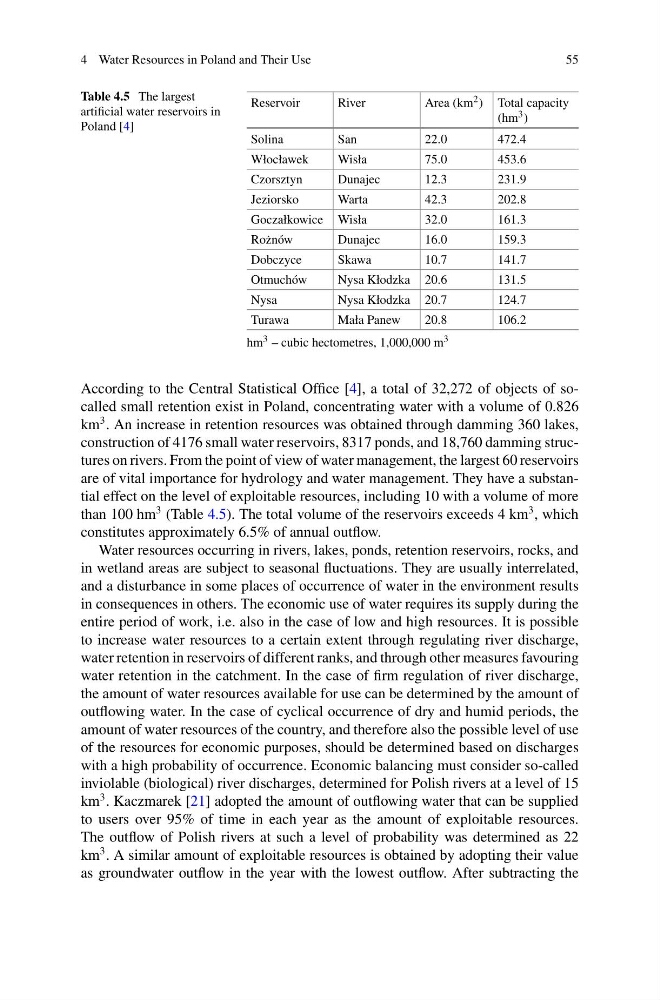
Table 4.5 The largest
artificial water reservoirs in
Poland [4]
Reservoir
River
Area (km 2 ) Total capacity
(hm 3 )
Solina
San
22.0
472.4
Włocławek
Wisła
75.0
453.6
Czorsztyn
Dunajec
12.3
231.9
Jeziorsko
Warta
42.3
202.8
Goczałkowice Wisła
32.0
161.3
Ro˙ znów
Dunajec
16.0
159.3
Dobczyce
Skawa
10.7
141.7
Otmuchów
Nysa Kłodzka 20.6
131.5
Nysa
Nysa Kłodzka 20.7
124.7
Turawa
Mała Panew
20.8
106.2
hm 3 – cubic hectometres, 1,000,000 m 3
According to the Central Statistical Office [4], a total of 32,272 of objects of socalled small retention exist in Poland, concentrating water with a volume of 0.826
km
3 . An increase in retention resources was obtained through damming 360 lakes,
construction of 4176 small water reservoirs, 8317 ponds, and 18,760 damming structures on rivers. From the point of view of water management, the largest 60 reservoirs
are of vital importance for hydrology and water management. They have a substantial effect on the level of exploitable resources, including 10 with a volume of more
than 100 hm
3 (Table 4.5). The total volume of the reservoirs exceeds 4 km
3 , which
constitutes approximately 6.5% of annual outflow.
Water resources occurring in rivers, lakes, ponds, retention reservoirs, rocks, and
in wetland areas are subject to seasonal fluctuations. They are usually interrelated,
and a disturbance in some places of occurrence of water in the environment results
in consequences in others. The economic use of water requires its supply during the
entire period of work, i.e. also in the case of low and high resources. It is possible
to increase water resources to a certain extent through regulating river discharge,
water retention in reservoirs of different ranks, and through other measures favouring
water retention in the catchment. In the case of firm regulation of river discharge,
the amount of water resources available for use can be determined by the amount of
outflowing water. In the case of cyclical occurrence of dry and humid periods, the
amount of water resources of the country, and therefore also the possible level of use
of the resources for economic purposes, should be determined based on discharges
with a high probability of occurrence. Economic balancing must consider so-called
inviolable (biological) river discharges, determined for Polish rivers at a level of 15
km
3 . Kaczmarek [21] adopted the amount of outflowing water that can be supplied
to users over 95% of time in each year as the amount of exploitable resources.
The outflow of Polish rivers at such a level of probability was determined as 22
km
3 . A similar amount of exploitable resources is obtained by adopting their value
as groundwater outflow in the year with the lowest outflow. After subtracting the
55
Table 4.5 The largest
artificial water reservoirs in
Poland [4]
Reservoir
River
Area (km 2 ) Total capacity
(hm 3 )
Solina
San
22.0
472.4
Włocławek
Wisła
75.0
453.6
Czorsztyn
Dunajec
12.3
231.9
Jeziorsko
Warta
42.3
202.8
Goczałkowice Wisła
32.0
161.3
Ro˙ znów
Dunajec
16.0
159.3
Dobczyce
Skawa
10.7
141.7
Otmuchów
Nysa Kłodzka 20.6
131.5
Nysa
Nysa Kłodzka 20.7
124.7
Turawa
Mała Panew
20.8
106.2
hm 3 – cubic hectometres, 1,000,000 m 3
According to the Central Statistical Office [4], a total of 32,272 of objects of socalled small retention exist in Poland, concentrating water with a volume of 0.826
km
3 . An increase in retention resources was obtained through damming 360 lakes,
construction of 4176 small water reservoirs, 8317 ponds, and 18,760 damming structures on rivers. From the point of view of water management, the largest 60 reservoirs
are of vital importance for hydrology and water management. They have a substantial effect on the level of exploitable resources, including 10 with a volume of more
than 100 hm
3 (Table 4.5). The total volume of the reservoirs exceeds 4 km
3 , which
constitutes approximately 6.5% of annual outflow.
Water resources occurring in rivers, lakes, ponds, retention reservoirs, rocks, and
in wetland areas are subject to seasonal fluctuations. They are usually interrelated,
and a disturbance in some places of occurrence of water in the environment results
in consequences in others. The economic use of water requires its supply during the
entire period of work, i.e. also in the case of low and high resources. It is possible
to increase water resources to a certain extent through regulating river discharge,
water retention in reservoirs of different ranks, and through other measures favouring
water retention in the catchment. In the case of firm regulation of river discharge,
the amount of water resources available for use can be determined by the amount of
outflowing water. In the case of cyclical occurrence of dry and humid periods, the
amount of water resources of the country, and therefore also the possible level of use
of the resources for economic purposes, should be determined based on discharges
with a high probability of occurrence. Economic balancing must consider so-called
inviolable (biological) river discharges, determined for Polish rivers at a level of 15
km
3 . Kaczmarek [21] adopted the amount of outflowing water that can be supplied
to users over 95% of time in each year as the amount of exploitable resources.
The outflow of Polish rivers at such a level of probability was determined as 22
km
3 . A similar amount of exploitable resources is obtained by adopting their value
as groundwater outflow in the year with the lowest outflow. After subtracting the