

54
Z. Michalczyk and J. Sposób
Cretaceous, Jurassic, and Triassic formations occur over a total of 46% of the area
of the country (Cretaceous 22%, Jurassic 19%, Triassic 5%), and collect 41.9% of
exploitable resources occurring in the main groundwater reservoirs (Table 4.3).
According to materials presented in the Hydrogeological atlas of Poland [14],
total infiltration of precipitation was evaluated as 100 km
3 ·year
−1 , and the amount of
renewable groundwater resources within useful aquifers was estimated for approximately 18 ± 3 km
3 ·year
−1 . In balance calculations concerning the possibilities of
use of groundwater, exploitable resources of useful aquifers should not exceed 15
km
3 ·year
−1 . In periods of moderate and low discharges, rivers are fed from groundwater resources, and floods occur during the runoff of precipitation and meltwaters.
Random occurrence of such events forces undertaking measures for regulating river
discharge. In addition to the construction of retention reservoirs, the regulation should
cover measures aimed at water retention in catchments, i.e. mainly in agricultural
and forest areas.
An essential role in water retention and development of water resources is played
by lakes, ponds, and retention reservoirs. There are 7081 lakes (larger than 1 ha) in
Poland, with a surface area of 2813.8 km
2 [15, 16]. Their number in the last century
considerably decreased, and Majdanowski [17] provides their number of 9296 and
total surface area of 3169.3 km
2 . K. D˛ ebski [18] mentions that lakes in Poland occupy
the area of approx. 3400 km
2 and their total volume is estimated for 33 km
3 . Whereas,
the capacity of soil and groundwaters in the water balance for Poland is evaluated
for 36.6 km
3 [18]. Total static resources of lakes in Poland are 18.747 km
3 , 99%
of which is located inside the range of Weichselian glaciation [19]. A large amount
of surface water is retained in wetlands, which is estimated for 15.5 km
3 [20]. The
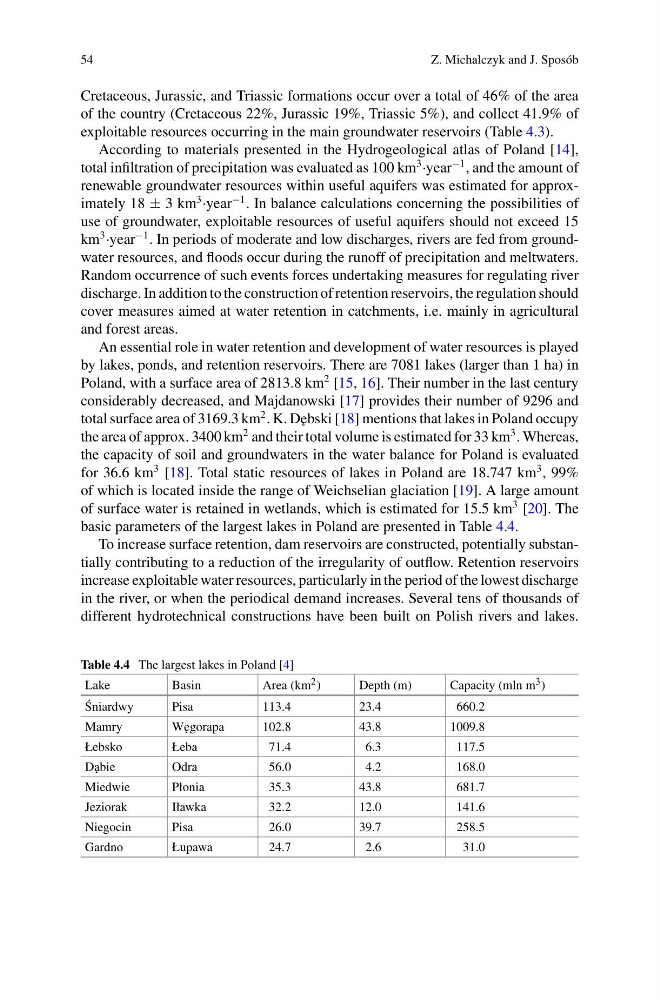
basic parameters of the largest lakes in Poland are presented in Table 4.4.
To increase surface retention, dam reservoirs are constructed, potentially substantially contributing to a reduction of the irregularity of outflow. Retention reservoirs
increase exploitable water resources, particularly in the period of the lowest discharge
in the river, or when the periodical demand increases. Several tens of thousands of
different hydrotechnical constructions have been built on Polish rivers and lakes.
Table 4.4 The largest lakes in Poland [4]
Lake
Basin
Area (km 2 )
Depth (m)
Capacity (mln m 3 )
´
Sniardwy
Pisa
113.4
23.4
660.2
Mamry
W˛ egorapa
102.8
43.8
1009.8
Łebsko
Łeba
71.4
6.3
117.5
D˛ abie
Odra
56.0
4.2
168.0
Miedwie
Płonia
35.3
43.8
681.7
Jeziorak
Iławka
32.2
12.0
141.6
Niegocin
Pisa
26.0
39.7
258.5
Gardno
Łupawa
24.7
2.6
31.0
Z. Michalczyk and J. Sposób
Cretaceous, Jurassic, and Triassic formations occur over a total of 46% of the area
of the country (Cretaceous 22%, Jurassic 19%, Triassic 5%), and collect 41.9% of
exploitable resources occurring in the main groundwater reservoirs (Table 4.3).
According to materials presented in the Hydrogeological atlas of Poland [14],
total infiltration of precipitation was evaluated as 100 km
3 ·year
−1 , and the amount of
renewable groundwater resources within useful aquifers was estimated for approximately 18 ± 3 km
3 ·year
−1 . In balance calculations concerning the possibilities of
use of groundwater, exploitable resources of useful aquifers should not exceed 15
km
3 ·year
−1 . In periods of moderate and low discharges, rivers are fed from groundwater resources, and floods occur during the runoff of precipitation and meltwaters.
Random occurrence of such events forces undertaking measures for regulating river
discharge. In addition to the construction of retention reservoirs, the regulation should
cover measures aimed at water retention in catchments, i.e. mainly in agricultural
and forest areas.
An essential role in water retention and development of water resources is played
by lakes, ponds, and retention reservoirs. There are 7081 lakes (larger than 1 ha) in
Poland, with a surface area of 2813.8 km
2 [15, 16]. Their number in the last century
considerably decreased, and Majdanowski [17] provides their number of 9296 and
total surface area of 3169.3 km
2 . K. D˛ ebski [18] mentions that lakes in Poland occupy
the area of approx. 3400 km
2 and their total volume is estimated for 33 km
3 . Whereas,
the capacity of soil and groundwaters in the water balance for Poland is evaluated
for 36.6 km
3 [18]. Total static resources of lakes in Poland are 18.747 km
3 , 99%
of which is located inside the range of Weichselian glaciation [19]. A large amount
of surface water is retained in wetlands, which is estimated for 15.5 km
3 [20]. The
basic parameters of the largest lakes in Poland are presented in Table 4.4.
To increase surface retention, dam reservoirs are constructed, potentially substantially contributing to a reduction of the irregularity of outflow. Retention reservoirs
increase exploitable water resources, particularly in the period of the lowest discharge
in the river, or when the periodical demand increases. Several tens of thousands of
different hydrotechnical constructions have been built on Polish rivers and lakes.
Table 4.4 The largest lakes in Poland [4]
Lake
Basin
Area (km 2 )
Depth (m)
Capacity (mln m 3 )
´
Sniardwy
Pisa
113.4
23.4
660.2
Mamry
W˛ egorapa
102.8
43.8
1009.8
Łebsko
Łeba
71.4
6.3
117.5
D˛ abie
Odra
56.0
4.2
168.0
Miedwie
Płonia
35.3
43.8
681.7
Jeziorak
Iławka
32.2
12.0
141.6
Niegocin
Pisa
26.0
39.7
258.5
Gardno
Łupawa
24.7
2.6
31.0