

372
M. Gor˛ aczko and K. Kubiak-Wójcicka
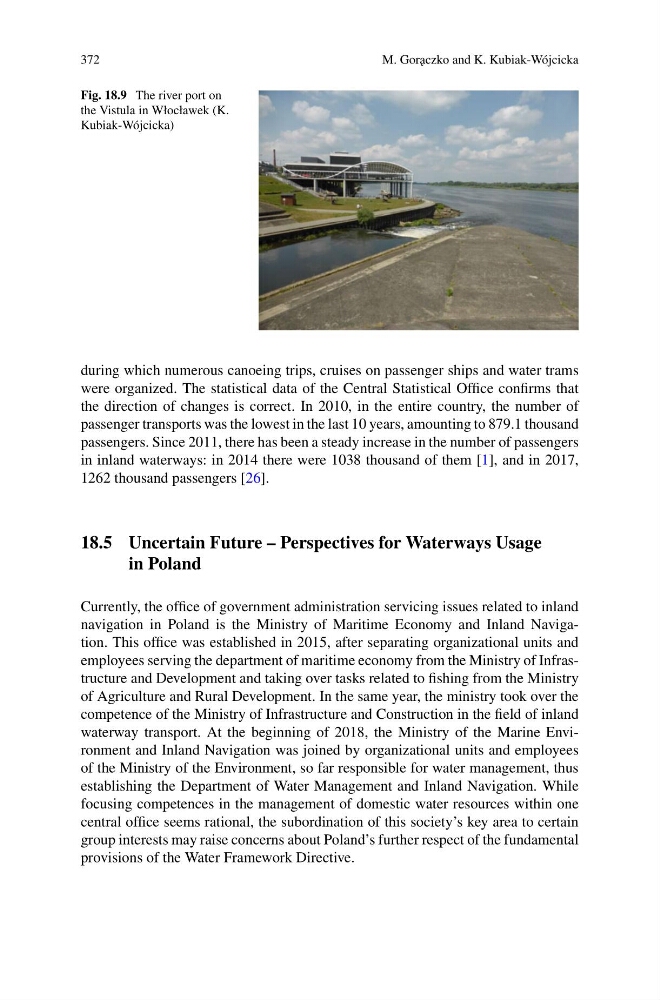
Fig. 18.9 The river port on
the Vistula in Włocławek (K.
Kubiak-Wójcicka)
during which numerous canoeing trips, cruises on passenger ships and water trams
were organized. The statistical data of the Central Statistical Office confirms that
the direction of changes is correct. In 2010, in the entire country, the number of
passenger transports was the lowest in the last 10 years, amounting to 879.1 thousand
passengers. Since 2011, there has been a steady increase in the number of passengers
in inland waterways: in 2014 there were 1038 thousand of them [1], and in 2017,
1262 thousand passengers [26].
18.5 Uncertain Future – Perspectives for Waterways Usage
in Poland
Currently, the office of government administration servicing issues related to inland
navigation in Poland is the Ministry of Maritime Economy and Inland Navigation. This office was established in 2015, after separating organizational units and
employees serving the department of maritime economy from the Ministry of Infrastructure and Development and taking over tasks related to fishing from the Ministry
of Agriculture and Rural Development. In the same year, the ministry took over the
competence of the Ministry of Infrastructure and Construction in the field of inland
waterway transport. At the beginning of 2018, the Ministry of the Marine Environment and Inland Navigation was joined by organizational units and employees
of the Ministry of the Environment, so far responsible for water management, thus
establishing the Department of Water Management and Inland Navigation. While
focusing competences in the management of domestic water resources within one
central office seems rational, the subordination of this society’s key area to certain
group interests may raise concerns about Poland’s further respect of the fundamental
provisions of the Water Framework Directive.
M. Gor˛ aczko and K. Kubiak-Wójcicka
Fig. 18.9 The river port on
the Vistula in Włocławek (K.
Kubiak-Wójcicka)
during which numerous canoeing trips, cruises on passenger ships and water trams
were organized. The statistical data of the Central Statistical Office confirms that
the direction of changes is correct. In 2010, in the entire country, the number of
passenger transports was the lowest in the last 10 years, amounting to 879.1 thousand
passengers. Since 2011, there has been a steady increase in the number of passengers
in inland waterways: in 2014 there were 1038 thousand of them [1], and in 2017,
1262 thousand passengers [26].
18.5 Uncertain Future – Perspectives for Waterways Usage
in Poland
Currently, the office of government administration servicing issues related to inland
navigation in Poland is the Ministry of Maritime Economy and Inland Navigation. This office was established in 2015, after separating organizational units and
employees serving the department of maritime economy from the Ministry of Infrastructure and Development and taking over tasks related to fishing from the Ministry
of Agriculture and Rural Development. In the same year, the ministry took over the
competence of the Ministry of Infrastructure and Construction in the field of inland
waterway transport. At the beginning of 2018, the Ministry of the Marine Environment and Inland Navigation was joined by organizational units and employees
of the Ministry of the Environment, so far responsible for water management, thus
establishing the Department of Water Management and Inland Navigation. While
focusing competences in the management of domestic water resources within one
central office seems rational, the subordination of this society’s key area to certain
group interests may raise concerns about Poland’s further respect of the fundamental
provisions of the Water Framework Directive.