

18 Waterways in Poland – The History, Present State and Future
371
usually interfere only pointwise in the network of waterways through the construction of marinas and parking spaces, often together with the associated accommodation and catering infrastructure and sanitary and technical facilities. They are most
often implemented by local self-governments interested in tourist activation in their
regions, with the support of financial resources from EU funds and programs. Among
many realizations of this type, one can mention:
– marina and river ports on Brda in Bydgoszcz servicing, among others “Water
Tram” (regular passenger vessels within the Bydgoszcz Water Node),
– marina in Nakło nad Noteci˛ a,
– yacht harbor on Lake D˛ abie in Szczecin,
– river port on the Vistula in Grudzi˛ adz,
– yacht marina on the Warta in Poznan,
– passenger ships on the Elbl˛ ag Canal.
Of course, this area is also not free from projects that are economically or functionally inaccurate, but the overall direction in the development of infrastructure for
users of waterways focused on tourism should be rated positively.
Inland waterways perform a number of non-transport functions that also have
significant economic and social value [21]. Over the last 10 years, revitalization of
waterfronts has been observed in cities located on larger rivers, e.g., in Warsaw [22],
Pozna´ n [23], Bydgoszcz [10, 24], and many others. Comprehensive revitalization of
water zones in cities is a must. It changes the image of the city by adding another
advantage – a city open to the water, which increases interest in inland passenger
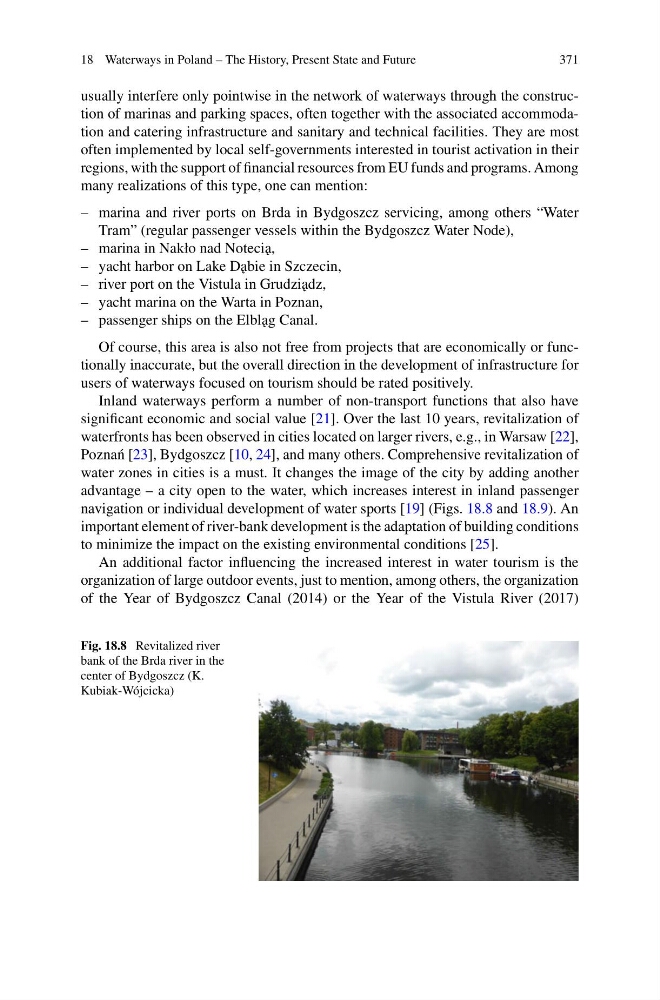
navigation or individual development of water sports [19] (Figs. 18.8 and 18.9). An
important element of river-bank development is the adaptation of building conditions
to minimize the impact on the existing environmental conditions [25].
An additional factor influencing the increased interest in water tourism is the
organization of large outdoor events, just to mention, among others, the organization
of the Year of Bydgoszcz Canal (2014) or the Year of the Vistula River (2017)
Fig. 18.8 Revitalized river
bank of the Brda river in the
center of Bydgoszcz (K.
Kubiak-Wójcicka)
371
usually interfere only pointwise in the network of waterways through the construction of marinas and parking spaces, often together with the associated accommodation and catering infrastructure and sanitary and technical facilities. They are most
often implemented by local self-governments interested in tourist activation in their
regions, with the support of financial resources from EU funds and programs. Among
many realizations of this type, one can mention:
– marina and river ports on Brda in Bydgoszcz servicing, among others “Water
Tram” (regular passenger vessels within the Bydgoszcz Water Node),
– marina in Nakło nad Noteci˛ a,
– yacht harbor on Lake D˛ abie in Szczecin,
– river port on the Vistula in Grudzi˛ adz,
– yacht marina on the Warta in Poznan,
– passenger ships on the Elbl˛ ag Canal.
Of course, this area is also not free from projects that are economically or functionally inaccurate, but the overall direction in the development of infrastructure for
users of waterways focused on tourism should be rated positively.
Inland waterways perform a number of non-transport functions that also have
significant economic and social value [21]. Over the last 10 years, revitalization of
waterfronts has been observed in cities located on larger rivers, e.g., in Warsaw [22],
Pozna´ n [23], Bydgoszcz [10, 24], and many others. Comprehensive revitalization of
water zones in cities is a must. It changes the image of the city by adding another
advantage – a city open to the water, which increases interest in inland passenger
navigation or individual development of water sports [19] (Figs. 18.8 and 18.9). An
important element of river-bank development is the adaptation of building conditions
to minimize the impact on the existing environmental conditions [25].
An additional factor influencing the increased interest in water tourism is the
organization of large outdoor events, just to mention, among others, the organization
of the Year of Bydgoszcz Canal (2014) or the Year of the Vistula River (2017)
Fig. 18.8 Revitalized river
bank of the Brda river in the
center of Bydgoszcz (K.
Kubiak-Wójcicka)