

16 Water Management in the Pomeranian Rivers Estuary Zone …
315
0
250
500
750
1000
1250
1500
1750
2000
Resko
Przymorskie
Jamno
Bukowo
Wicko
Gardno
Łebsko
Sarbsko
Chlorides [mg·dm 3
]
Lake
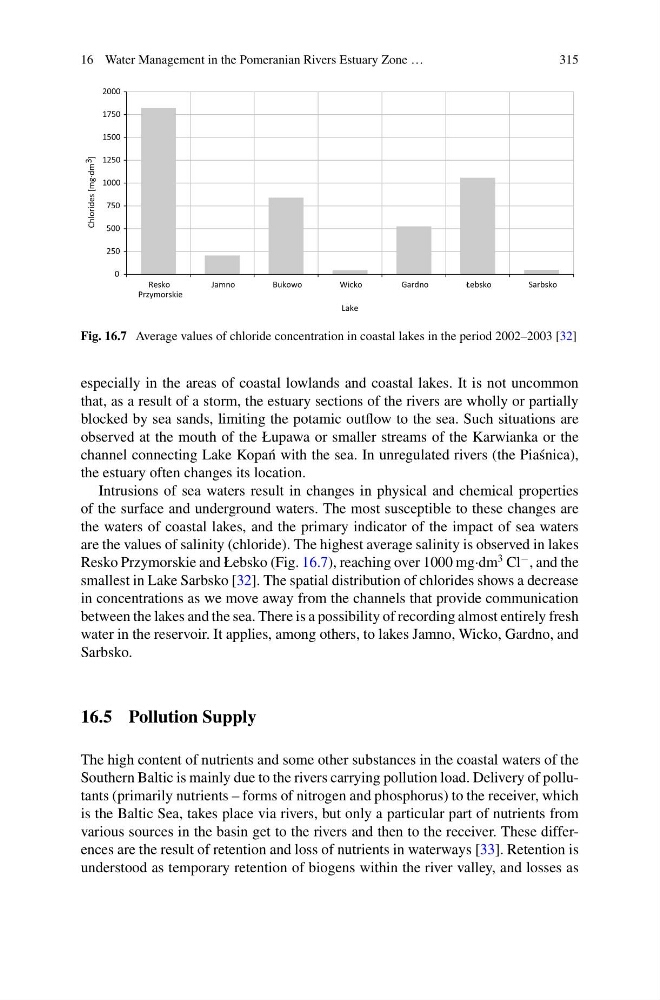
Fig. 16.7 Average values of chloride concentration in coastal lakes in the period 2002–2003 [32]
especially in the areas of coastal lowlands and coastal lakes. It is not uncommon
that, as a result of a storm, the estuary sections of the rivers are wholly or partially
blocked by sea sands, limiting the potamic outflow to the sea. Such situations are
observed at the mouth of the Łupawa or smaller streams of the Karwianka or the
channel connecting Lake Kopa´ n with the sea. In unregulated rivers (the Pia´ snica),
the estuary often changes its location.
Intrusions of sea waters result in changes in physical and chemical properties
of the surface and underground waters. The most susceptible to these changes are
the waters of coastal lakes, and the primary indicator of the impact of sea waters
are the values of salinity (chloride). The highest average salinity is observed in lakes
Resko Przymorskie and Łebsko (Fig. 16.7), reaching over 1000 mg·dm
3 Cl
− , and the
smallest in Lake Sarbsko [32]. The spatial distribution of chlorides shows a decrease
in concentrations as we move away from the channels that provide communication
between the lakes and the sea. There is a possibility of recording almost entirely fresh
water in the reservoir. It applies, among others, to lakes Jamno, Wicko, Gardno, and
Sarbsko.
16.5 Pollution Supply
The high content of nutrients and some other substances in the coastal waters of the
Southern Baltic is mainly due to the rivers carrying pollution load. Delivery of pollutants (primarily nutrients – forms of nitrogen and phosphorus) to the receiver, which
is the Baltic Sea, takes place via rivers, but only a particular part of nutrients from
various sources in the basin get to the rivers and then to the receiver. These differences are the result of retention and loss of nutrients in waterways [33]. Retention is
understood as temporary retention of biogens within the river valley, and losses as
315
0
250
500
750
1000
1250
1500
1750
2000
Resko
Przymorskie
Jamno
Bukowo
Wicko
Gardno
Łebsko
Sarbsko
Chlorides [mg·dm 3
]
Lake
Fig. 16.7 Average values of chloride concentration in coastal lakes in the period 2002–2003 [32]
especially in the areas of coastal lowlands and coastal lakes. It is not uncommon
that, as a result of a storm, the estuary sections of the rivers are wholly or partially
blocked by sea sands, limiting the potamic outflow to the sea. Such situations are
observed at the mouth of the Łupawa or smaller streams of the Karwianka or the
channel connecting Lake Kopa´ n with the sea. In unregulated rivers (the Pia´ snica),
the estuary often changes its location.
Intrusions of sea waters result in changes in physical and chemical properties
of the surface and underground waters. The most susceptible to these changes are
the waters of coastal lakes, and the primary indicator of the impact of sea waters
are the values of salinity (chloride). The highest average salinity is observed in lakes
Resko Przymorskie and Łebsko (Fig. 16.7), reaching over 1000 mg·dm
3 Cl
− , and the
smallest in Lake Sarbsko [32]. The spatial distribution of chlorides shows a decrease
in concentrations as we move away from the channels that provide communication
between the lakes and the sea. There is a possibility of recording almost entirely fresh
water in the reservoir. It applies, among others, to lakes Jamno, Wicko, Gardno, and
Sarbsko.
16.5 Pollution Supply
The high content of nutrients and some other substances in the coastal waters of the
Southern Baltic is mainly due to the rivers carrying pollution load. Delivery of pollutants (primarily nutrients – forms of nitrogen and phosphorus) to the receiver, which
is the Baltic Sea, takes place via rivers, but only a particular part of nutrients from
various sources in the basin get to the rivers and then to the receiver. These differences are the result of retention and loss of nutrients in waterways [33]. Retention is
understood as temporary retention of biogens within the river valley, and losses as