

13 Flood Marks in Poland and Their Significance in Water …
259
the beginning of the nineteenth century display many characteristics common with
sepulchral monuments, in the decades that followed, they gradually moved towards
the universal form of a rectangular metal plaque. The attempts to standardize the
form, content and placement method are visible particularly in the case of marks
erected in the 1960s from the initiative of the national hydrological-meteorological
service. It implemented a uniform country-wide pattern for the flood marks, with the
date of the flood was minted using a special dater [22].
The high watermarks can be found both outdoors and indoors, although the
formers are decisively much more common. They are usually placed on objects
whose structure can withstand the passage of time, natural or man-made disasters
– such as fires, war, or floods [12]. They are usually located on walls of buildings,
particularly churches – which for centuries had been ones of the few stone/brick
structures existing in the rural areas. Since the beginning of the eighteenth century,
when the water regulation and channeling work intensified, they began to appear
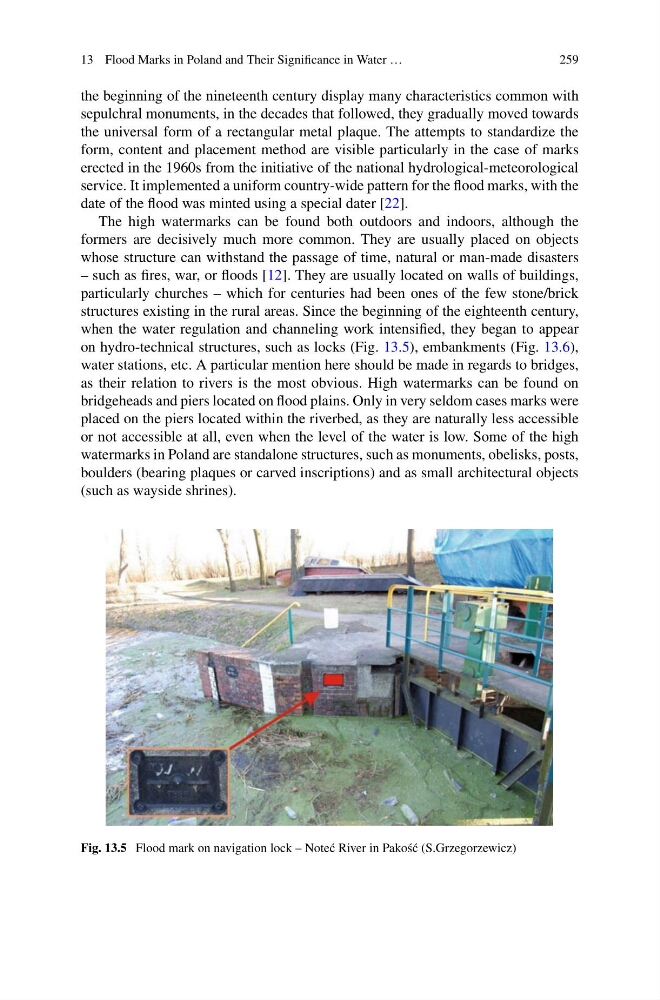
on hydro-technical structures, such as locks (Fig. 13.5), embankments (Fig. 13.6),
water stations, etc. A particular mention here should be made in regards to bridges,
as their relation to rivers is the most obvious. High watermarks can be found on
bridgeheads and piers located on flood plains. Only in very seldom cases marks were
placed on the piers located within the riverbed, as they are naturally less accessible
or not accessible at all, even when the level of the water is low. Some of the high
watermarks in Poland are standalone structures, such as monuments, obelisks, posts,
boulders (bearing plaques or carved inscriptions) and as small architectural objects
(such as wayside shrines).
Fig. 13.5 Flood mark on navigation lock – Note´ c River in Pako´ s´ c (S.Grzegorzewicz)
259
the beginning of the nineteenth century display many characteristics common with
sepulchral monuments, in the decades that followed, they gradually moved towards
the universal form of a rectangular metal plaque. The attempts to standardize the
form, content and placement method are visible particularly in the case of marks
erected in the 1960s from the initiative of the national hydrological-meteorological
service. It implemented a uniform country-wide pattern for the flood marks, with the
date of the flood was minted using a special dater [22].
The high watermarks can be found both outdoors and indoors, although the
formers are decisively much more common. They are usually placed on objects
whose structure can withstand the passage of time, natural or man-made disasters
– such as fires, war, or floods [12]. They are usually located on walls of buildings,
particularly churches – which for centuries had been ones of the few stone/brick
structures existing in the rural areas. Since the beginning of the eighteenth century,
when the water regulation and channeling work intensified, they began to appear
on hydro-technical structures, such as locks (Fig. 13.5), embankments (Fig. 13.6),
water stations, etc. A particular mention here should be made in regards to bridges,
as their relation to rivers is the most obvious. High watermarks can be found on
bridgeheads and piers located on flood plains. Only in very seldom cases marks were
placed on the piers located within the riverbed, as they are naturally less accessible
or not accessible at all, even when the level of the water is low. Some of the high
watermarks in Poland are standalone structures, such as monuments, obelisks, posts,
boulders (bearing plaques or carved inscriptions) and as small architectural objects
(such as wayside shrines).
Fig. 13.5 Flood mark on navigation lock – Note´ c River in Pako´ s´ c (S.Grzegorzewicz)