

166
D. Wrzesi´ nski
a rich hydrometric material collected at 516 water gauge stations, located on 295
rivers from the period 1971–2010.
Type 1 – the nival poorly formed regime. It is characteristic of rivers whose
average flow of the spring month does not exceed 130% of the average annual flow.
This refers mainly to the rivers of Przymorze (east of the Pars˛ eta River) and the
Pomeranian Lake District (the upper Drawa River, and the Gwda and Brda rivers).
This type of regime is also represented by some rivers in the Masurian Lake District,
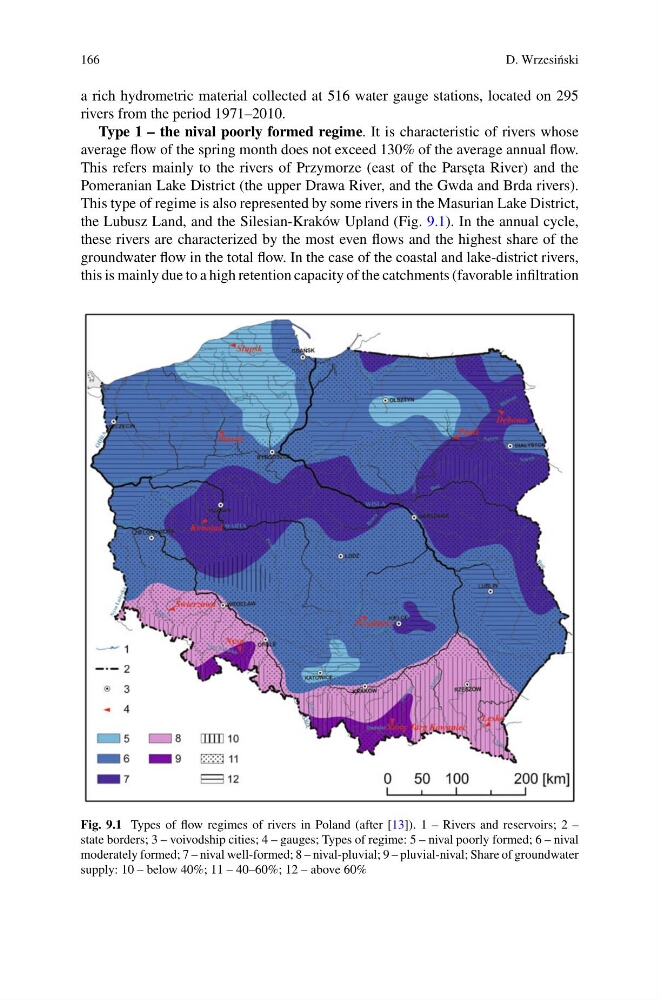
the Lubusz Land, and the Silesian-Kraków Upland (Fig. 9.1). In the annual cycle,
these rivers are characterized by the most even flows and the highest share of the
groundwater flow in the total flow. In the case of the coastal and lake-district rivers,
this is mainly due to a high retention capacity of the catchments (favorable infiltration
Fig. 9.1 Types of flow regimes of rivers in Poland (after [13]). 1 – Rivers and reservoirs; 2 –
state borders; 3 – voivodship cities; 4 – gauges; Types of regime: 5 – nival poorly formed; 6 – nival
moderately formed; 7 – nival well-formed; 8 – nival-pluvial; 9 – pluvial-nival; Share of groundwater
supply: 10 – below 40%; 11 – 40–60%; 12 – above 60%
D. Wrzesi´ nski
a rich hydrometric material collected at 516 water gauge stations, located on 295
rivers from the period 1971–2010.
Type 1 – the nival poorly formed regime. It is characteristic of rivers whose
average flow of the spring month does not exceed 130% of the average annual flow.
This refers mainly to the rivers of Przymorze (east of the Pars˛ eta River) and the
Pomeranian Lake District (the upper Drawa River, and the Gwda and Brda rivers).
This type of regime is also represented by some rivers in the Masurian Lake District,
the Lubusz Land, and the Silesian-Kraków Upland (Fig. 9.1). In the annual cycle,
these rivers are characterized by the most even flows and the highest share of the
groundwater flow in the total flow. In the case of the coastal and lake-district rivers,
this is mainly due to a high retention capacity of the catchments (favorable infiltration
Fig. 9.1 Types of flow regimes of rivers in Poland (after [13]). 1 – Rivers and reservoirs; 2 –
state borders; 3 – voivodship cities; 4 – gauges; Types of regime: 5 – nival poorly formed; 6 – nival
moderately formed; 7 – nival well-formed; 8 – nival-pluvial; 9 – pluvial-nival; Share of groundwater
supply: 10 – below 40%; 11 – 40–60%; 12 – above 60%