

94
J. Dawidek et al.
of the high variability of flows, helped to increase the transport efficiency of the beds
and faster outflow of river waters throughout the year. Significant lengthening of
the basins (beds) in relation to their width does not favor the limnic functioning of
these forms. Only a few basins can be considered anastomotic lakes. The condition
of the functioning of the flow of potamic waters through the basin must be met while
maintaining the zones of standing waters or waters with very slow motion.
Division by supply direction
The origin of the floodplain lake determines the manner and rate of supplying the
basin with the parent river water, and during the potamophase, most of the floodplain
lakes have a flowing character. Depending on the direction of supplying waters
in relation to the slope of the valley bottom, there are four hydrological types of
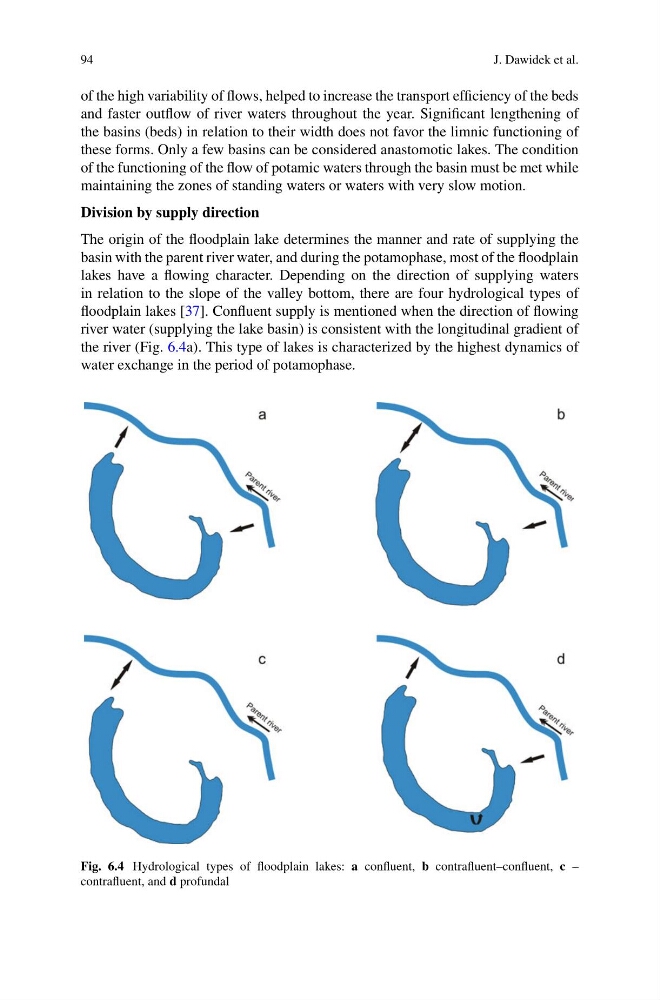
floodplain lakes [37]. Confluent supply is mentioned when the direction of flowing
river water (supplying the lake basin) is consistent with the longitudinal gradient of
the river (Fig. 6.4a). This type of lakes is characterized by the highest dynamics of
water exchange in the period of potamophase.
Fig. 6.4 Hydrological types of floodplain lakes: a confluent, b contrafluent–confluent, c –
contrafluent, and d profundal
J. Dawidek et al.
of the high variability of flows, helped to increase the transport efficiency of the beds
and faster outflow of river waters throughout the year. Significant lengthening of
the basins (beds) in relation to their width does not favor the limnic functioning of
these forms. Only a few basins can be considered anastomotic lakes. The condition
of the functioning of the flow of potamic waters through the basin must be met while
maintaining the zones of standing waters or waters with very slow motion.
Division by supply direction
The origin of the floodplain lake determines the manner and rate of supplying the
basin with the parent river water, and during the potamophase, most of the floodplain
lakes have a flowing character. Depending on the direction of supplying waters
in relation to the slope of the valley bottom, there are four hydrological types of
floodplain lakes [37]. Confluent supply is mentioned when the direction of flowing
river water (supplying the lake basin) is consistent with the longitudinal gradient of
the river (Fig. 6.4a). This type of lakes is characterized by the highest dynamics of
water exchange in the period of potamophase.
Fig. 6.4 Hydrological types of floodplain lakes: a confluent, b contrafluent–confluent, c –
contrafluent, and d profundal