

1 Foundation of Fluid Mechanics
59
different values for different flow problems, but also had different values for
the same flow problem in different regions at different times. According to
turbulent motion characteristics, v t could change obviously in the flow field.
According to the results of dimensional analysis and turbulence research, the
characteristic length scale and characteristic velocity scale of eddy viscous v t
with loaded energy are determined, namely
ν t ∝ l t V t
l t —Energy – carrying Vortex Length Scale
V t —Velocity Scale of Energy – carrying Vortex
Ratio of turbulent stress to viscous stress
τ t
τ l
=
−ρu v
ρν
∂u
∂ y
=
ρν t
∂u
∂ y
ρν
∂u
∂ y
=
ν t
ν
=
l t V t
ν
= Re t
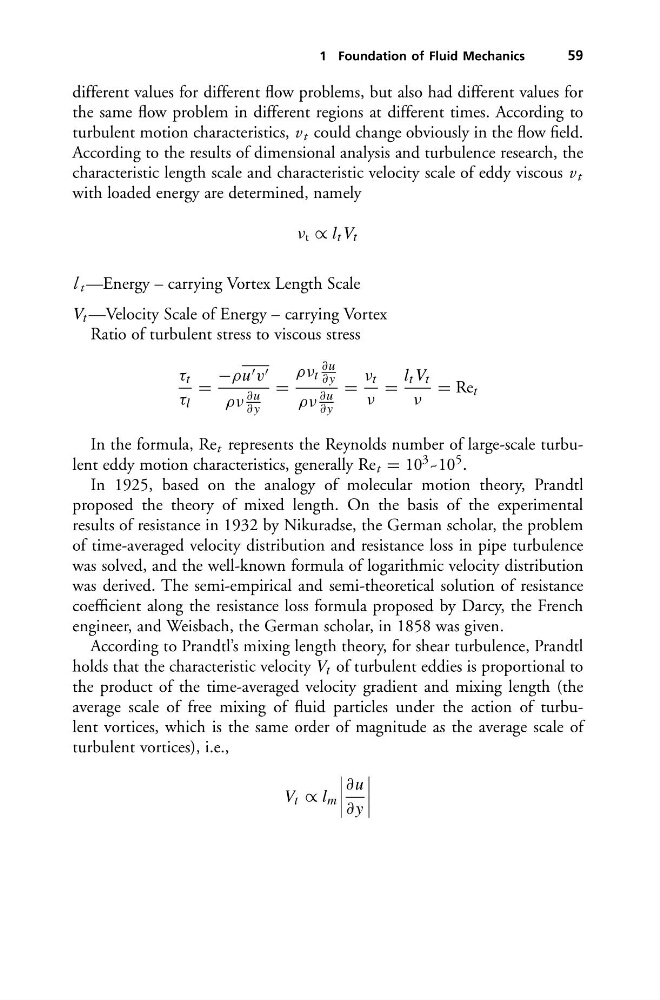
In the formula, Re t represents the Reynolds number of large-scale turbulent eddy motion characteristics, generally Re t = 10 3 ~10 5 .
In 1925, based on the analogy of molecular motion theory, Prandtl
proposed the theory of mixed length. On the basis of the experimental
results of resistance in 1932 by Nikuradse, the German scholar, the problem
of time-averaged velocity distribution and resistance loss in pipe turbulence
was solved, and the well-known formula of logarithmic velocity distribution
was derived. The semi-empirical and semi-theoretical solution of resistance
coefficient along the resistance loss formula proposed by Darcy, the French
engineer, and Weisbach, the German scholar, in 1858 was given.
According to Prandtl’s mixing length theory, for shear turbulence, Prandtl
holds that the characteristic velocity V t of turbulent eddies is proportional to
the product of the time-averaged velocity gradient and mixing length (the
average scale of free mixing of fluid particles under the action of turbulent vortices, which is the same order of magnitude as the average scale of
turbulent vortices), i.e.,
V t ∝ l m
∂u
∂ y
59
different values for different flow problems, but also had different values for
the same flow problem in different regions at different times. According to
turbulent motion characteristics, v t could change obviously in the flow field.
According to the results of dimensional analysis and turbulence research, the
characteristic length scale and characteristic velocity scale of eddy viscous v t
with loaded energy are determined, namely
ν t ∝ l t V t
l t —Energy – carrying Vortex Length Scale
V t —Velocity Scale of Energy – carrying Vortex
Ratio of turbulent stress to viscous stress
τ t
τ l
=
−ρu v
ρν
∂u
∂ y
=
ρν t
∂u
∂ y
ρν
∂u
∂ y
=
ν t
ν
=
l t V t
ν
= Re t
In the formula, Re t represents the Reynolds number of large-scale turbulent eddy motion characteristics, generally Re t = 10 3 ~10 5 .
In 1925, based on the analogy of molecular motion theory, Prandtl
proposed the theory of mixed length. On the basis of the experimental
results of resistance in 1932 by Nikuradse, the German scholar, the problem
of time-averaged velocity distribution and resistance loss in pipe turbulence
was solved, and the well-known formula of logarithmic velocity distribution
was derived. The semi-empirical and semi-theoretical solution of resistance
coefficient along the resistance loss formula proposed by Darcy, the French
engineer, and Weisbach, the German scholar, in 1858 was given.
According to Prandtl’s mixing length theory, for shear turbulence, Prandtl
holds that the characteristic velocity V t of turbulent eddies is proportional to
the product of the time-averaged velocity gradient and mixing length (the
average scale of free mixing of fluid particles under the action of turbulent vortices, which is the same order of magnitude as the average scale of
turbulent vortices), i.e.,
V t ∝ l m
∂u
∂ y