

156
P. Liu
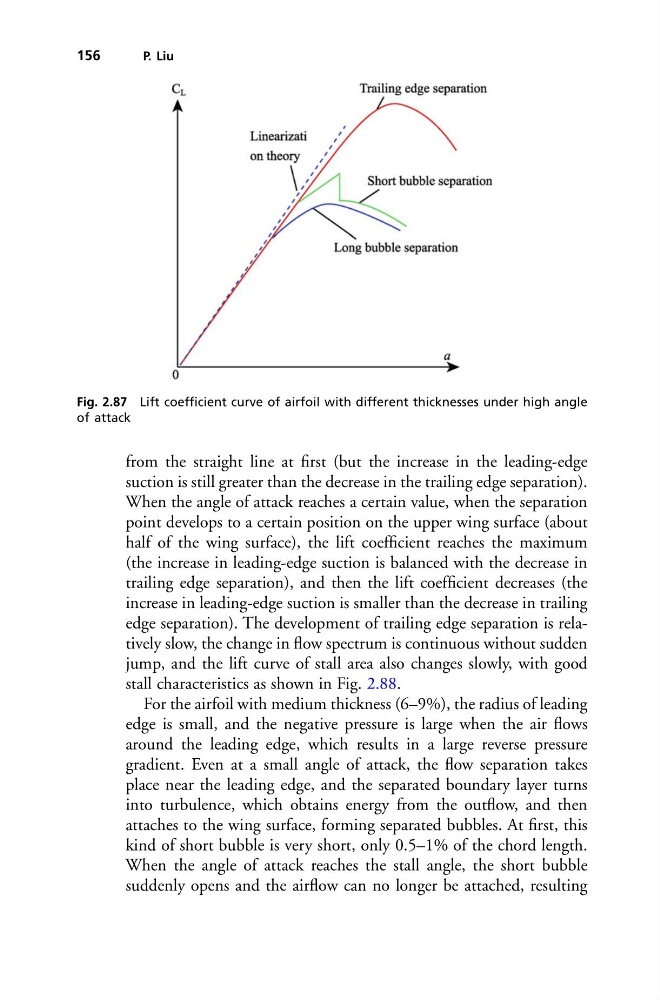
Fig. 2.87 Lift coefficient curve of airfoil with different thicknesses under high angle
of attack
from the straight line at first (but the increase in the leading-edge
suction is still greater than the decrease in the trailing edge separation).
When the angle of attack reaches a certain value, when the separation
point develops to a certain position on the upper wing surface (about
half of the wing surface), the lift coefficient reaches the maximum
(the increase in leading-edge suction is balanced with the decrease in
trailing edge separation), and then the lift coefficient decreases (the
increase in leading-edge suction is smaller than the decrease in trailing
edge separation). The development of trailing edge separation is relatively slow, the change in flow spectrum is continuous without sudden
jump, and the lift curve of stall area also changes slowly, with good
stall characteristics as shown in Fig. 2.88.
For the airfoil with medium thickness (6–9%), the radius of leading
edge is small, and the negative pressure is large when the air flows
around the leading edge, which results in a large reverse pressure
gradient. Even at a small angle of attack, the flow separation takes
place near the leading edge, and the separated boundary layer turns
into turbulence, which obtains energy from the outflow, and then
attaches to the wing surface, forming separated bubbles. At first, this
kind of short bubble is very short, only 0.5–1% of the chord length.
When the angle of attack reaches the stall angle, the short bubble
suddenly opens and the airflow can no longer be attached, resulting
P. Liu
Fig. 2.87 Lift coefficient curve of airfoil with different thicknesses under high angle
of attack
from the straight line at first (but the increase in the leading-edge
suction is still greater than the decrease in the trailing edge separation).
When the angle of attack reaches a certain value, when the separation
point develops to a certain position on the upper wing surface (about
half of the wing surface), the lift coefficient reaches the maximum
(the increase in leading-edge suction is balanced with the decrease in
trailing edge separation), and then the lift coefficient decreases (the
increase in leading-edge suction is smaller than the decrease in trailing
edge separation). The development of trailing edge separation is relatively slow, the change in flow spectrum is continuous without sudden
jump, and the lift curve of stall area also changes slowly, with good
stall characteristics as shown in Fig. 2.88.
For the airfoil with medium thickness (6–9%), the radius of leading
edge is small, and the negative pressure is large when the air flows
around the leading edge, which results in a large reverse pressure
gradient. Even at a small angle of attack, the flow separation takes
place near the leading edge, and the separated boundary layer turns
into turbulence, which obtains energy from the outflow, and then
attaches to the wing surface, forming separated bubbles. At first, this
kind of short bubble is very short, only 0.5–1% of the chord length.
When the angle of attack reaches the stall angle, the short bubble
suddenly opens and the airflow can no longer be attached, resulting