

water, as assessed by faecal indicators (E. coli, faecal coliforms, and enterococci)
and pathogens like Salmonella spp. E. coli O157:H7 and Listeria spp. [52, 53].
Orlofsky et al. [54] carried out field experiments to monitor the human pathogenic
bacteria, protozoa, and viruses in parallel trials of tomatoes watered with treated
wastewater or with fresh water using a combination of microscopic, cultivationbased, and molecular techniques. The results revealed that microbial contamination
on the surface of the tomatoes was not associated with the source of the irrigation
water. In the specific case of greywater (domestic wastewater that excludes wastewater from toilets), contradicting results regarding increasing levels of faecal coliforms in soils following long-term greywater irrigation have been reported [55].
Efficacy of removal of pathogens and indicators is strictly dependent on the type
of treatment conducted prior to irrigation reuse of wastewater: engineered systems
that may include membrane filtration and UV disinfection units typically achieve the
highest performance but also have higher installation and upkeep costs. Conversely,
constructed wetlands and phytodepuration systems are considerably less technologically and energetically demanding, but their performance is consequently more
variable [56].
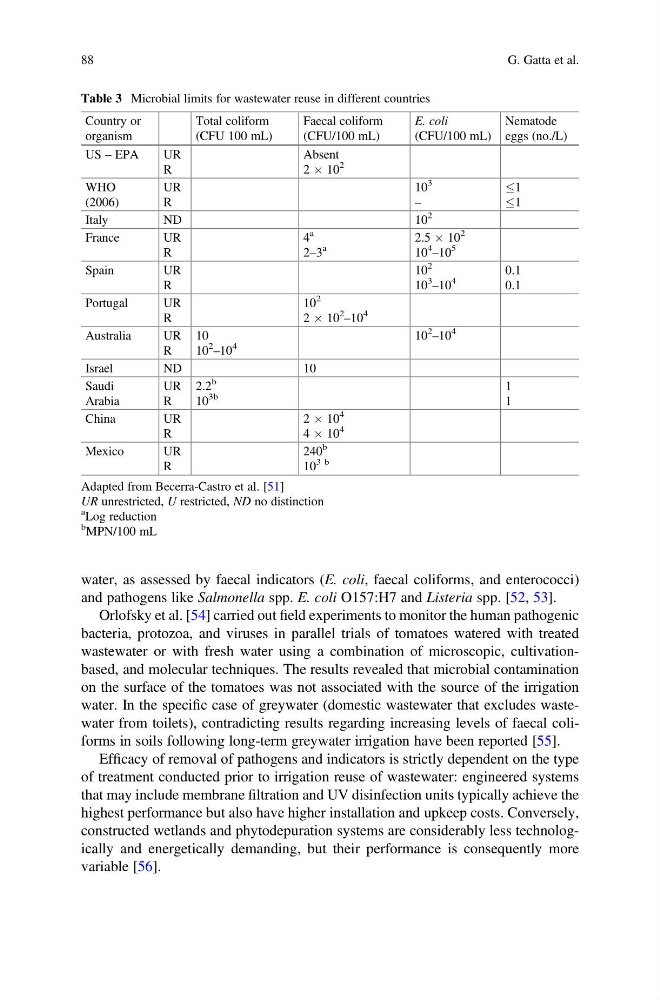
Table 3 Microbial limits for wastewater reuse in different countries
Country or
organism
Total coliform
(CFU 100 mL)
Faecal coliform
(CFU/100 mL)
E. coli
(CFU/100 mL)
Nematode
eggs (no./L)
US – EPA
UR
R
Absent
2 Â 10
2
WHO
(2006)
UR
R
10
3
–
1
1
Italy
ND
10
2
France
UR
R
4
a
2–3
a
2.5 Â 10
2
10
4
–10
5
Spain
UR
R
10
2
10
3
–10
4
0.1
0.1
Portugal
UR
R
10
2
2 Â 10
2
–10
4
Australia
UR
R
10
10
2
–10
4
10
2
–10
4
Israel
ND
10
Saudi
Arabia
UR
R
2.2
b
10
3b
1
1
China
UR
R
2 Â 10
4
4 Â 10
4
Mexico
UR
R
240
b
10
3 b
Adapted from Becerra-Castro et al. [51]
UR unrestricted, U restricted, ND no distinction
a Log reduction
b
MPN/100 mL
88
G. Gatta et al.
and pathogens like Salmonella spp. E. coli O157:H7 and Listeria spp. [52, 53].
Orlofsky et al. [54] carried out field experiments to monitor the human pathogenic
bacteria, protozoa, and viruses in parallel trials of tomatoes watered with treated
wastewater or with fresh water using a combination of microscopic, cultivationbased, and molecular techniques. The results revealed that microbial contamination
on the surface of the tomatoes was not associated with the source of the irrigation
water. In the specific case of greywater (domestic wastewater that excludes wastewater from toilets), contradicting results regarding increasing levels of faecal coliforms in soils following long-term greywater irrigation have been reported [55].
Efficacy of removal of pathogens and indicators is strictly dependent on the type
of treatment conducted prior to irrigation reuse of wastewater: engineered systems
that may include membrane filtration and UV disinfection units typically achieve the
highest performance but also have higher installation and upkeep costs. Conversely,
constructed wetlands and phytodepuration systems are considerably less technologically and energetically demanding, but their performance is consequently more
variable [56].
Table 3 Microbial limits for wastewater reuse in different countries
Country or
organism
Total coliform
(CFU 100 mL)
Faecal coliform
(CFU/100 mL)
E. coli
(CFU/100 mL)
Nematode
eggs (no./L)
US – EPA
UR
R
Absent
2 Â 10
2
WHO
(2006)
UR
R
10
3
–
1
1
Italy
ND
10
2
France
UR
R
4
a
2–3
a
2.5 Â 10
2
10
4
–10
5
Spain
UR
R
10
2
10
3
–10
4
0.1
0.1
Portugal
UR
R
10
2
2 Â 10
2
–10
4
Australia
UR
R
10
10
2
–10
4
10
2
–10
4
Israel
ND
10
Saudi
Arabia
UR
R
2.2
b
10
3b
1
1
China
UR
R
2 Â 10
4
4 Â 10
4
Mexico
UR
R
240
b
10
3 b
Adapted from Becerra-Castro et al. [51]
UR unrestricted, U restricted, ND no distinction
a Log reduction
b
MPN/100 mL
88
G. Gatta et al.