

5 Sewage Sludge Management
Searches of the International Scientific Indexing database (ISI) for articles dealing
with sludge and biosolids yielded 4,030 articles published between 1976 and 2008
and 6,410 between 2009 and 2018. The articles dealing with application on agricultural land were concerned with the emission of gases (CH 4 , NO 2 , NH 3 ), with 15% of
ammonia (NH 3 ) [31, 89]. The evaluation of sludge life cycle highlights their richness
in nitrogen and phosphorus explaining their valorization as fertilizer in several
countries. Within EU countries, there are three main sludge disposal possibilities.
Sludge valorisation as fertilizer remains a priority, and in France, 60% of WW
sludge is used as fertilizer in agricultural fields [89], even though different existing
methods for sludge disposal are based on landfilling, composting and incineration
are practiced [90, 91] (Fig. 4). Sludge is used as fertilizer for agriculture in Portugal,
Ireland, the United Kingdom, Spain, Norway, and Albania. However, 2/3 of sludge
was composted in Estonia (2013 data) and Hungary (2015 data). Incineration is the
main mode of sludge disposal in the Netherlands, Germany, Slovenia, and Austria,
as well as Switzerland. Controlled landfill is the main and only mode of
treatment used in Malta and Serbia, as well as in Bosnia and Herzegovina. Other
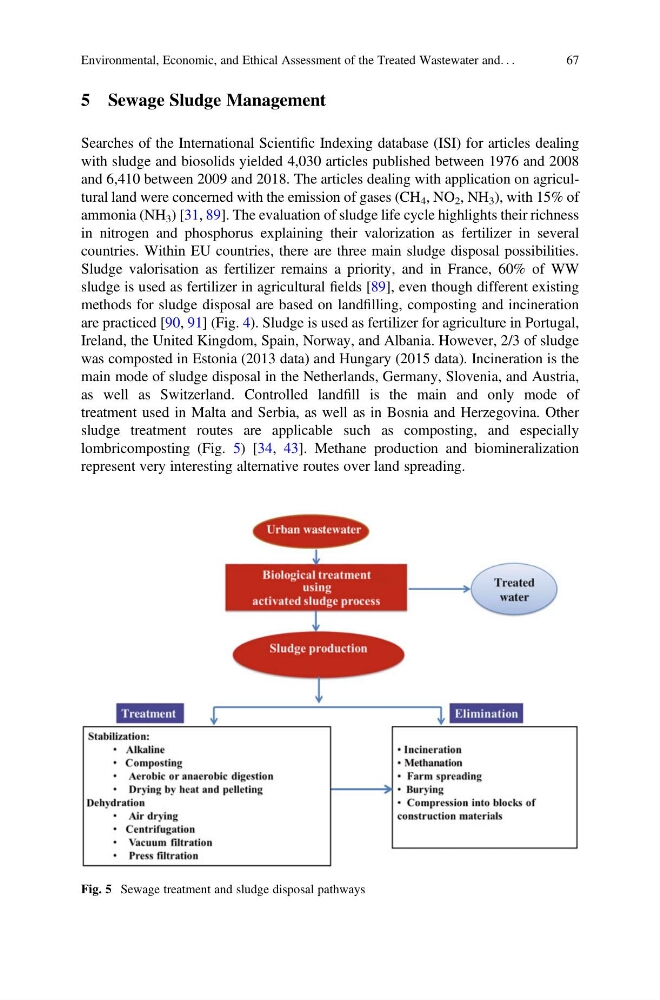
sludge treatment routes are applicable such as composting, and especially
lombricomposting (Fig. 5) [34, 43]. Methane production and biomineralization
represent very interesting alternative routes over land spreading.
Fig. 5 Sewage treatment and sludge disposal pathways
Environmental, Economic, and Ethical Assessment of the Treated Wastewater and. . .
67
Searches of the International Scientific Indexing database (ISI) for articles dealing
with sludge and biosolids yielded 4,030 articles published between 1976 and 2008
and 6,410 between 2009 and 2018. The articles dealing with application on agricultural land were concerned with the emission of gases (CH 4 , NO 2 , NH 3 ), with 15% of
ammonia (NH 3 ) [31, 89]. The evaluation of sludge life cycle highlights their richness
in nitrogen and phosphorus explaining their valorization as fertilizer in several
countries. Within EU countries, there are three main sludge disposal possibilities.
Sludge valorisation as fertilizer remains a priority, and in France, 60% of WW
sludge is used as fertilizer in agricultural fields [89], even though different existing
methods for sludge disposal are based on landfilling, composting and incineration
are practiced [90, 91] (Fig. 4). Sludge is used as fertilizer for agriculture in Portugal,
Ireland, the United Kingdom, Spain, Norway, and Albania. However, 2/3 of sludge
was composted in Estonia (2013 data) and Hungary (2015 data). Incineration is the
main mode of sludge disposal in the Netherlands, Germany, Slovenia, and Austria,
as well as Switzerland. Controlled landfill is the main and only mode of
treatment used in Malta and Serbia, as well as in Bosnia and Herzegovina. Other
sludge treatment routes are applicable such as composting, and especially
lombricomposting (Fig. 5) [34, 43]. Methane production and biomineralization
represent very interesting alternative routes over land spreading.
Fig. 5 Sewage treatment and sludge disposal pathways
Environmental, Economic, and Ethical Assessment of the Treated Wastewater and. . .
67