

cycle, methanogenesis, and sulfate reduction have been reported [81]. It was also
observed that degradation products of amoxicillin contaminate groundwater in an
agricultural field irrigated with WW [82].
With regard to the ARGs, studies by Wang et al. demonstrated that the WWTP
could not effectively remove super antibiotic resistance genes (SARGs) with high
amount being discharged into the Yangtze River. They were transported into the
drinking water treatment plant (DWTP), and the persistent SARGs in the effluent
would probably be transferred into human, thus imposing great threats on public
health [83]. About 40% of the erythromycin resistance genes and 80% of the
tetracycline resistance genes could not be eliminated from the WW even after
chlorination [84, 85]. In a recent study, using metagenomics approaches Chu et al.
have also shown a large abundance of ARGs belonging to the aminoglycoside and
phenicols groups, including chloramphenicol and its florfenicol derivatives and
thiamphenicol, in river water that has received effluents from the WWTP
[86]. Indeed, they tracked genes specific to antibiotic resistance and mobile genetic
elements and their associated organisms, from WWTPs to lake sediments, based on
two different WWTPs microbiomes with different treatment processes. Thus, a
thorough risk assessment of antibiotics and ARGs within the sewage sludge and
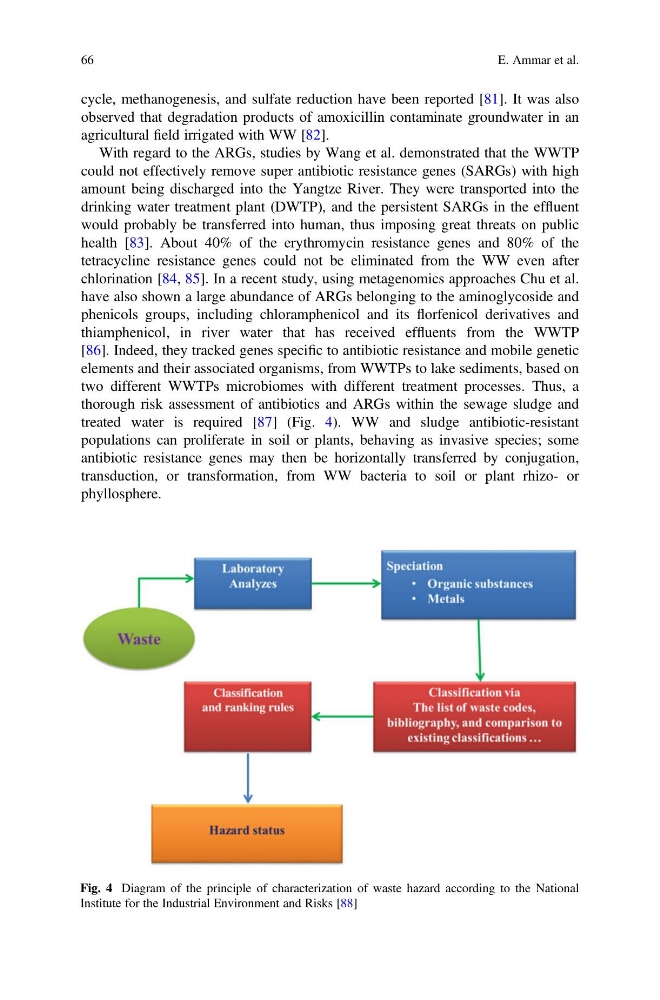
treated water is required [87] (Fig. 4). WW and sludge antibiotic-resistant
populations can proliferate in soil or plants, behaving as invasive species; some
antibiotic resistance genes may then be horizontally transferred by conjugation,
transduction, or transformation, from WW bacteria to soil or plant rhizo- or
phyllosphere.
Fig. 4 Diagram of the principle of characterization of waste hazard according to the National
Institute for the Industrial Environment and Risks [88]
66
E. Ammar et al.
observed that degradation products of amoxicillin contaminate groundwater in an
agricultural field irrigated with WW [82].
With regard to the ARGs, studies by Wang et al. demonstrated that the WWTP
could not effectively remove super antibiotic resistance genes (SARGs) with high
amount being discharged into the Yangtze River. They were transported into the
drinking water treatment plant (DWTP), and the persistent SARGs in the effluent
would probably be transferred into human, thus imposing great threats on public
health [83]. About 40% of the erythromycin resistance genes and 80% of the
tetracycline resistance genes could not be eliminated from the WW even after
chlorination [84, 85]. In a recent study, using metagenomics approaches Chu et al.
have also shown a large abundance of ARGs belonging to the aminoglycoside and
phenicols groups, including chloramphenicol and its florfenicol derivatives and
thiamphenicol, in river water that has received effluents from the WWTP
[86]. Indeed, they tracked genes specific to antibiotic resistance and mobile genetic
elements and their associated organisms, from WWTPs to lake sediments, based on
two different WWTPs microbiomes with different treatment processes. Thus, a
thorough risk assessment of antibiotics and ARGs within the sewage sludge and
treated water is required [87] (Fig. 4). WW and sludge antibiotic-resistant
populations can proliferate in soil or plants, behaving as invasive species; some
antibiotic resistance genes may then be horizontally transferred by conjugation,
transduction, or transformation, from WW bacteria to soil or plant rhizo- or
phyllosphere.
Fig. 4 Diagram of the principle of characterization of waste hazard according to the National
Institute for the Industrial Environment and Risks [88]
66
E. Ammar et al.