

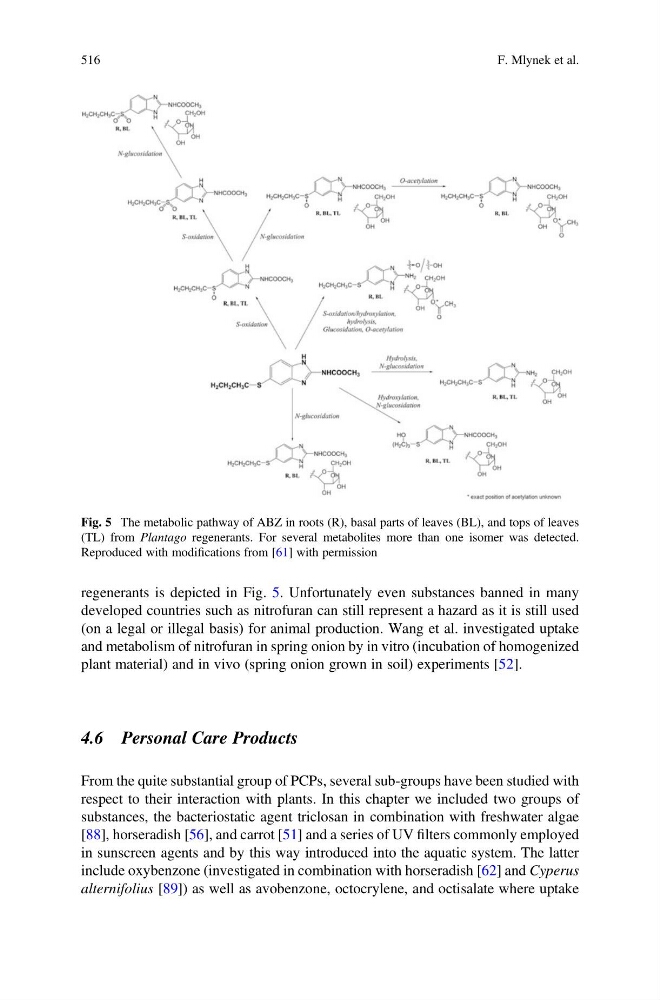
regenerants is depicted in Fig. 5. Unfortunately even substances banned in many
developed countries such as nitrofuran can still represent a hazard as it is still used
(on a legal or illegal basis) for animal production. Wang et al. investigated uptake
and metabolism of nitrofuran in spring onion by in vitro (incubation of homogenized
plant material) and in vivo (spring onion grown in soil) experiments [52].
4.6 Personal Care Products
From the quite substantial group of PCPs, several sub-groups have been studied with
respect to their interaction with plants. In this chapter we included two groups of
substances, the bacteriostatic agent triclosan in combination with freshwater algae
[88], horseradish [56], and carrot [51] and a series of UV filters commonly employed
in sunscreen agents and by this way introduced into the aquatic system. The latter
include oxybenzone (investigated in combination with horseradish [62] and Cyperus
alternifolius [89]) as well as avobenzone, octocrylene, and octisalate where uptake
Fig. 5 The metabolic pathway of ABZ in roots (R), basal parts of leaves (BL), and tops of leaves
(TL) from Plantago regenerants. For several metabolites more than one isomer was detected.
Reproduced with modifications from [61] with permission
516
F. Mlynek et al.
developed countries such as nitrofuran can still represent a hazard as it is still used
(on a legal or illegal basis) for animal production. Wang et al. investigated uptake
and metabolism of nitrofuran in spring onion by in vitro (incubation of homogenized
plant material) and in vivo (spring onion grown in soil) experiments [52].
4.6 Personal Care Products
From the quite substantial group of PCPs, several sub-groups have been studied with
respect to their interaction with plants. In this chapter we included two groups of
substances, the bacteriostatic agent triclosan in combination with freshwater algae
[88], horseradish [56], and carrot [51] and a series of UV filters commonly employed
in sunscreen agents and by this way introduced into the aquatic system. The latter
include oxybenzone (investigated in combination with horseradish [62] and Cyperus
alternifolius [89]) as well as avobenzone, octocrylene, and octisalate where uptake
Fig. 5 The metabolic pathway of ABZ in roots (R), basal parts of leaves (BL), and tops of leaves
(TL) from Plantago regenerants. For several metabolites more than one isomer was detected.
Reproduced with modifications from [61] with permission
516
F. Mlynek et al.