

4 More Detailed Discussion of Papers Published Within
This Field
A comprehensive overview of the current state of literature within the field discussed
in this book chapter is provided in Table 1. Thereby information about drugs and
personal care products investigated, plant or plant cell models employed, metabolites
detected (phase I + II), as well as strategies used for metabolite detection and
identification is given.
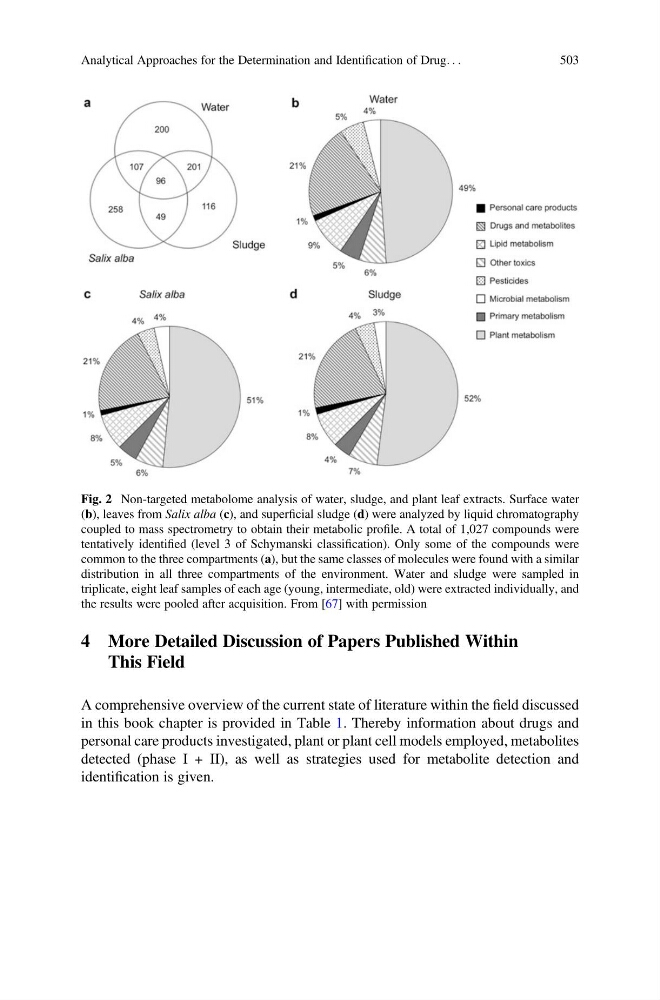
Fig. 2 Non-targeted metabolome analysis of water, sludge, and plant leaf extracts. Surface water
(b), leaves from Salix alba (c), and superficial sludge (d) were analyzed by liquid chromatography
coupled to mass spectrometry to obtain their metabolic profile. A total of 1,027 compounds were
tentatively identified (level 3 of Schymanski classification). Only some of the compounds were
common to the three compartments (a), but the same classes of molecules were found with a similar
distribution in all three compartments of the environment. Water and sludge were sampled in
triplicate, eight leaf samples of each age (young, intermediate, old) were extracted individually, and
the results were pooled after acquisition. From [67] with permission
Analytical Approaches for the Determination and Identification of Drug. . .
503
This Field
A comprehensive overview of the current state of literature within the field discussed
in this book chapter is provided in Table 1. Thereby information about drugs and
personal care products investigated, plant or plant cell models employed, metabolites
detected (phase I + II), as well as strategies used for metabolite detection and
identification is given.
Fig. 2 Non-targeted metabolome analysis of water, sludge, and plant leaf extracts. Surface water
(b), leaves from Salix alba (c), and superficial sludge (d) were analyzed by liquid chromatography
coupled to mass spectrometry to obtain their metabolic profile. A total of 1,027 compounds were
tentatively identified (level 3 of Schymanski classification). Only some of the compounds were
common to the three compartments (a), but the same classes of molecules were found with a similar
distribution in all three compartments of the environment. Water and sludge were sampled in
triplicate, eight leaf samples of each age (young, intermediate, old) were extracted individually, and
the results were pooled after acquisition. From [67] with permission
Analytical Approaches for the Determination and Identification of Drug. . .
503