

countries. These concentrations of pharmaceuticals can induce serious environmental threats such as congenital disorders, physical abnormalities, impairments of the
endocrine and reproductive system, and feminization of some fish species
[13, 14]. Due to the capability of micro-pollutants and pharmaceutically active
compounds to cause adverse effects to the ecosystem and human health, they have
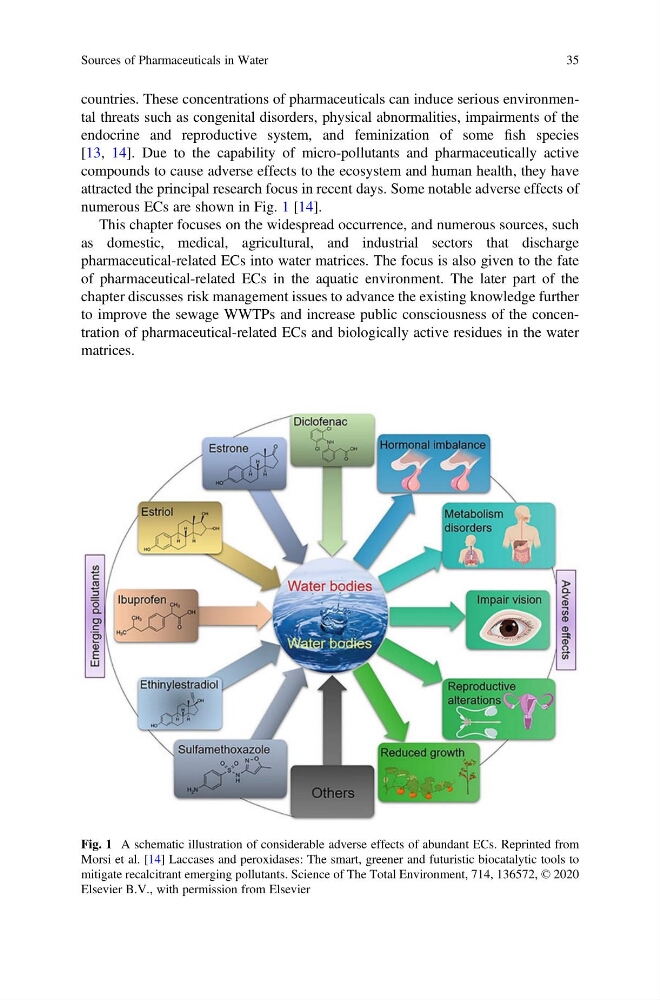
attracted the principal research focus in recent days. Some notable adverse effects of
numerous ECs are shown in Fig. 1 [14].
This chapter focuses on the widespread occurrence, and numerous sources, such
as domestic, medical, agricultural, and industrial sectors that discharge
pharmaceutical-related ECs into water matrices. The focus is also given to the fate
of pharmaceutical-related ECs in the aquatic environment. The later part of the
chapter discusses risk management issues to advance the existing knowledge further
to improve the sewage WWTPs and increase public consciousness of the concentration of pharmaceutical-related ECs and biologically active residues in the water
matrices.
Fig. 1 A schematic illustration of considerable adverse effects of abundant ECs. Reprinted from
Morsi et al. [14] Laccases and peroxidases: The smart, greener and futuristic biocatalytic tools to
mitigate recalcitrant emerging pollutants. Science of The Total Environment, 714, 136572, © 2020
Elsevier B.V., with permission from Elsevier
Sources of Pharmaceuticals in Water
35
endocrine and reproductive system, and feminization of some fish species
[13, 14]. Due to the capability of micro-pollutants and pharmaceutically active
compounds to cause adverse effects to the ecosystem and human health, they have
attracted the principal research focus in recent days. Some notable adverse effects of
numerous ECs are shown in Fig. 1 [14].
This chapter focuses on the widespread occurrence, and numerous sources, such
as domestic, medical, agricultural, and industrial sectors that discharge
pharmaceutical-related ECs into water matrices. The focus is also given to the fate
of pharmaceutical-related ECs in the aquatic environment. The later part of the
chapter discusses risk management issues to advance the existing knowledge further
to improve the sewage WWTPs and increase public consciousness of the concentration of pharmaceutical-related ECs and biologically active residues in the water
matrices.
Fig. 1 A schematic illustration of considerable adverse effects of abundant ECs. Reprinted from
Morsi et al. [14] Laccases and peroxidases: The smart, greener and futuristic biocatalytic tools to
mitigate recalcitrant emerging pollutants. Science of The Total Environment, 714, 136572, © 2020
Elsevier B.V., with permission from Elsevier
Sources of Pharmaceuticals in Water
35