

rate of certain organic pollutants in these biostructures [71, 154]. However, because
of the high organic carbon content and quality (humification) in casts and burrow
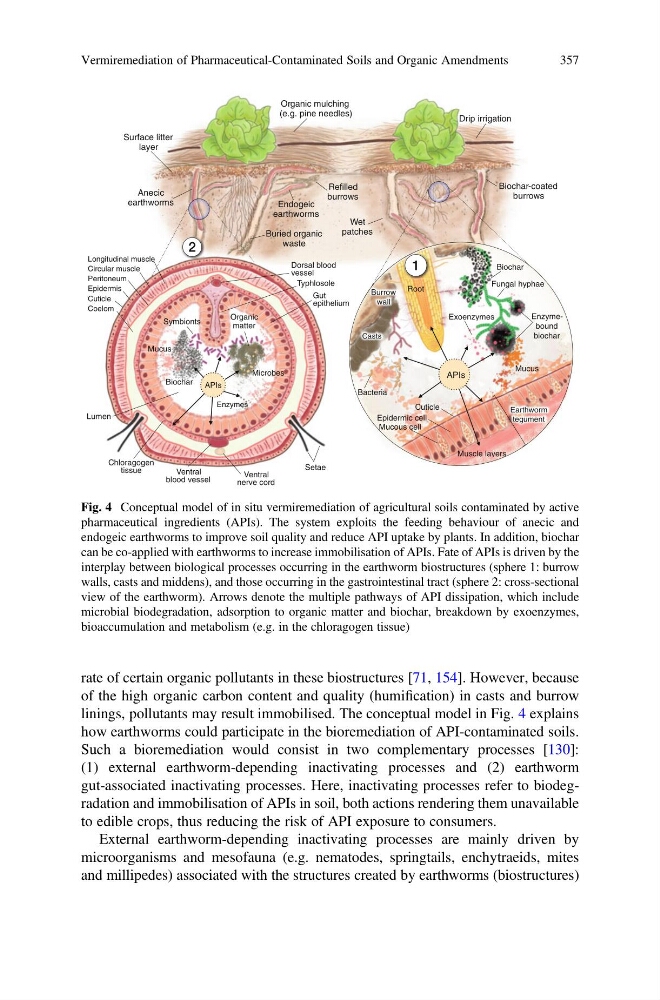
linings, pollutants may result immobilised. The conceptual model in Fig. 4 explains
how earthworms could participate in the bioremediation of API-contaminated soils.
Such a bioremediation would consist in two complementary processes [130]:
(1) external earthworm-depending inactivating processes and (2) earthworm
gut-associated inactivating processes. Here, inactivating processes refer to biodegradation and immobilisation of APIs in soil, both actions rendering them unavailable
to edible crops, thus reducing the risk of API exposure to consumers.
External earthworm-depending inactivating processes are mainly driven by
microorganisms and mesofauna (e.g. nematodes, springtails, enchytraeids, mites
and millipedes) associated with the structures created by earthworms (biostructures)
Drip irrigation
Organic mulching
(e.g. pine needles)
Anecic
earthworms
Endogeic
earthworms
Buried organic
waste
Wet
patches
Surface litter
layer
Biochar-coated
burrows
burrows
2
Biochar
Organic
matter
Symbionts
Mucus
Microbes
Setae
Coelom
Ventral
nerve cord
Ventral
blood vessel
Cuticle
Epidermis
Circular muscle
Longitudinal muscle
Peritoneum
Chloragogen
tissue
Typhlosole
Lumen
Gut
epithelium
Dorsal blood
vessel
APIs
Biochar
Mucus
Bacteria
Fungal hyphae
Exoenzymes
Enzymebound
biochar
Epidermic cell
Mucous cell
Muscle layers
1
Cuticle
APIs
Enzymes
Root
Casts
Burrow Burrow
wall
Earthworm Earth r worm
tegument
Fig. 4 Conceptual model of in situ vermiremediation of agricultural soils contaminated by active
pharmaceutical ingredients (APIs). The system exploits the feeding behaviour of anecic and
endogeic earthworms to improve soil quality and reduce API uptake by plants. In addition, biochar
can be co-applied with earthworms to increase immobilisation of APIs. Fate of APIs is driven by the
interplay between biological processes occurring in the earthworm biostructures (sphere 1: burrow
walls, casts and middens), and those occurring in the gastrointestinal tract (sphere 2: cross-sectional
view of the earthworm). Arrows denote the multiple pathways of API dissipation, which include
microbial biodegradation, adsorption to organic matter and biochar, breakdown by exoenzymes,
bioaccumulation and metabolism (e.g. in the chloragogen tissue)
Vermiremediation of Pharmaceutical-Contaminated Soils and Organic Amendments
357
of the high organic carbon content and quality (humification) in casts and burrow
linings, pollutants may result immobilised. The conceptual model in Fig. 4 explains
how earthworms could participate in the bioremediation of API-contaminated soils.
Such a bioremediation would consist in two complementary processes [130]:
(1) external earthworm-depending inactivating processes and (2) earthworm
gut-associated inactivating processes. Here, inactivating processes refer to biodegradation and immobilisation of APIs in soil, both actions rendering them unavailable
to edible crops, thus reducing the risk of API exposure to consumers.
External earthworm-depending inactivating processes are mainly driven by
microorganisms and mesofauna (e.g. nematodes, springtails, enchytraeids, mites
and millipedes) associated with the structures created by earthworms (biostructures)
Drip irrigation
Organic mulching
(e.g. pine needles)
Anecic
earthworms
Endogeic
earthworms
Buried organic
waste
Wet
patches
Surface litter
layer
Biochar-coated
burrows
burrows
2
Biochar
Organic
matter
Symbionts
Mucus
Microbes
Setae
Coelom
Ventral
nerve cord
Ventral
blood vessel
Cuticle
Epidermis
Circular muscle
Longitudinal muscle
Peritoneum
Chloragogen
tissue
Typhlosole
Lumen
Gut
epithelium
Dorsal blood
vessel
APIs
Biochar
Mucus
Bacteria
Fungal hyphae
Exoenzymes
Enzymebound
biochar
Epidermic cell
Mucous cell
Muscle layers
1
Cuticle
APIs
Enzymes
Root
Casts
Burrow Burrow
wall
Earthworm Earth r worm
tegument
Fig. 4 Conceptual model of in situ vermiremediation of agricultural soils contaminated by active
pharmaceutical ingredients (APIs). The system exploits the feeding behaviour of anecic and
endogeic earthworms to improve soil quality and reduce API uptake by plants. In addition, biochar
can be co-applied with earthworms to increase immobilisation of APIs. Fate of APIs is driven by the
interplay between biological processes occurring in the earthworm biostructures (sphere 1: burrow
walls, casts and middens), and those occurring in the gastrointestinal tract (sphere 2: cross-sectional
view of the earthworm). Arrows denote the multiple pathways of API dissipation, which include
microbial biodegradation, adsorption to organic matter and biochar, breakdown by exoenzymes,
bioaccumulation and metabolism (e.g. in the chloragogen tissue)
Vermiremediation of Pharmaceutical-Contaminated Soils and Organic Amendments
357